Table of Contents
Agentic AI is no longer a research concept. It is running inside hospitals, software companies, marketing teams, and customer support systems right now. If you have heard the term but are not sure what it means or why it matters, this guide is for you.
By the end you will understand how it works, where it is already being used, how it differs from regular AI agents, and what it means for your career in 2026 and beyond.
What Is Agentic AI?
Agentic AI is an advanced form of artificial intelligence that does not just answer questions. It plans, makes decisions, uses tools, and completes multi-step tasks with minimal human supervision.
The word “agentic” comes from “agency,” meaning the capacity to act independently and make choices. Unlike a standard chatbot that waits for your next instruction, agentic AI receives a goal, figures out how to achieve it, takes action, checks its results, adjusts its approach, and reports back when the work is done.
The simplest way to understand agentic AI is through a three-level comparison:
Traditional AI is like a calculator. You give it an input and it gives you a fixed output. No reasoning, no adaptation, no initiative.
ChatGPT or Claude in basic mode is like a knowledgeable assistant. You ask a question and it gives you a smart answer. But it stops there. It does not go and do the work for you.
Agentic AI is like a capable employee. You give it a goal, it figures out the steps, uses the tools available, completes the work, and delivers the result without you managing every decision along the way.
This shift from responding to acting is what makes agentic AI one of the most important developments in the history of artificial intelligence.
To understand the building blocks that power these systems, our guide on what is a large language model covers the core technology underneath agentic systems.
What Makes Agentic AI Different?
Many people use the terms traditional AI, LLM, AI agent, and agentic AI interchangeably. They are not the same. Here is a clear comparison:
| Traditional AI | LLM | AI Agent | Agentic AI | |
|---|---|---|---|---|
| How it works | Follows fixed rules | Generates text responses | Uses tools to perform tasks | Plans, reasons, and acts autonomously |
| Capability | Very limited | Smart responses | Completes specific tasks | Achieves complex goals end to end |
| Human input needed | Every step | Every prompt | Some oversight | Minimal supervision |
| Example | Spam filter | ChatGPT answering a question | Zapier sending an email | AI that plans and runs an entire campaign |
The defining characteristic of agentic AI is autonomy combined with reasoning. It does not just execute instructions. It interprets goals, creates plans, adapts when things go wrong, and pursues outcomes independently.
Our AI agents guide covers the foundational concepts you need before exploring agentic AI in depth.
How Agentic AI Works
Understanding the mechanics helps you see why this technology is so much more powerful than what came before. The workflow follows a continuous loop:
Step 1: Receive a goal A human gives the system a high-level objective. For example: “Research our competitors and produce a summary report.”
Step 2: Understand the objective The large language model at the core interprets what the goal requires and what success looks like.
Step 3: Create a plan The system breaks the goal into a sequence of subtasks and decides what needs to happen first, second, and third.
Step 4: Use tools The system uses connected tools to execute each step. These might include web search, code execution, file management, API calls, calendar access, email, and databases.
Step 5: Check results After each action, the system evaluates whether the result moved it closer to the goal or whether something went wrong.
Step 6: Adjust strategy If a step did not work, it adapts and tries a different approach rather than stopping and waiting for human input.
Step 7: Complete the task Once all subtasks are done, the system compiles the output and delivers the result.
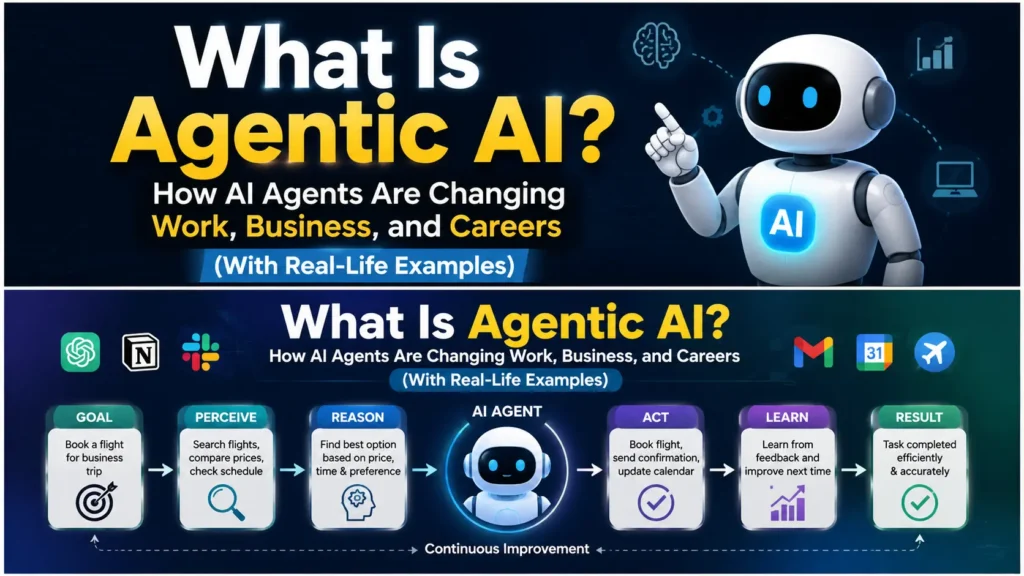
Step 8: Report back The system summarises what it did, what decisions it made, and what the outcome was, giving the human full visibility.
This plan, act, observe, adjust loop is what separates this approach from every AI system that came before it.
To get the best results from any agentic system, how you write instructions matters enormously. Our prompt engineering guide shows you exactly how to do that.
Real-Life Example 1: Customer Support
Imagine an online shopping company receives this message:
“My order has not arrived. What is happening?”
Without automation: A human support agent logs in, searches the order system, checks the tracking, contacts the courier, and manually updates the customer. This takes 15 to 30 minutes per ticket.
With this approach: The system understands the request, opens the order database, retrieves the order details, checks shipment tracking status, contacts the courier API for a live update, calculates the revised delivery window, sends the customer an updated estimate automatically, and creates a support ticket if the delay exceeds the acceptable threshold.
Human intervention: almost none. Resolution time: under 60 seconds.
This is a complete end-to-end workflow that previously required a human at every step.
Real-Life Example 2: Software Development
A developer types a single instruction:
“Fix all security vulnerabilities in my project.”
The system reads the entire GitHub repository, identifies vulnerable code patterns, searches the latest security documentation for recommended fixes, generates corrected code, runs automated tests to verify the fixes work, opens a pull request with all changes, and writes a changelog explaining every modification.
The developer reviews and approves. The system handled the research, coding, testing, and documentation. This is why these systems are already transforming engineering workflows at companies of every size.
Real-Life Example 3: Marketing Campaign
A business owner gives a single instruction:
“Launch my new AI course.”
Instead of helping with one task, the system coordinates the entire campaign. It writes a long-form blog article optimised for search, drafts a LinkedIn post with hook and call to action, creates a full email sequence, generates Facebook and Instagram ad copy with multiple variations, researches SEO keywords for the course landing page, builds a draft landing page structure, and produces an analytics tracking plan.
What would take a marketing team a full week takes a fraction of the time. The human role shifts from doing the work to reviewing and refining the output.
Real-Life Example 4: Healthcare
A doctor starts the morning shift and says:
“Prepare today’s patient summary for ward rounds.”
The system reads every patient report from the previous 24 hours, reviews all lab results and flags abnormal values, summarises each patient’s medical history relevant to today’s rounds, highlights risk factors requiring immediate attention, and suggests follow-up tests based on current clinical guidelines.
The doctor arrives to a complete, structured briefing instead of spending an hour pulling records manually. The doctor still makes every medical decision. The system handles the information gathering and organisation.
Real-Life Example 5: Finance
An investment firm needs overnight market monitoring.
The system reads financial news from dozens of sources, tracks real-time stock prices and compares them against portfolio holdings, detects unusual trading activity or volatility patterns, builds a structured morning report with key insights, and sends targeted alerts to fund managers when thresholds are crossed.
By the time analysts arrive at their desks, thousands of data points have been processed and the ones that matter most have been surfaced automatically.
Agentic AI vs AI Agents: What Is the Difference?
This is one of the most searched questions in this space and the confusion is completely understandable.
AI Agent = A software system that uses AI to perform specific tasks using tools. It is a piece of software.
Agentic AI = The capability that allows a system to independently reason, plan, adapt, and pursue goals. It is a property, a level of capability.
The clearest analogy: a robot is the AI agent. The ability to think, plan, and act independently is the agentic capability.
Every system built on agentic AI uses AI agents internally. But not every AI agent has agentic capability. A simple Zapier automation that sends an email when triggered is an AI agent. A system that reads your inbox, identifies which emails need responses, drafts replies, schedules follow-ups, and flags urgent items represents agentic AI.
The difference is autonomous reasoning and multi-step goal pursuit.
Industries Being Changed Right Now
This technology is not limited to technology companies. Here is how it is already reshaping ten major industries:
Healthcare: Patient record summarisation, clinical decision support, appointment scheduling, and drug interaction checking.
Banking and Finance: Fraud detection, automated reporting, portfolio monitoring, and regulatory compliance checking.
Education: Personalised lesson planning, student progress tracking, automated assignment feedback, and curriculum adaptation.
Manufacturing: Predictive maintenance, quality control, supply chain optimisation, and production scheduling.
Retail and E-commerce: Inventory management, personalised recommendations, customer support automation, and pricing optimisation.
Customer Support: End-to-end ticket resolution, escalation routing, sentiment analysis, and proactive outreach.
Software Development: Code review, security scanning, automated testing, documentation generation, and bug fixing.
Marketing: Campaign planning, content creation, performance analysis, audience segmentation, and ad optimisation.
Human Resources: Resume screening, interview scheduling, onboarding automation, and employee query handling.
Legal: Contract review, case research, regulatory monitoring, and document summarisation.
In every one of these sectors, the technology is not replacing human expertise. It is handling repetitive, time-consuming information work so professionals can focus on judgment, relationships, and decisions that require real-world experience.
How This Technology Will Change Your Career
This technology does not eliminate careers. It transforms them. Here is what that looks like across major professions:
Software Engineers gain an AI pair programmer that writes boilerplate, runs tests, and handles documentation while engineers focus on architecture and complex problem solving.
Teachers gain an AI lesson planner that personalises content for each student, tracks progress, and flags those who need extra support.
Doctors gain an AI assistant that handles information gathering and administrative tasks while they focus on diagnosis and patient care.
Lawyers gain an AI research tool that reviews case law, summarises contracts, and monitors regulatory changes overnight.
Accountants gain automated bookkeeping, anomaly detection, and report generation that frees them for advisory work.
Designers gain an AI creative partner that generates concepts and handles production files while they focus on creative direction.
The professionals who will thrive are those who learn to direct, review, and leverage agentic AI rather than those who try to compete against it. Our AI basics guides is the best starting point if you are new to working with AI systems.
Key Benefits of Using Agentic AI
The reasons organisations are investing heavily come down to seven core advantages:
Saves significant time. Tasks that take humans hours complete in minutes when the system handles information gathering, processing, and drafting.
Works around the clock. Agentic AI does not have working hours. It processes, monitors, and acts 24 hours a day, 7 days a week.
Handles repetitive work at scale. The system can process thousands of queries, documents, or data points simultaneously without fatigue or error.
Reduces operational costs. Automating high-volume repetitive tasks dramatically reduces the cost per task compared to human-only workflows.
Makes faster decisions. Agentic AI processes information and takes action in seconds, enabling faster responses to customers, markets, and operational events.
Improves consistency. The same standard applies to every task every time, unlike human teams where quality can vary.
Scales instantly. One deployment can handle ten tasks or ten thousand tasks without hiring, training, or infrastructure changes.
Challenges and Risks to Understand
These systems come with real challenges every organisation needs to understand:
Hallucinations. These systems can generate confident but incorrect information, especially in domains where training data is limited or outdated.
Privacy concerns. Systems that access databases, emails, and documents raise serious questions about data security and information control.
Security vulnerabilities. Access to APIs, code repositories, and communication tools creates new attack surfaces if not properly secured.
Bias in decision making. Models inherit biases from training data, which can surface in hiring, lending, medical triage, and other high-stakes decisions.
Human oversight gaps. The more autonomous these systems become, the harder it is to monitor every decision and catch errors before they cascade.
Regulatory uncertainty. Laws governing AI decision-making, liability, and transparency are still evolving in most countries, creating compliance challenges.
Ethical concerns. Questions about accountability and the pace of workforce displacement require serious ongoing attention from developers and policymakers alike.
Popular Agentic AI Frameworks
These are the leading frameworks developers use to build these systems today:
Microsoft AutoGen is an open-source framework for building multi-agent applications. It allows multiple AI agents to collaborate, debate, and solve problems together.
Explore What Is Microsoft AutoGen? Complete Guide to Building Multi-Agent AI Applications
LangGraph enables developers to build stateful, multi-step AI workflows using graph-based architecture. Ideal for complex reasoning pipelines.
CrewAI lets you create teams of specialised AI agents with different roles, goals, and tools, coordinating them toward a shared outcome.
Explore What Is CrewAI? Complete Beginner’s Guide to AI Agent Teams
OpenAI Agents SDK is OpenAI’s official framework for building production-ready agentic applications with tool use, agent handoffs, and safety guardrails.
LangChain is the most widely adopted framework for connecting large language models to tools, databases, and APIs. It is the foundation many agentic systems are built on.
You do not need these frameworks to get started. Tools like Claude Projects, Make.com, and Zapier deliver this capability with zero coding required. Our Claude tutorial for beginners shows you how to start building these workflows today without any technical background.
Explore Claude AI to Earn Money Guide: 4 Proven Ways That Actually Work
What the Future Holds for Agentic AI
The trajectory points toward a world where AI systems take on increasingly complex work with decreasing human supervision. Here is what the next few years look like:
Personal AI assistants that manage your calendar, inbox, research, travel, and finances as a full-time background service.
AI coworkers that join project teams with defined roles, attend meetings via transcript, complete assigned tasks, and report progress like human team members.
Autonomous businesses where AI systems handle operations, customer service, marketing, and reporting with humans providing strategic direction only.
Multi-agent systems where dozens of specialised agents collaborate in real time, each handling their domain and passing outputs to the next in the workflow.
explore What Is a Multi-Agent System? How AI Teams Work Together
Robotics integration where the technology moves from digital tasks into physical ones, controlling robots in warehouses, hospitals, and construction sites.
AI operating systems that coordinate all software, managing applications, data flows, and decisions the way an operating system manages hardware today.
The professionals, businesses, and organisations that understand agentic AI now will be well positioned to direct, manage, and benefit from these systems as they become more capable and more widespread.
Frequently Asked Questions
What is agentic AI in simple terms?
Agentic AI is an advanced form of artificial intelligence that plans, makes decisions, uses tools, and completes multi-step tasks autonomously with minimal human input. Unlike a standard AI that only responds to questions, agentic AI receives a goal and independently figures out how to achieve it, taking action and adapting until the task is complete.
How is agentic AI different from AI agents?
An AI agent is a software system that performs specific tasks using AI and tools. Agentic AI is the capability that enables a system to reason, plan, and pursue goals independently across multiple steps. Every system built on agentic AI uses AI agents internally. but not every AI agent has agentic capability. The difference is autonomous reasoning versus executing a single predefined task.
Is ChatGPT an agentic AI?
Standard ChatGPT does not use agentic AI. It responds to prompts within a single conversation without taking autonomous action. However, when given tools like web search, code execution, or file access and configured to complete multi-step goals, it begins to exhibit agentic behaviour. OpenAI’s GPT-4o with tools enabled moves significantly closer to full agentic capability.
Can agentic AI make decisions on its own?
Yes. Agentic AI makes decisions at every step of a workflow without waiting for human input. It decides which tool to use, which action to take next, and how to adapt when something goes wrong. Human oversight is still recommended for high-stakes decisions, but these systems are designed to operate with significant autonomy between check-in points.
What industries use agentic AI today?
These systems are already deployed across healthcare, banking, software development, marketing, customer support, legal, education, manufacturing, retail, and human resources. In each sector, it handles information-intensive workflows that previously required significant human time, freeing professionals to focus on higher-value work.
Will agentic AI replace jobs?
This technology will transform jobs rather than simply eliminate them. Roles focused on repetitive information processing face the most disruption. However, these systems also create new demand for professionals who can direct, configure, review, and improve AI workflows. The safest position is to become someone who works effectively alongside these systems rather than competing against them.
What skills should I learn for an agentic AI future?
The most valuable skills are prompt engineering to direct AI systems effectively, workflow design to structure multi-step automation, critical thinking to review AI outputs, and deep domain expertise so you can judge the quality of the work produced. Python and API integration add further advantage for those who want to build these systems themselves.
What is the future of agentic AI?
This field is moving toward personal assistants managing entire areas of life and work, AI coworkers embedded in professional teams, multi-agent systems where dozens of specialised agents collaborate autonomously, and eventually AI operating systems coordinating all software and data flows. Understanding agentic AI now puts you in a position to lead rather than follow this transition.
Explore other articles
Blogs – Pathway Lab
What Is Retrieval Augmented Generation (RAG)? A Beginner’s Guide With Real Life Examples
Free AI Courses with Certificate in 2026