Everyone is talking about AI jobs. But nobody is giving you a clear, honest answer on how to actually get there.
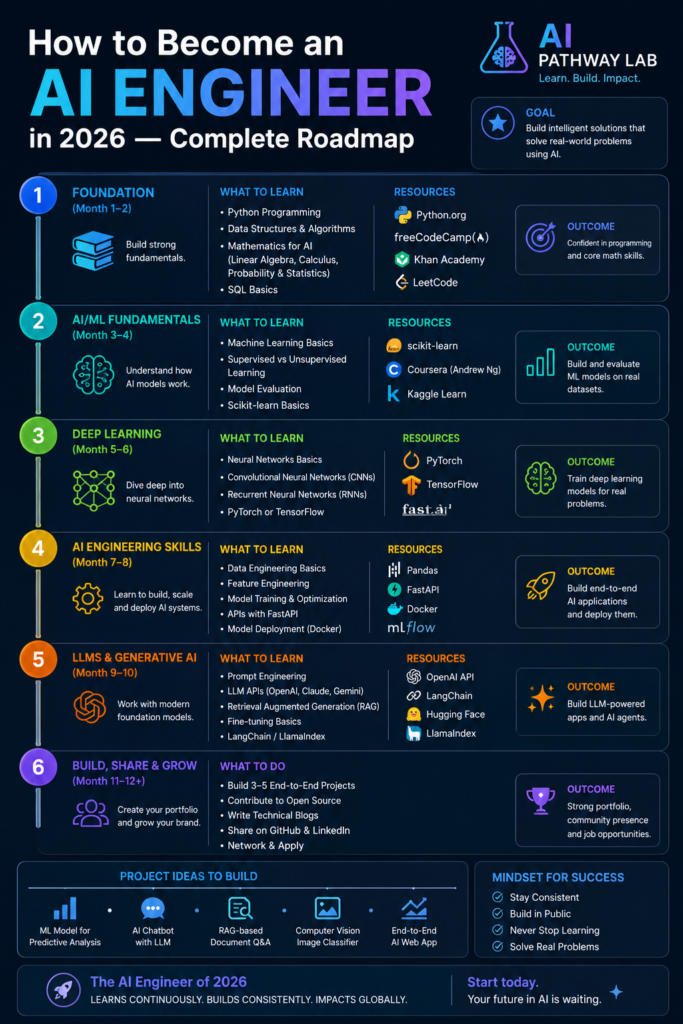
Table of Contents
Becoming an AI Engineer is one of the most powerful career moves you can make in 2026.
I know because I have been on this journey myself. Six months ago, I was a techie wondering if AI engineering was even possible for someone like me, no fancy computer science degree, no machine learning research background, just a strong desire to work with AI professionally.
Here is what I discovered: becoming an AI Engineer in 2026 is more achievable than ever before. The field has shifted dramatically in the last two years. Companies no longer need you to build AI from scratch. They need people who can use, integrate, deploy, and automate AI tools effectively across real business workflows. And that changes everything for career changers.
The AI Engineer of 2026 is not the researcher in a lab training neural networks from scratch. The AI Engineer of 2026 is the professional who knows how to connect AI tools to real systems, build AI agents that automate workflows, and deliver measurable business outcomes using the powerful models that already exist.
If you are a tester, developer, analyst, or even a non-technical professional ready to level up, this roadmap is for you.
What Does an AI Engineer Actually Do?
Before diving into the roadmap, let us get clear on what an AI Engineer actually does day to day, because many people confuse this role with a Data Scientist or Machine Learning Researcher.
An AI Engineer builds real-world applications powered by AI. Think of them as the person who takes a powerful AI model like Claude, ChatGPT, or Gemini and connects it to business systems, automates workflows, and solves actual problems for companies.
Here is what their work looks like in practice:
API Integration – connecting AI models to apps and services using code. Read our Claude API Tutorial to see exactly how this works in practice.
AI Agents – building autonomous systems that complete multi-step tasks automatically. Our What Are AI Agents guide covers the full picture of how agents work and what they can do.
Automation Pipelines – replacing manual workflows with intelligent AI processes. Explore our AI Automation and Workflows hub for practical examples.
Prompt Engineering – crafting precise instructions that get reliable, high-quality results from AI models. Our Prompt Engineering Guide is the best starting point for beginners.
Multi Agent Systems – coordinating multiple AI agents to complete complex goals together. Read our Multi Agent System Guide for a clear explanation.
Retrieval Augmented Generation (RAG) – connecting AI to external documents and databases for accurate, grounded responses. Our RAG Guide explains this in plain English.
Cloud Deployment – deploying AI solutions on Azure, AWS, or Google Cloud. The AWS AI services overview covers the main cloud AI options available today.
Responsible AI – ensuring AI systems are safe, unbiased, and ethical in production. Anthropic’s approach to AI safety is one of the best resources on this topic.
Notice what is NOT on that list: advanced mathematics, statistical modelling, or building neural networks from scratch. That is the domain of Data Scientists and ML Researchers, a completely different career path with entirely different requirements.
Do You Need a Degree to Become an AI Engineer?
No. And this is the most important thing to understand before you start.
While a computer science degree is helpful, many successful AI Engineers in 2026 have transitioned from testing, project management, data analysis, and even non-technical backgrounds. What matters far more is demonstrable skills -Python proficiency, API experience, formal AI qualifications, and real projects you have built.
The combination of a recognised AI qualification + hands-on project experience + practical certifications is what hiring managers are looking for right now. Not a degree from ten years ago.
Core Skills You Need to Become an AI Engineer
1. Python Programming
Python is the language of AI. You do not need to be an advanced developer, but you do need to be comfortable writing scripts, working with APIs, and handling data. Focus on functions, loops, file handling, and working with JSON. Free resources like freeCodeCamp and Kaggle will get you there in 4 to 6 weeks of consistent practice.
2. Understanding Large Language Models (LLMs)
You need to know what LLMs are, how they process text, what tokens and context windows mean, and why prompt design matters. You do not need to build an LLM — you need to know how to work with one. Claude, GPT-4, and Gemini are the three LLMs every AI Engineer should be familiar with. Eexplore LLM Tutorial
3. API Integration and Tool Use
This is the technical heart of AI engineering. Learning to call the Claude API or OpenAI API, pass structured prompts, handle responses, and connect AI outputs to other tools is where most of your practical work happens. The Anthropic Academy Claude API Fundamentals course is one of the best free resources available for this skill.
Claude API Tutorial for Complete Beginners: Best Hands-On Guide
4. Prompt Engineering
The ability to write clear, structured, and effective prompts is genuinely valuable – and still underrated in most job descriptions. Good prompt engineers dramatically improve AI output quality, reduce errors, and build reliable automated pipelines. I tested this on a real workflow and reduced manual reporting time by over 70%.
Prompt Engineering for QA Agents – Best Practices Complete Guide-10x faster Work
5. Cloud Concepts
Understanding the basics of cloud computing – how services communicate, what serverless functions are, and how to deploy an application — is essential. You do not need to be a cloud architect. The Microsoft AI-900 certification or AWS Cloud Practitioner gives you a solid working foundation in 2 weeks.
6. AI Agents and Automation Frameworks
This is the skill that separates junior AI Engineers from mid-level ones. Understanding how to build AI agents – systems that autonomously plan, decide, and act -using tools like LangChain, CrewAI, or Model Context Protocol (MCP) is the most in-demand skill in the market right now. Blogs: Explore AI Agents
Step-by-Step Roadmap to Become an AI Engineer in 6 Months
Step 1 – Build Your AI Foundations (Weeks 1 to 4)
Complete the Anthropic Academy Claude 101 and AI Fluency courses, Claude Free Certificates. These are completely free, take under 5 hours combined, and give you a real professional framework for thinking about AI. Start Python basics in parallel using freeCodeCamp or Kaggle’s free Python course. By the end of week 4, you will have your first two certifications and basic Python confidence.
Step 2 – Learn LLMs and Prompt Engineering (Weeks 5 to 8)
Work through the Anthropic Academy Prompt Engineering course and start experimenting with Claude every single day. Build 5 to 10 real prompts that solve problems in your own work or life. Document what works and what does not. This documentation becomes your first portfolio piece — proof that you understand how AI actually behaves in practice.
Step 3 – Master the Claude API and MCP Protocol (Weeks 9 to 14)
The Claude API Fundamentals course is where things get real. You will write Python code that calls the API, handles responses, and builds simple automated tools. Follow this with the MCP Beginner course to learn how to connect Claude to external services — databases, calendars, emails, and productivity tools. This is cutting-edge knowledge that very few candidates have yet. Explore Anthropic Claude free Certicates
What Is Model Context Protocol (MCP)? The New Way AI Systems Connect, Complete Guide
Step 4 – Build Your First AI Project (Weeks 15 to 18)
This is the most important step in the entire roadmap. Build one real project — something that solves an actual problem. An AI test case generator, an automated report tool, a document summariser, or a chatbot connected to your company FAQ. Push it to GitHub. This single working project is worth more than five certificates to most hiring managers.
How to Build a No-Code AI Agent: From Zero to First Automation
Step 5 – Certify, Polish, and Apply (Weeks 19 to 24)
Complete your Microsoft AI-900 certification — 2 weeks of free study on Microsoft Learn, then a $99 USD exam that never expires. Update your LinkedIn profile with all certifications, your GitHub link, and a clear AI Engineer headline. Start applying for AI Engineer, Junior AI Engineer, or AI QA Engineer roles. Target companies actively growing their AI capabilities — they are hiring right now and the competition is still manageable.
Best Certifications for AI Engineers in 2026
Anthropic Academy – Full Curriculum (FREE): Claude 101, AI Fluency, Claude API Fundamentals, MCP Beginner, MCP Advanced, and Claude Code. All free with official certificates. Directly from the creators of Claude. Launched March 2026 — very few candidates have these yet.
Microsoft AI-900 – Azure AI Fundamentals (PAID ~$99 USD). Covers AI workloads, ML basics, computer vision, NLP, and Generative AI on Azure. Does not expire. Highly recognised by enterprise and government employers globally.
Google AI Essentials (FREE) Practical AI tools and workflows course from Google. Good for LinkedIn visibility and building foundational confidence.
AWS Cloud Practitioner – CLF-C02 (PAID ~$100 USD) Cloud computing fundamentals. Pairs perfectly with AI skills since most AI deployments run on cloud infrastructure.
Free AI Courses with Certificate in 2026
AI Engineer Salary: What Can You Actually Earn?
One of the biggest motivations for moving into AI engineering is the salary trajectory. The numbers are genuinely compelling, and they are only moving in one direction.
Here is what the market looks like in 2026 for AI Engineer roles across New Zealand and the United States:
Junior AI Engineer
NZD $90,000 to $110,000 per year
USD $85,000 to $110,000 per year
This is the entry point for someone transitioning from testing, development, or analysis into their first dedicated AI engineering role. Companies at this level are looking for practical project experience, API integration skills, and a demonstrated ability to build and deploy working AI tools.
Mid-Level AI Engineer
NZD $120,000 to $150,000 per year
USD $120,000 to $160,000 per year
At this level you are expected to build production-ready AI systems independently, work with frameworks like LangChain or CrewAI, and design multi-agent workflows that solve real business problems. Two to three years of hands-on AI engineering experience typically puts you here.
Senior AI Engineer
NZD $150,000 to $180,000 per year
USD $160,000 to $210,000 per year
Senior AI Engineers lead technical decisions, mentor junior team members, and architect complex AI systems at scale. They are deeply familiar with RAG pipelines, agentic systems, cloud deployment on AWS or Azure, and responsible AI practices.
AI Engineering Lead
NZD $180,000 to $220,000 per year
USD $200,000 to $280,000 per year
At the lead level you are setting the AI strategy for an entire team or organisation. You combine deep technical expertise with strong business understanding and the ability to communicate AI value to non-technical stakeholders. These roles are highly sought after and genuinely well compensated.
These salary ranges reflect base pay only. Many US AI engineering roles at this level also include stock options, performance bonuses, and remote work flexibility that significantly increases total compensation beyond the base figures shown.
Final Thoughts
Becoming an AI Engineer in 2026 does not require a perfect background. It does not require a computer science degree from a prestigious university or years of machine learning research experience. It requires the right skills, real projects, and the determination to keep going when it feels difficult.
Your testing background, your data background, your analytical mindset, your years of experience working inside real organisations with real systems and real stakeholders. These are not weaknesses. They are exactly what makes you different from every other AI Engineer candidate who only knows how to write code in isolation.
The AI engineering field needs people who understand how software breaks in production. People who can communicate clearly with non-technical teams. People who have spent years thinking about quality, reliability, and real world outcomes. That is you.
The path is clear. The tools are accessible. The courses are free. The jobs are growing faster than the talent pool can fill them.
You do not need to be ready. You just need to start.
AI Pathway Lab is here to guide you every step of the way, from your first Claude API call to your first AI engineering job offer.
Future of AI: 15 Trends and Predictions That Will Shape the Next Decade
Anthropic Free AI Certificates: All 13 Courses Explained in Under 20 Minutes
Frequently Asked Questions
Do AI Engineers need advanced mathematics?
No. Data Scientists and ML Researchers need deep maths. AI Engineers primarily integrate and build with existing AI models – which requires logical thinking and programming skills, not calculus or linear algebra.
How long does it take to become an AI Engineer?
With consistent effort of 1 to 2 hours daily, most people with a tech background can be job-ready in 4 to 6 months. The roadmap above is designed for a 6-month part-time timeline.
Is it too late to enter AI engineering in 2026?
Absolutely not. Most companies are still in the early stages of figuring out how to use AI effectively. The demand is growing faster than the supply of qualified engineers. You are not too late — you are right on time.
What is the single best first step to take today?
Create a free account at anthropic.skilljar.com and start Claude 101. It takes under an hour, gives you a real certificate, and introduces you to the most in-demand AI platform in the enterprise world right now.
What does an AI engineer do?
An AI engineer builds, trains, and deploys AI models for real-world business applications. They work with large language models, AI agents, and APIs to solve specific problems. Day to day tasks include writing code, fine-tuning models, and integrating AI into products.
What is a $900,000 AI job?
The $900,000 AI job refers to senior AI research and engineering roles at top US companies like Google DeepMind, OpenAI, and Anthropic. These packages combine base salary, stock options, and annual bonuses paid in USD. Most require deep expertise in machine learning research or large language model development.
What is an AI engineer’s salary?
AI engineer salaries in the US range from USD $80,000 to USD $200,000 per year depending on experience, location, and specialisation. Entry level roles typically start at USD $80,000 to USD $110,000 annually. Senior engineers at top US tech companies earn USD $150,000 to USD $300,000 before stock compensation.