Table of Contents
What is AI-Powered Test Automation with Playwright
AI-Powered Test Automation with Playwright is the theme that ties every article in this series together, from the very first pillar guide through the tactical tutorials that followed it. The rest of this series covered specific, tactical uses of AI inside a Playwright suite: generating a locator from HTML, drafting a page object, writing API tests from an OpenAPI spec, suggesting assertion matchers, and using MCP to generate and triage a CI/CD pipeline. Each of those is a real, narrow application. AI-Powered Test Automation with Playwright, as a broader idea, is bigger than any single one of them.
Industry data backs up just how quickly this shift has moved from novelty to baseline expectation, and it applies just as much to AI-Powered Test Automation with Playwright specifically as it does to testing in general. The 2026 State of Testing Report from PractiTest found that most teams have adopted AI somewhere in their testing workflow, but also surfaced a real gap worth paying attention to: the large majority of that AI usage goes toward generating more test cases faster, while only a small fraction goes toward the strategic work of identifying which risks actually matter to test in the first place. That gap is exactly the theme this article returns to throughout.
This article steps back from individual tasks and looks at the whole picture: where most teams actually sit on the path from manual testing to AI-assisted automation, how techniques like self-healing locators and flaky test detection actually work under the hood, and, just as importantly, where AI-Powered Test Automation with Playwright still falls short and still needs a human making the real decisions, which is the central tension running through this whole approach.
Before diving into the full article, explore these essential beginner-f articles first.
Playwright Automation Testing with AI: Complete JavaScript & TypeScript Framework From Scratch
Playwright CI/CD setup with GitHub Actions and AI Complete Automation Testing Pipeline Guide
Playwright Locators Tutorial with Examples: Use AI to Build Better Test Automation
Playwright Page Object Model Tutorial: Build a Scalable Test Framework with AI
Playwright Assertions Tutorial with Examples: Validate Your Tests with AI
Playwright API Testing Tutorial: Test REST APIs with JavaScript and AI
Playwright Test Automation Framework Structure: Build a Scalable Setup with AI
The Test Automation Maturity Model
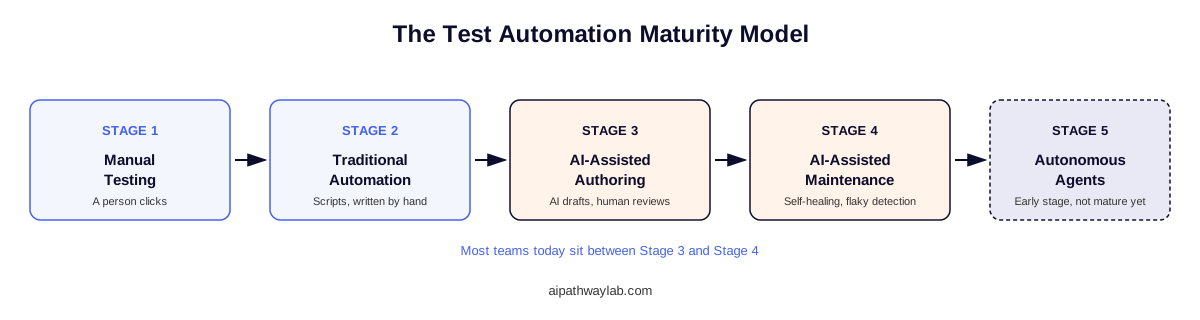
Most teams are not starting AI-Powered Test Automation with Playwright from zero, and most are also nowhere close to the far end of what the technology can currently do. It helps to think in stages.
Stage 1: Manual testing. A person clicks through the application by hand, every time, for every release. No automation exists yet.
Stage 2: Traditional automation. Scripts like the ones covered earlier in this series, Playwright locators, page objects, assertions, run repeatedly without a person clicking anything, but every test is written and maintained entirely by hand.
Stage 3: AI-assisted authoring. This is where most of this series has lived. AI drafts locators, page objects, and test cases from a description or existing markup, speeding up the writing process while a human still designs the test strategy and reviews everything generated.
Stage 4: AI-assisted maintenance. Beyond writing new tests, AI helps keep existing ones alive, detecting stale locators after a UI change, flagging duplicated logic, and identifying flaky patterns across historical runs, covered in more depth below.
Stage 5: Autonomous agents. The frontier stage, where an AI agent can independently explore an application, generate new test coverage for untested areas, and adapt existing tests without a person initiating each individual change. This exists in early, limited forms today, not as a mature, dependable practice yet.
Most teams practicing genuine AI-Powered Test Automation with Playwright right now sit somewhere between stage 3 and stage 4. This tracks with what the BrowserStack State of AI in Software Testing 2026 survey found across hundreds of engineering leaders, most organizations already use AI across a meaningful share of their testing workflow, but treat that adoption as an ongoing process of integration rather than a finished state. Stage 5 is worth understanding as a direction, not treating as something to adopt wholesale today.
AI Test Data Generation, Done Properly
The pillar article mentioned AI test data generation in a single line. It deserves more care than that, because done carelessly, it creates real problems rather than solving them.
Generic test data, “John Doe,” repeated across every test, is one of the quieter weak points in AI-Powered Test Automation with Playwright, since it misses the bugs that only show up with realistic variation: names with apostrophes, addresses with unusual formatting, emails with plus-addressing, numeric fields at their actual boundaries rather than round numbers. Tools built for AI-Powered Test Automation with Playwright are genuinely useful here, generating varied, realistic datasets far faster than a person hand-crafting edge cases one at a time.
The part worth being careful about is privacy. Asking an AI assistant to generate synthetic data that resembles real customer records, without ever pasting actual customer data into the request, is the safe pattern. The reverse, feeding real production data into a prompt to “generate more like this,” is a common and avoidable mistake once a team starts leaning on AI-Powered Test Automation with Playwright for data generation at scale.
How Self-Healing Locators Actually Work
Earlier in this series, the Locators tutorial covered asking an AI assistant to fix a broken locator manually, pasting the old locator and new HTML into a chat. Self-healing locators, as a feature built into some AI-Powered Test Automation with Playwright platforms, automate that same idea at runtime, and it is worth understanding the mechanism rather than treating it as a black box.
When a locator fails to find its target, a self-healing system typically compares the current page’s DOM against a snapshot taken the last time the test passed successfully. It looks for an element with similar attributes, similar text, a similar position, or a similar role, and calculates a confidence score for how likely that element is to be the intended target. Above a certain confidence threshold, the system substitutes the new locator and the test continues, a small but representative example of how AI-Powered Test Automation with Playwright operates under the hood.
This is genuinely useful for surviving minor UI changes, a renamed CSS class, a slightly restructured wrapper div, without a test failing over something that does not actually represent a real bug. It has a real limitation worth naming directly: a self-healing locator can also silently substitute the wrong element, or worse, mask a genuine regression by finding something similar enough to pass when the actual intended element is now broken or missing. Treating self-healing as a way to stop reviewing test failures entirely is the mistake. Treating it as a way to reduce noise from trivial changes, while still reviewing what actually changed, is the useful version.
Flaky Test Detection Across Historical Runs
The CI/CD article in this series covered using AI to triage failures within a single completed run. Flaky test detection is a related but distinct problem: identifying tests that fail intermittently across many runs over time, not because of a real bug, but because of timing, environment, or test design issues.
In the context of AI-Powered Test Automation with Playwright, a test that fails once in fifty runs is easy to dismiss as a fluke and easy to miss as a pattern, since no single failure looks alarming on its own. Tools built for AI-Powered Test Automation with Playwright that analyze CI history across weeks or months can surface this pattern clearly, flagging a specific test’s failure rate, correlating failures with specific browsers, times of day, or recent code changes, and ranking flaky tests by how much they are actually degrading confidence in the suite.
This matters because flaky tests carry a hidden cost beyond the failures themselves. A team that stops trusting a red build because “that test is just flaky” has quietly lost one of the main benefits of having a CI/CD setup at all, fast, trustworthy feedback on every change.
Risk-Based Test Selection
Running an entire suite on every single code change works fine for a small project and becomes genuinely expensive as a suite grows into the hundreds or thousands of tests. Risk-based test selection uses AI-Powered Test Automation with Playwright to predict which tests are actually relevant to a given change, rather than running everything every time.
In practice, this means analyzing which files and functions a code change touches, cross-referencing that against which tests exercise those same code paths based on historical coverage data, and running a prioritized subset immediately, with the full suite still running on a schedule or before a release as a safety net. This is meaningfully different from the simple @smoke tagging covered in the Framework Structure article, since tagging is a manual, static categorization, while risk-based selection is a dynamic prediction based on the actual change being tested.
This is one of the more mature applications of AI-Powered Test Automation with Playwright available today, and also one of the more demanding to set up correctly, since it depends on having reliable historical data connecting code changes to test outcomes in the first place.
What AI Still Can’t Replace
Every article in this series has included a version of “review before merging,” and that pattern holds for a reason worth stating plainly here rather than as a footnote.
AI-Powered Test Automation with Playwright is genuinely strong at generating, maintaining, and analyzing tests faster than a person working alone. It is not yet reliable at deciding what actually matters to test in the first place. Understanding which user flows carry real business risk, which edge cases are worth the engineering time to cover, and when a passing test suite is giving false confidence because it is testing the wrong things entirely, remain fundamentally human judgment calls that no current level of AI-Powered Test Automation with Playwright replaces.
There is also a quieter risk worth naming directly: over-trusting AI-generated coverage can create a false sense of security. A suite full of AI-generated tests that all pass is not the same thing as a suite that actually protects against the failures that matter to real users. The tools covered throughout this series speed up the mechanical work of AI-Powered Test Automation with Playwright considerably. They do not yet replace the strategic thinking behind deciding what “well-tested” actually means for a specific application.
How This Fits the Rest of the Series
Every article in this series covers one tactical piece of AI-Powered Test Automation with Playwright, and none of them make sense fully in isolation from the others. This one is the map connecting them. Locators and Page Objects cover AI-assisted authoring at the individual test level. API Testing and Assertions extend that same authoring assistance to backend checks and validation logic. CI/CD Setup covers AI-assisted maintenance and triage inside a pipeline. Framework Structure covers the scaffolding that makes all of it maintainable at scale. This article is where those pieces sit inside a bigger picture, and where the honest limits of the whole approach get named directly rather than glossed over.
Getting Started With AI-Powered Test Automation with Playwright Today
For a team deciding where to actually begin building AI-Powered Test Automation with Playwright into daily work, the practical starting point is rarely stage 5. It is auditing where a team currently sits on the maturity model honestly, then picking one or two stage 3 or stage 4 practices already covered in this series and applying them consistently before adding more.
A reasonable sequence looks like this: start with AI-assisted locator and page object generation, since those pay off immediately and carry low risk. Add AI-assisted test data generation next, being deliberate about the privacy pattern covered earlier. Once a CI pipeline has run long enough to accumulate real history, flaky test detection becomes worth investing in. Risk-based test selection and self-healing locators are worth adopting later, once the underlying suite is stable enough that the more advanced techniques have reliable data to work from.
Trying to adopt every layer of AI-Powered Test Automation with Playwright at once, without this kind of sequencing, is a common way teams end up with tooling that nobody fully trusts or understands. A narrower, sequential rollout tends to build the kind of confidence that makes the more advanced stages worth pursuing later.
Frequently Asked Questions about AI-Powered Test Automation with Playwright
What is AI-Powered Test Automation with Playwright, in practical terms?
It covers a range of applications, from AI helping write and maintain individual tests, to detecting flaky patterns across historical runs, to predicting which tests matter most for a given code change. Most real-world use today sits closer to the authoring and maintenance end than fully autonomous testing.
Are self-healing locators safe to rely on completely?
Not entirely. They reduce noise from trivial UI changes effectively, but they can occasionally substitute the wrong element or mask a real regression, which is why reviewing what actually changed still matters even with self-healing in place.
How is flaky test detection different from normal CI failure triage?
CI failure triage looks at what went wrong in a single completed run. Flaky test detection looks across many runs over time to identify tests that fail intermittently for reasons unrelated to real bugs, a pattern that is difficult to spot from any single run alone.
Is risk-based test selection worth setting up for a small project?
Usually not yet. It depends on reliable historical data connecting code changes to test outcomes, which mainly pays off once a suite has grown large enough that running everything on every change has become genuinely slow or expensive.
Will AI eventually replace manual test strategy decisions entirely?
Not based on where AI-powered test automation currently stands as a technology. AI-powered test automation is strong at execution and maintenance, but deciding what actually matters to test, and why, remains a human judgment call tied to real business risk.
Where should someone start if this whole series feels like a lot at once?
Locators and the Page Object Model tutorial are the strongest starting point, since nearly everything else in this series, from API testing to framework structure, builds on those two foundations directly.
Conclusion
AI-Powered Test Automation with Playwright is not one feature or one trick. It is a collection of genuinely different capabilities, faster authoring, smarter maintenance, pattern detection across historical data, and eventually more autonomous exploration, each suited to a different stage of a team’s testing maturity. The tactical articles earlier in this series cover the authoring and maintenance end in real depth. This one exists to place those pieces inside the bigger picture, and to say plainly where the current limits actually sit rather than overselling what the technology can do today.
The honest summary running through every article in this series holds here too: AI accelerates the mechanical work of building and maintaining a Playwright suite considerably. It does not yet replace the judgment behind deciding what deserves to be tested, why, and how much confidence a passing suite should actually inspire.
Explore more articles from AI blogs AI Learning Hub, AI tools pagesubscribe to AI Pathway Lab AI for Testers
- Prompt Engineering Guide – The Skill That Makes You 10x Faster
- What Are AI Agents? Complete Beginner Guide 2026
- 12 Proven Ways to Make Money With AI That Actually Work
- Claude AI to Earn Money Guide: 4 Proven Ways That Actually Work
- Free AI Courses with Certificate in 2026
- AI Test Case Generation Guide for QA Engineers Using ChatGPT and Claude
3 Proven Ways AI Accelerates Software QA Workflows
Automation with AI, Write Test Scripts 10x Faster in 2026
AI Workflows for QA Automation, How to Integrate
Explor AI Automation & Workflows
For further reading, the PractiTest 2026 State of Testing Report and the BrowserStack State of AI in Software Testing 2026 survey offer a deeper, data-backed look at how the maturity stages covered in this article play out across real engineering teams, and Playwright’s own documentation remains the most reliable source as its tooling continues to evolve alongside the wider AI-Powered Test Automation with Playwright landscape.