Table of Contents
If you have ever asked an AI a question and it gave you a confident but completely wrong answer, you have experienced the exact problem that Retrieval Augmented Generation was built to solve. This guide explains what it is, how it works, where you already use it without realising, and why it makes AI dramatically more accurate and trustworthy.
No technical background required. Just read on.
Start Here: A Story About Grandma and Her Medicine
Imagine your grandmother calls you and asks:
“Can you find my diabetes medicine instructions? What is the correct dosage?”
You have two options.
Option 1: You try to remember everything you once read about diabetes medicine from a textbook three years ago. You do your best but your memory is fuzzy, possibly outdated, and you might get the dosage wrong.
Option 2: You walk to the medicine cabinet, open the box, pull out the instruction leaflet, read the exact dosage, and then explain it to her clearly and accurately.
Option 2 is retrieval augmented generation.
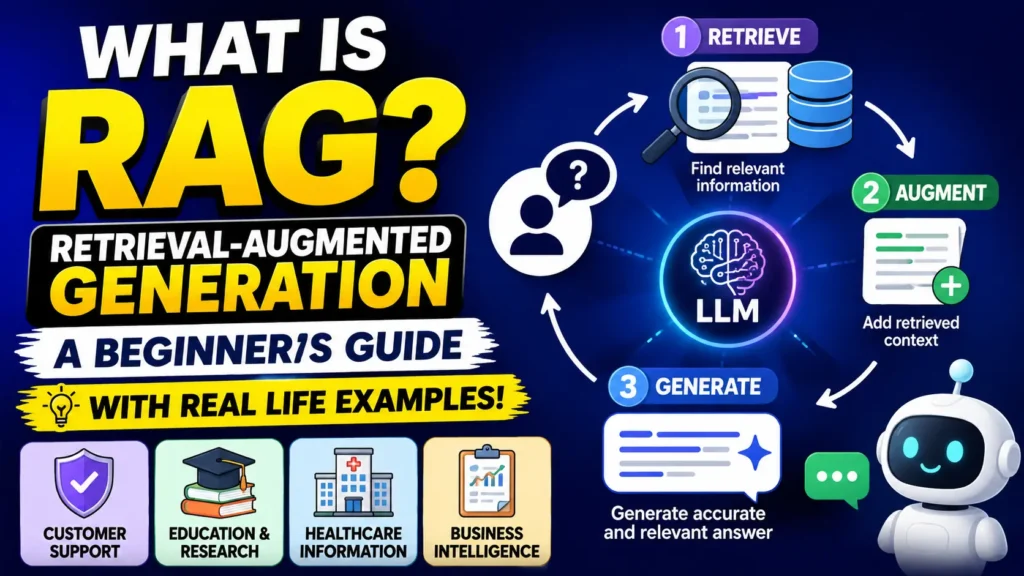
Instead of relying only on what it memorised during training, an AI using this approach first retrieves the latest relevant information from trusted documents or databases, then generates an accurate answer based on what it just read.
That one simple shift, retrieve first then answer, is what makes retrieval augmented generation one of the most important developments in practical AI today.
What Is Retrieval Augmented Generation?
Retrieval Augmented Generation (RAG) is an AI technique that combines two steps: retrieving relevant information from an external source and then using a large language model to generate an answer based on that retrieved content.
The term was introduced by researchers at Meta AI in a 2020 paper and has since become one of the most widely adopted approaches for building accurate, reliable, and up-to-date AI systems.
To understand this technology fully, it helps to understand the problem it solves.
A standard large language model is trained on a massive dataset up to a specific cutoff date. Once training is complete, its knowledge is frozen. Ask it about something that happened last month and it will not know. Ask it about your company’s internal leave policy and it will guess. Ask it about a patient’s specific medical history and it will hallucinate an answer.
Retrieval augmented generation fixes all three of these problems by giving the AI access to external, up-to-date, and specific information at the moment you ask your question.
If you are new to how large language models work, our guide on what is a large language model covers the foundation you need before going deeper into RAG. Explore Artificial Intelligence for Beginners: Complete Step-by-Step Guide
How Does Retrieval Augmented Generation Work?
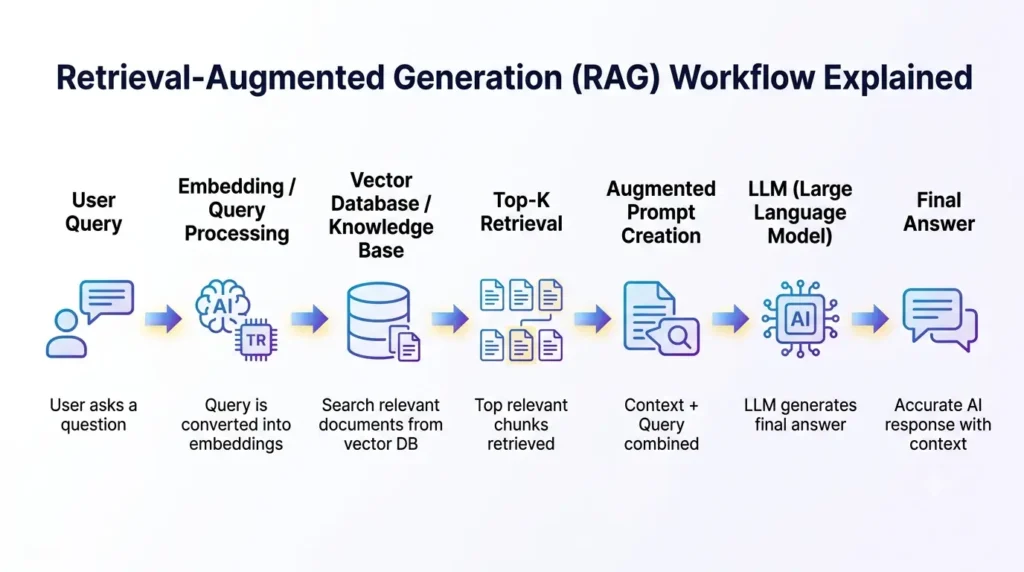
The retrieval augmented generation process follows four clear steps every time you ask a question.
Step 1: You ask a question You type your query into an AI system that uses RAG.
Step 2: The system retrieves relevant information Instead of going straight to generating an answer, the system searches a connected knowledge base, database, or set of documents for content relevant to your question. This could be a company document library, a medical database, a product catalog, or any trusted source of information.
Step 3: The retrieved content is passed to the LLM The relevant documents or passages are handed to the large language model along with your original question. The model now has both your query and the specific, up-to-date context it needs.
Step 4: The LLM generates a grounded answer Using the retrieved content as its source, the model generates a response that is accurate, specific, and grounded in real information rather than relying purely on training memory.
This is the four-step RAG process in full. Retrieve, then generate. Every time.
Real Life Example 1: The Laptop Shop
Here is an everyday scenario that makes this concept instantly clear.
Imagine you walk into a laptop store and ask the salesperson:
“How much does the Dell XPS 15 cost and is it in stock?”
Without RAG: The salesperson answers purely from memory. They recall the price from when they last checked, which was eight months ago.
“That laptop costs $1,200 and we usually have it in stock.”
But today the price has dropped to $950 and the store sold its last unit yesterday. The salesperson gave a confident answer that was completely wrong on both counts.
With RAG: Before answering, the salesperson checks the live inventory system on their tablet. They retrieve today’s actual price and current stock levels.
“That laptop is $950 today and we have three units available. Want me to hold one for you?”
That is RAG in a retail setting. The same logic applies when an AI system checks a live product database before answering your shopping question instead of guessing from outdated training data.
Real Life Example 2: The Library Exam
Here is a second example that shows RAG from a learning angle.
Imagine you are sitting an exam and you have two versions of yourself taking it.
Version 1, without RAG: You answer every question purely from memory. You studied hard but some facts are fuzzy. Some information you learned is now outdated. Some answers you simply cannot recall accurately. You do your best but confidence and accuracy are inconsistent.
Version 2, with retrieval augmented generation: Before answering each question, you are allowed to walk to the library shelf, find the exact relevant textbook, open it to the right page, read the passage, and then write your answer.
Your answers are now grounded in the actual source material. They are accurate, up-to-date, and specific. You are not guessing. You are retrieving, reading, and then responding.
Version 2 is retrieval augmented generation. The AI equivalent is a system that checks its connected knowledge base before every response rather than relying only on what it memorised during training.
RAG Without and With: A Simple Comparison
| Without RAG | With Retrieval Augmented Generation |
|---|---|
| Uses training memory only | Searches documents before answering |
| Knowledge has a cutoff date | Uses latest available data |
| Can hallucinate confidently | Grounded in real retrieved content |
| Fixed knowledge base | Dynamic and updatable knowledge |
| Cannot access your company data | Can answer using internal documents |
| Generic responses | Specific, contextual responses |
This table captures why retrieval augmented generation has become the standard approach for enterprise AI, healthcare AI, legal AI, and any application where accuracy is non-negotiable.
Explore our Top 100 AI Words You Need to Know: Complete AI Glossary
Where You Already Use Retrieval Augmented Generation
Most people interact with retrieval augmented generation every day without realising it. Here are the tools and situations where it is already working behind the scenes.
Google NotebookLM When you upload a PDF or research paper to NotebookLM and ask it questions, that is retrieval augmented generation in action. It retrieves content from your uploaded documents before generating answers, which is why it can answer specific questions about your own files rather than giving generic responses.
Claude Projects When you add documents to a Claude Project and Claude references those files in its answers, that is RAG at work. Claude retrieves content from your uploaded files before generating responses, making Claude Projects powerful for research, legal work, and business analysis.
Microsoft Copilot with Company Files When Copilot searches your SharePoint files, emails, and Teams conversations before answering a work question, it is using RAG. Copilot retrieves your actual company documents and then generates an answer grounded in your real business context.
ChatGPT with Uploaded Documents When ChatGPT says “I searched your uploaded document” before answering, that is RAG at work. The system retrieved relevant passages from your file and used them to ground the response.
AI Customer Support Chatbots When a company chatbot answers your question about your specific order, account balance, or subscription details, it pulls your real data from the company’s systems before responding. That is RAG in a customer service context.
Medical AI Assistants When an AI clinical tool checks the latest hospital protocols, updated drug guidelines, and a patient’s medical history before suggesting a treatment approach, that is RAG keeping patients safer.
Why Retrieval Augmented Generation Matters for AI Accuracy
The single biggest problem with AI systems that do not use retrieval augmented generation is hallucination. This is when a large language model generates a confident, fluent, completely fabricated answer because it has no real source to check against.
Grounding every response in retrieved content dramatically reduces this problem. The model is not guessing from memory. It is reading from a source and summarising what it found.
This is why RAG has become the standard architecture for:
- Legal AI tools that need to cite accurate case law and current regulations
- Medical AI assistants that must reference up-to-date clinical guidelines
- Financial AI that needs today’s market data and regulatory documents
- Enterprise knowledge bases where employees ask questions about internal policies
In any domain where being wrong has real consequences, retrieval augmented generation is not optional. It is essential.
Our AI basics guide covers why AI accuracy matters across different use cases and industries if you want to explore this further.
Retrieval Augmented Generation vs Fine-Tuning: What Is the Difference?
When people first learn about retrieval augmented generation, they often ask how it differs from fine-tuning, another popular approach to improving AI accuracy.
Fine-tuning involves retraining a large language model on a specific dataset to bake new knowledge permanently into the model’s parameters. It is expensive, time-consuming, and requires technical expertise. Every time your data changes, you need to retrain.
Retrieval augmented generation keeps the base model unchanged and simply connects it to an external knowledge source at query time. It is faster to implement, cheaper to maintain, and the knowledge source can be updated instantly without touching the model.
For most businesses and developers, RAG is the more practical and cost-effective approach. Fine-tuning is reserved for cases where you need the model to adopt a completely new style, language, or behaviour rather than just access new information.
To understand how AI agents use retrieval augmented generation as part of their tool stack, our What Are AI Agents? Complete Beginner Guide 2026 explains how these systems connect to real world information sources.
How to Use Retrieval Augmented Generation Right Now
You do not need to be a developer to start benefiting from retrieval augmented generation today. Here are three practical ways to use it right now.
Use Claude Projects Upload your study notes, work documents, company reports, or research papers to a Claude Project. Ask Claude questions about those files. Every answer Claude gives will be grounded in your actual uploaded content. That is RAG working for you right now with zero technical setup.
Use Google NotebookLM Upload any PDF, Google Doc, or research paper to NotebookLM. Ask it to summarise, explain, or answer questions about your content. NotebookLM retrieves from your documents before every response, making it one of the most practical free RAG tools available today.
Use Perplexity AI Perplexity retrieves live web content before every answer it generates, with citations you can verify. This makes it a powerful retrieval augmented generation tool for research and fact-checking where up-to-date accuracy matters.
If you want to learn how to prompt these tools more effectively, our prompt engineering guide shows you how to write instructions that get the best results from any AI system.
Retrieval Augmented Generation and Your AI Career
If you are building toward an AI career, retrieval augmented generation is one of the most in-demand skills in the job market right now. Every enterprise AI project, every company knowledge bot, and every domain-specific AI assistant is built on RAG architecture.
Understanding RAG at a conceptual level, even without coding skills, puts you ahead of most candidates applying for AI-adjacent roles. Being able to explain how it works, why it reduces hallucination, and how tools like Claude Projects and NotebookLM implement it is genuinely valuable knowledge in interviews, client conversations, and internal AI strategy discussions.
Our Claude tutorial for beginners shows you how to use Claude Projects effectively, which is the most accessible hands-on introduction to working with retrieval augmented generation in a real workflow. For deeper technical context, the original RAG research paper from Meta AI is the foundational academic source. The LangChain documentation is the most widely used developer framework for building RAG systems if you want to go further technically.
Frequently Asked Questions About Retrieval Augmented Generation
What is Retrieval Augmented Generation in simple terms?
Retrieval augmented generation is an AI technique where the system retrieves relevant information from external documents or databases before generating an answer. Instead of relying only on training memory, the AI checks a trusted source first and then responds based on what it finds. This makes RAG far more accurate than standard AI generation.
Why is retrieval augmented generation important?
It solves the two biggest problems with standard AI: outdated knowledge and hallucination. By retrieving current, specific information before generating a response, RAG produces answers grounded in real sources rather than fabricated from memory. This makes AI safe enough for medical, legal, and enterprise use.
What is the difference between RAG and a standard LLM?
A standard large language model answers from training memory alone, which has a fixed cutoff date and can produce hallucinations. Retrieval augmented generation adds a retrieval step before generation, connecting the model to live or specific documents. The result is more accurate, more current, and more trustworthy than a standard LLM response.
Which tools use retrieval augmented generation?
Several widely used tools already implement RAG including Google NotebookLM, Claude Projects, Microsoft Copilot with company files, ChatGPT with uploaded documents, and Perplexity AI. Enterprise customer service bots, medical AI assistants, and legal research tools also run on RAG architecture at their core. expolre 12 Best AI Chatbots in 2026: ChatGPT, Claude, Gemini & More Compared
Is retrieval augmented generation difficult to implement?
For end users, RAG requires no technical skill at all. Tools like NotebookLM and Claude Projects deliver this capability through a simple upload and chat interface. For developers building custom systems, frameworks like LangChain and LlamaIndex make implementation significantly faster than building from scratch.
Can retrieval augmented generation eliminate AI hallucinations completely?
RAG significantly reduces hallucinations but does not eliminate them entirely. If the retrieved document contains incorrect information, the model may still generate an inaccurate response. The quality of your system depends heavily on the quality and accuracy of the knowledge source it retrieves from. Garbage in, garbage out still applies.
How is retrieval augmented generation used in healthcare?
In healthcare, RAG allows AI systems to check the latest clinical guidelines, hospital protocols, drug interaction databases, and patient records before generating a recommendation. This makes medical AI far safer than systems relying on static training knowledge. Retrieval augmented generation is increasingly used in clinical decision support, patient FAQ bots, and medical documentation tools.
What is the future of retrieval augmented generation?
RAG is already moving beyond text documents to include real-time web data, images, audio transcripts, and structured databases. As AI agents become more sophisticated, retrieval augmented generation will be embedded in every step of multi-agent workflows. Understanding RAG now positions you ahead of the curve as this becomes the default architecture for enterprise AI systems.
Explore more Articles on Blogs Earn Money with AI Claude AI