- What Is Prompt Engineering?
- Why Prompt Engineering Matters More Than Ever in 2026
- The Anatomy of a Strong Prompt
- 7 Prompt Engineering Techniques That Actually Work
- Common Prompt Engineering Mistakes to Avoid
- Prompt Engineering for Different Professions
- How to Start Learning Prompt Engineering Today
- The Bigger Picture – Why This Skill Shapes Careers
- What to Explore Next
- Final Thought
- Frequently Asked Questions
- What is Prompt Engineering in simple words?
- Do I need coding skills to learn Prompt Engineering?
- How does Prompt Engineering make you 10x faster?
- Which AI tools work best with Prompt Engineering?
- What is the difference between zero-shot and few-shot prompting?
- Can QA testers and software testers use Prompt Engineering?
- How long does it take to learn Prompt Engineering?
- Is Prompt Engineering a good career skill in 2026?
- What is system prompt engineering?
- Where can I learn Prompt Engineering for free?
Prompt Engineering is the most valuable AI skill nobody taught you in school.
You have probably used an AI tool at least once. Maybe you typed a question, got a confusing answer, and thought , “This AI is not that smart.”
Here is the truth nobody tells you: The AI was not the problem. The prompt was.
It is simply how you ask.
And that single skill – knowing exactly how to ask AI the right way – is what prompt engineering is all about. Master it, and you will work 10 times faster, earn more, and do things with AI that most people think are impossible.
This Prompt Engineering Guide will show you exactly how to communicate with AI tools like Claude and ChatGPT. Whether you are a beginner or a professional, these 7 practical techniques will make your work 10x faster
And in 2026, it has become one of the most valuable skills a professional can have, whether you are a student, software Developer, tester, a content creator, a business owner, or someone just starting their AI journey.
This guide breaks down everything you need to know about Prompt Engineering, clearly, practically, and honestly.
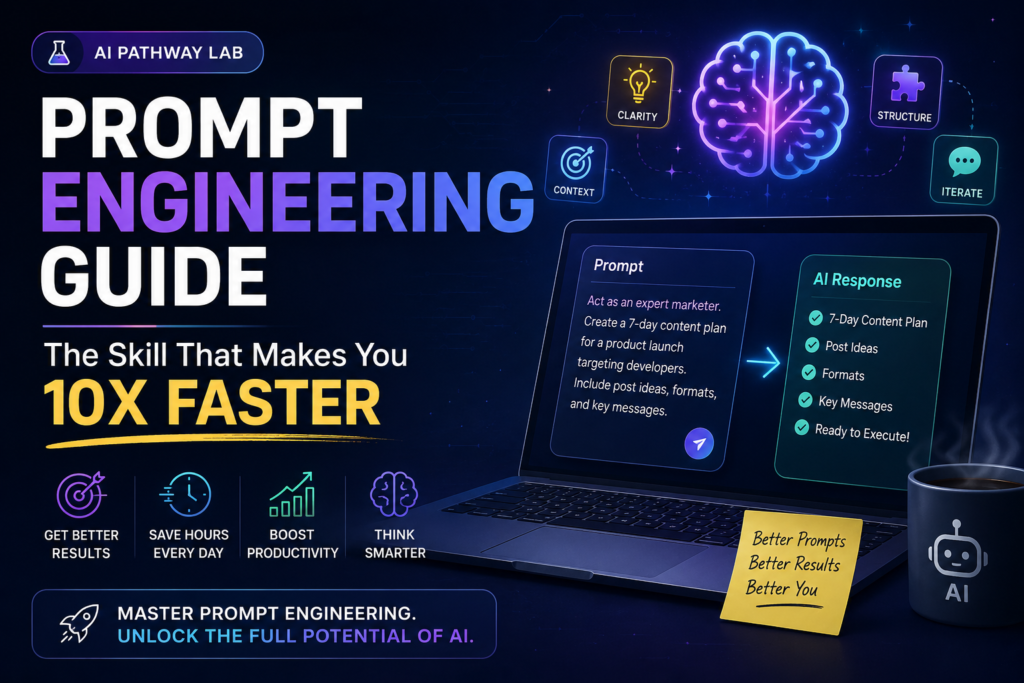
What Is Prompt Engineering?
Prompt Engineering is the practice of designing clear, structured instructions for AI models to produce accurate, useful, and high-quality responses.
Think of it this way. When you talk to a colleague, you give them context. You explain the background, the goal, and what you need. You do not just say “write something.” You say, “Write a 3-paragraph summary of our project for a non-technical client.”
AI works the same way.
A prompt is the instruction you give to an AI tool like Claude, ChatGPT, or Gemini. Prompt Engineering is the skill of crafting those instructions well.
When done right, Prompt Engineering transforms AI from a basic chatbot into a powerful thinking partner that can:
- Draft professional documents in minutes
- Analyze complex data and summarize findings
- Generate structured content for blogs, social media, and reports
- Automate repetitive writing and research tasks
- Help you think through problems you are stuck on
Why Prompt Engineering Matters More Than Ever in 2026
A year ago, people were impressed when AI wrote a paragraph. Today, AI can build workflows, write code, create entire content strategies, and reason through complex problems.
But here is the gap most people miss.
Two people using the exact same AI tool can get completely different results — not because one has better AI access, but because one knows how to prompt effectively.
In a recent workplace study, professionals who used structured prompting techniques reported completing tasks 40% faster than those who used basic prompts. That gap is only growing.
For job seekers, this matters enormously. Companies hiring for AI-adjacent roles – AI Engineers, Automation Specialists, AI-Assisted Testers, Content Strategists -are actively looking for people who understand how to direct AI models effectively.
Prompt Engineering is no longer a niche developer skill. It is a core professional skill for 2026 and beyond.
The Anatomy of a Strong Prompt
Most people write prompts like search queries. Short. Vague. Hopeful.
“Write a blog post about AI.”
That prompt will get you something generic, forgettable, and probably not useful.
A strong prompt has structure. Here is what that looks like:
1. Role
Tell the AI who it is in this context.
“You are an experienced AI educator writing for beginners with no technical background.”
2. Task
Be specific about exactly what you need.
“Write a 600-word blog introduction explaining what AI Agents are and why they matter in 2026.”
3. Context
Give the AI the background it needs to help you properly.
“The audience is working professionals in India aged 25–40 who are curious about AI but feel overwhelmed by technical language.”
4. Format
Tell the AI how you want the output structured.
“Use short paragraphs, subheadings every 150 words, and end with a clear call to action.”
5. Tone
Specify the voice and style.
“Write in a warm, encouraging tone — like a knowledgeable friend explaining something over coffee.”
When you combine all five elements, the AI has everything it needs to produce something genuinely useful.
7 Prompt Engineering Techniques That Actually Work
These are not theoretical frameworks. These are practical techniques used daily by AI practitioners, content creators, and engineers in 2026.
1. Zero-Shot Prompting
The most basic form – you give the AI a task with no examples.
Example: “Summarise the key benefits of using AI in software testing in 5 bullet points.”
Best for: Simple, well-defined tasks where the format is obvious.
2. Few-Shot Prompting
You give the AI 2–3 examples of what you want before asking it to produce something.
Example: “Here are two examples of how I write LinkedIn posts: [Example 1] [Example 2]. Now write a LinkedIn post about prompt engineering in the same style.”
Best for: Matching a specific tone, style, or format that is hard to describe in words.
3. Chain of Thought Prompting
You ask the AI to reason through a problem step by step before giving the final answer.
Example: “Think through this step by step. A QA tester wants to use AI to reduce regression testing time. What are the key steps they should take, and what tools would help at each stage?”
Best for: Complex problems, analysis, and decisions where reasoning matters.
4. Role Prompting
You assign the AI a specific expert persona to draw on deeper domain knowledge.
Example: “You are a senior AI Engineer with 10 years of experience building automation workflows. Explain how you would approach setting up an AI-powered QA pipeline for a mid-sized tech company.”
Best for: Technical explanations, professional advice, and expert-level content.
5. Constraint Prompting
You deliberately limit the AI’s output to sharpen the result.
Example: “Explain what Generative AI is in exactly 3 sentences. No technical jargon. Write for someone who has never used AI before.”
Best for: Social media content, executive summaries, and concise explanations.
6. Iterative Prompting
You treat the AI like a collaborator – refining, expanding, and redirecting across multiple exchanges.
Example:
- First prompt: “Give me 10 blog post ideas about AI for QA testers.”
- Second prompt: “Take idea number 4 and expand it into a full outline with 6 subheadings.”
- Third prompt: “Write the introduction section in a conversational, beginner-friendly tone.”
Best for: Long-form content creation, complex projects, and detailed research.
7. System Prompt Engineering
Used when building AI-powered applications and tools, system prompts define the AI’s behaviour, personality, and constraints at a foundational level.
Example: “You are an AI assistant for AI Pathway Lab. Your role is to answer questions about AI learning, tools, and career pathways. Always respond in simple, beginner-friendly language. Never give financial advice. If asked something outside your scope, direct users to aipathwaylab.com.”
Best for: Developers and AI Engineers building products on top of AI models – a critical skill for anyone pursuing an AI Engineer career path.
Common Prompt Engineering Mistakes to Avoid
Even experienced users fall into these traps.
Being too vague. “Write something about AI” gives the AI nothing to work with. Specificity is everything.
Skipping context. The AI does not know your audience, your goals, or your brand voice unless you tell it. Always provide background.
Accepting the first output. Great prompting is iterative. If the first response is 70% there, refine it. Ask the AI to adjust the tone, expand a section, or simplify the language.
Overloading one prompt. Asking an AI to research, analyse, write, and format in a single prompt often produces mediocre results across all tasks. Break complex tasks into steps.
Ignoring model differences. Claude handles nuanced reasoning and long documents exceptionally well. ChatGPT is strong at creative tasks. Perplexity excels at research with real-time web access. Match your prompt to the right tool.
ChatGPT Tutorial for Beginners: Complete Step-by-Step Guide
Claude Tutorial for Beginners: Master AI in 20 Minutes (Step-by-Step Guide)
Prompt Engineering for Different Professions
For Software Testers and QA Professionals
Prompt Engineering directly enhances your testing workflow. Use structured prompts to:
- Generate comprehensive test cases from requirements documents
- Write bug report summaries in seconds
- Create automation script templates with AI assistance
- Analyze test results and identify patterns
If you are a QA professional exploring AI, the AI for Testers hub on AI Pathway Lab was built specifically for your career path.
For Content Creators
Structured prompts eliminate blank page paralysis. Use them to:
- Generate content calendars with topic clusters
- Draft blog introductions across multiple angles
- Repurpose long articles into social media posts
- Write in a consistent brand voice across platforms
For Business Professionals
Prompt Engineering helps you work smarter in daily tasks:
- Summarise lengthy reports into executive briefs
- Draft professional emails for complex situations
- Analyse data and identify key insights
- Prepare structured meeting agendas and follow-ups
How to Start Learning Prompt Engineering Today
You do not need a computer science degree. You do not need to know how to code. You need curiosity, practice, and the right resources.
Step 1 – Start with free certified courses. Anthropic Learn offers free courses on Claude and prompt engineering fundamentals. Google, Microsoft, and AWS also offer free AI learning paths. For a full list, explore the Free AI Courses guide on AI Pathway Lab.
Step 2 – Practice daily with real tasks. The fastest way to improve is to use AI for actual work tasks. Start with something small — summarising a document, drafting an email, generating ideas. Pay attention to what works and what does not.
Step 3 – Study prompt libraries. Resources like Anthropic’s prompt library and community prompt databases show you how experts structure prompts for different use cases.
Step 4 – Experiment with different AI models Each model has strengths. Spend time with Claude, ChatGPT, and Perplexity. Notice how the same prompt produces different results — and what adjustments improve each one.
Step 5 – Build a personal prompt library. Keep a document of prompts that work well for your specific use cases. Over time, this becomes an invaluable personal resource – and a portfolio of your AI skills.
The Bigger Picture – Why This Skill Shapes Careers
Here is something worth sitting with.
Every major technology shift creates a new literacy gap. People who learned to use computers effectively in the 1990s had significant career advantages. People who learned digital marketing in the 2000s built entire businesses. People who learned data analysis in the 2010s became indispensable.
We are in that moment right now with AI.
Prompt Engineering is the new literacy of the AI era.
Not because it is complicated – it is genuinely learnable. But because most people are not investing in it seriously. They are using AI casually, getting average results, and concluding that AI is overhyped.
The professionals who invest in this skill now will be the ones directing AI workflows, building AI-powered tools, and leading AI transformation in their organizations by 2027.
If you are a tester, a content creator, a business analyst, or anyone who works with information, this is your moment.
What to Explore Next
Prompt Engineering does not exist in isolation. It is the foundation layer for everything else in AI:
- AI Agents — autonomous systems that execute multi-step tasks using sequences of prompts
- AI Automation & Workflows — connecting AI with tools like n8n and Zapier using structured AI instructions
- Generative AI — understanding the models that respond to your prompts
- AI for Testers — applying prompt skills directly to QA and software testing careers
Start here. Build the foundation. Then watch everything else in AI become more accessible.

Final Thought
The best prompt engineers are not the ones who memorized the most frameworks. They are the ones who stayed curious, kept experimenting, and treated AI as a genuine thinking partner rather than a search engine.
You already have that curiosity — otherwise you would not be here.
Now go practise. Open Claude or ChatGPT, pick one task from your actual work today, and try prompting it properly using the structure in this guide.
The results will surprise you.
Explore more at AI Pathway Lab — your practical guide to learning AI, building AI skills, and growing your career in the AI era.
If you are specifically looking for prompt engineering techniques for QA agents, read our dedicated Prompt Engineering for QA Agents – Best Practices Complete Guide
Related reads:
- What Are AI Agents? Complete Beginner Guide 2026
- How to Become an AI Engineer
- Free AI Courses with Certificate in 2026
- AI Automation & Workflow Tutorials
- Generative AI
- Home – Pathway Lab
Frequently Asked Questions
What is Prompt Engineering in simple words?
Prompt Engineering is the skill of writing clear, structured instructions for AI tools like Claude or ChatGPT to get accurate, useful results. Think of it as learning how to communicate effectively with AI — the better your instruction, the better the output.
Do I need coding skills to learn Prompt Engineering?
No. Prompt Engineering requires no coding knowledge. It is a communication skill — if you can write clearly and think logically, you can learn prompt engineering. Most beginners pick up the basics within a few days of practice.
How does Prompt Engineering make you 10x faster?
By using structured prompts with role, task, context, format and tone, you get usable AI outputs in one or two attempts instead of ten. Tasks that used to take hours like drafting reports, summarising documents, or writing content, can be completed in minutes.
Which AI tools work best with Prompt Engineering?
Claude by Anthropic is excellent for reasoning, long documents and structured outputs. ChatGPT is strong for creative tasks. Perplexity AI is best for research with real-time web results. Each tool responds differently to prompts so it helps to practise with all three.
What is the difference between zero-shot and few-shot prompting?
Zero-shot prompting means giving AI a task with no examples — just a clear instruction. Few-shot prompting means providing 2 or 3 examples of what you want before asking AI to produce something similar. Few-shot works better when you need a specific tone or format that is hard to describe in words.
Can QA testers and software testers use Prompt Engineering?
Absolutely. QA professionals use prompt engineering to generate test cases, write bug report summaries, create automation script templates and analyse test results. It is one of the fastest ways for testers to add AI skills to their career toolkit.
How long does it take to learn Prompt Engineering?
The basics can be learned in a weekend. Getting genuinely good takes 2 to 4 weeks of daily practice with real tasks. Advanced techniques like system prompt engineering for AI applications take longer but are very learnable without a technical background.
Is Prompt Engineering a good career skill in 2026?
Yes , it is one of the most in-demand skills right now. Companies hiring for AI Engineer, AI Automation Specialist, and AI-assisted roles actively look for prompt engineering knowledge. It is also the foundation skill for building AI Agents and automation workflows.
What is system prompt engineering?
System prompt engineering is used when building AI-powered applications. A system prompt defines the AI’s behaviour, personality, scope and limitations at a foundational level — before any user interaction happens. It is a critical skill for AI Engineers and developers building products on top of AI models.
Where can I learn Prompt Engineering for free?
Anthropic Academy offers free courses on Claude and prompting fundamentals. Google, Microsoft and AWS also have free AI learning paths with certificates. AI Pathway Lab covers practical prompt engineering techniques with real-world examples designed for beginners and working profession