Table of Contents
AI Tokens- You type a message into Claude or ChatGPT. You hit send. Within seconds, you get a response.
But between the moment you press send and the moment the AI starts responding, something fascinating happens that most people never think about. The AI does not read your message the way you do. It does not process one word at a time. It breaks your entire message into small pieces called AI tokens, processes those pieces mathematically, and then generates a response one token at a time.
Understanding this is not just a technical curiosity. It has real practical implications for how much you pay for API usage, why responses sometimes get cut off, and how to write prompts that get better results without wasting money.
This guide explains everything you need to know in plain English, with examples from ChatGPT, Claude, Google Gemini, and Microsoft Copilot.
Why Understanding AI Tokens Can Save You Money and Improve Your Results
Before diving into what AI tokens are, here is why they actually matter for everyday AI users.
For API users: Every major AI provider charges per token. OpenAI charges per million tokens for GPT-4o. Anthropic charges per million tokens for Claude. Google charges per million tokens for Gemini. Understanding tokens helps you write prompts that achieve the same result with fewer tokens, directly reducing your costs.
For free tier users: Even on free plans, AI tokens determine how long your conversations can be before the AI starts forgetting earlier context. Understanding these limits helps you get better, more consistent responses.
For quality: Knowing how tokenisation works helps you understand why AI sometimes produces unexpected outputs. A prompt that seems clear to a human reader may be ambiguous at the token level. Understanding this makes you a more effective prompter.
To understand the large language models that use AI tokens to process your prompts, our large language model guide covers the foundational technology clearly.
What Are AI Tokens?
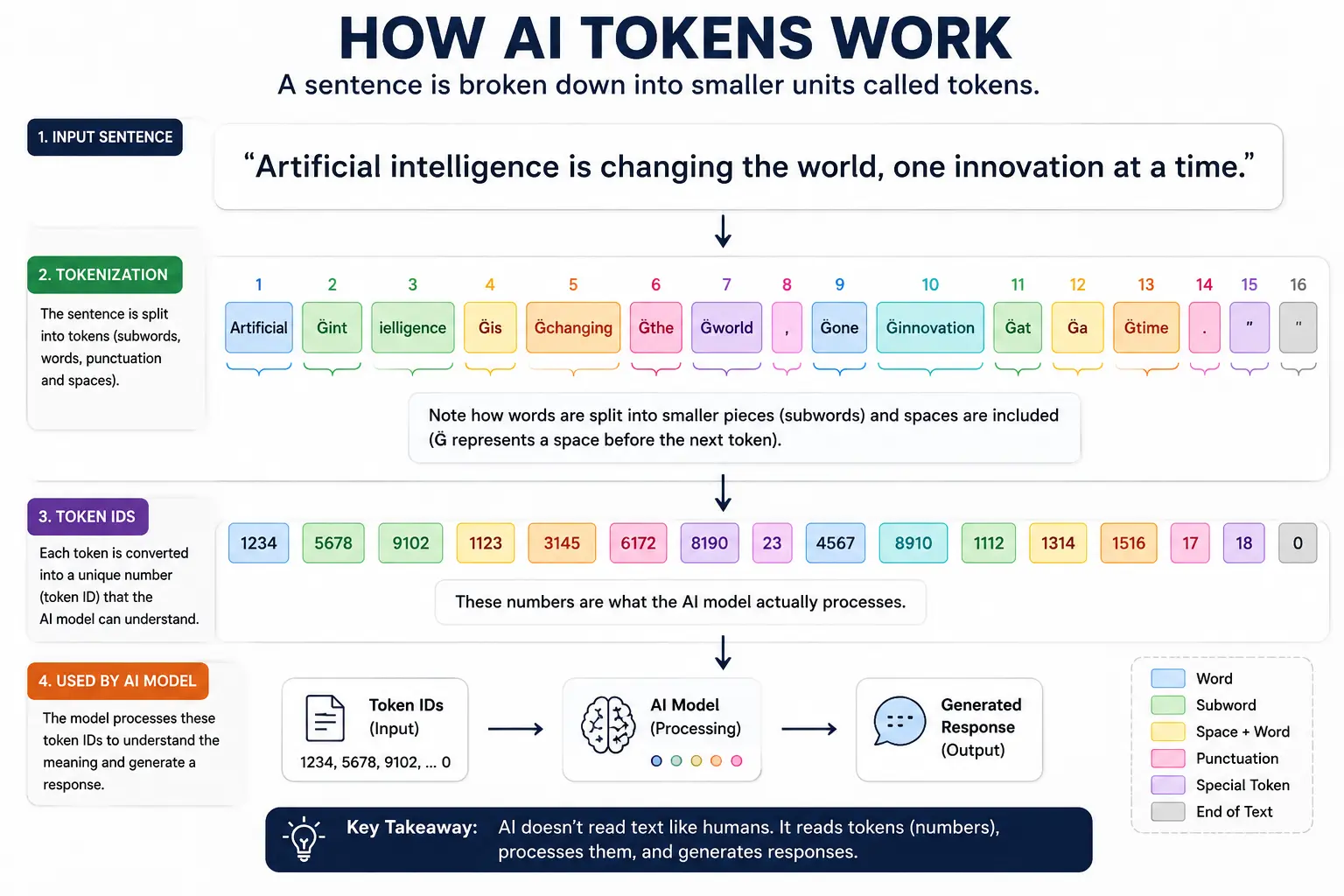
AI tokens are the basic units that large language models use to process text. AI tokens are chunks of text, somewhere between individual characters and complete words, that the AI uses as its unit of meaning.
Here is the simplest way to understand AI tokens. When you learned to read as a child, you did not process one letter at a time. Your brain grouped letters into recognisable patterns and words. AI models do something similar but at a different granularity. They group characters into tokens based on patterns learned from enormous amounts of training text.
A single AI token is typically:
- A short common word like “the”, “is”, “and”, “a”
- Part of a longer word like “token” might be one token, but “tokenization” might be two
- A punctuation mark or space
- A number or code fragment
The key insight is that AI tokens are not the same as words. This surprises most people who assume AI models count words the way a word processor does. They do not. They count AI tokens.
As a rough rule: 100 words equals approximately 75 AI tokens. Or alternatively, one AI token equals roughly 0.75 words on average. This varies between models and languages.
How ChatGPT, Claude, Gemini and Copilot Break Down Your Prompt
Each major AI model uses its own tokenisation approach, producing different numbers of tokens for the same sentence.
Here is a real example. Take this simple sentence:
“Understanding AI is important for your career.”
Let us see how different models might break this into AI tokens:
ChatGPT (GPT-4o using tiktoken): “Understanding” / ” AI” / ” is” / ” important” / ” for” / ” your” / ” career” / “.” Approximately 8 AI tokens.
Claude (Anthropic tokenizer): “Under” / “standing” / ” AI” / ” is” / ” important” / ” for” / ” your” / ” career” / “.” Approximately 9 AI tokens.
Google Gemini (SentencePiece tokenizer): “Understanding” / ” AI” / ” is” / ” important” / ” for” / ” your” / ” career” / “.” Approximately 8 AI tokens.
Microsoft Copilot uses GPT-4 under the hood and therefore shares the same tiktoken tokenisation approach as ChatGPT, giving approximately the same token count for most English text.
Notice how “Understanding” stayed as one token for ChatGPT and Gemini but split into “Under” and “standing” for Claude. This is why the same prompt can cost slightly different amounts across different providers even when the word count is identical.
Why AI Does Not Read Word by Word
This is one of the most important things to understand about how AI models actually work and why AI tokens exist at all.
Traditional text processing software reads text character by character or word by word. AI language models do neither. They process text through a mathematical representation called an embedding, where each AI token is converted into a vector of numbers that captures its meaning in relation to all other tokens the model has seen during training.
When you send a message to Claude or ChatGPT, here is what actually happens:
- Your text is broken into AI tokens by a tokeniser specific to that model
- Each unit is converted into a numerical vector (embedding)
- The model processes all these numerical vectors simultaneously using attention mechanisms
- The model predicts the most likely next AI token based on all the context
- It generates one token at a time until the response is complete
This is why AI responses appear word by word when streaming is enabled. The model is literally generating one AI token at a time, and each token determines what the next token is most likely to be.
Understanding this process also explains why AI models struggle with tasks that seem simple to humans, like counting the letters in a word. When you ask Claude how many times the letter “r” appears in “strawberry,” it is working with tokens not letters, which makes individual character counting genuinely difficult.
Visual Examples of Tokenisation
Let us look at some concrete examples to make AI tokens tangible. Each segment between the dividers represents one token:
Simple sentence: [The] [ quick] [ brown] [ fox] 4 tokens. Common short words tend to be individual tokens.
Technical term: [token] [isation] 2 tokens. Longer or less common words often split.
Code snippet: [def] [ calculate] [_tokens] [(] [text] [):] 6 tokens. Code has its own tokenisation patterns.
Number: [2026] 1 token. Short numbers are typically single tokens.
Long number: [1] [,] [000] [,] [000] 5 tokens. Long numbers often split at punctuation boundaries.
This has a practical implication: If you are using the Claude API or GPT-4 API and want to estimate costs, you cannot simply count words. You need to use the model-specific tokeniser to get an accurate count. OpenAI provides a free tokeniser tool at platform.openai.com/tokenizer. Anthropic documents their tokenisation approach in the Anthropic API documentation. Google covers Gemini tokenisation in the Google AI documentation that lets you paste any text and see exactly how it breaks into AI tokens.
Input Tokens vs Output Tokens
This distinction matters enormously for API pricing and understanding how AI usage is measured.
Input tokens are the AI tokens in everything you send to the model. This includes your system prompt (the instructions you give the AI about how to behave), your conversation history (all previous messages in the current session), and your current user message.
Output tokens are the AI tokens the model generates in its response to you.
Here is why this matters for pricing across major models:
| Model | Input tokens (per million) | Output tokens (per million) |
|---|---|---|
| Claude Haiku 3.5 | USD $0.80 | USD $4.00 |
| Claude Sonnet 4 | USD $3.00 | USD $15.00 |
| GPT-4o | USD $2.50 | USD $10.00 |
| GPT-4o mini | USD $0.15 | USD $0.60 |
| Gemini 1.5 Flash | USD $0.075 | USD $0.30 |
| Gemini 1.5 Pro | USD $1.25 | USD $5.00 |
Two patterns jump out immediately. First, output tokens almost always cost more than input tokens across every model. This makes sense because generating text requires more computation than reading it. Second, Gemini Flash is significantly cheaper than comparable models, making it attractive for high-volume applications where cost per token matters.
For free tier users on Claude or ChatGPT, you do not pay per token but you do encounter daily or monthly usage limits that are measured in tokens. Understanding AI tokens helps you use your free allocation more efficiently.
How Token Limits Affect AI Responses
Every AI model has a maximum number of AI tokens it can process in a single context window. This is called the context window, one of the most important constraints when working with AI.
What is a context window? The context window is the total number of AI tokens the model can see at once, including your system prompt, your entire conversation history, and the response it is about to generate. When the total token count exceeds the context window limit, the model starts losing access to earlier parts of the conversation.
Context window sizes across major models:
| Model | Context window |
|---|---|
| Claude 3.5 Sonnet | 200,000 tokens |
| GPT-4o | 128,000 tokens |
| Gemini 1.5 Pro | 2,000,000 tokens |
| Gemini 1.5 Flash | 1,000,000 tokens |
| Microsoft Copilot | 128,000 tokens (GPT-4 based) |
Gemini 1.5 Pro’s 2 million token context window is extraordinary and represents the current frontier for context length. For reference, 2 million tokens is approximately 1,500,000 words or roughly 1,500 pages of text.
What happens when you hit the token limit? When your conversation approaches the context window limit, the AI model starts to lose access to the earliest messages. This is why long conversations feel like the AI has forgotten earlier context. It has simply run out of token space.
This is also why retrieval augmented generation exists as an architectural approach. Rather than stuffing everything into the context window, RAG retrieves only the most relevant information for each query. Our retrieval augmented generation guide explains this in full detail.
7 Ways to Reduce AI Token Usage Without Losing Quality
Whether paying per token or using a free tier, these seven strategies help you get the same results with fewer tokens.
1. Remove repetition from your prompts. Many people repeat instructions thinking it adds emphasis. “Please write clearly, make sure it is clear, and I want it to be very clear” uses far more AI tokens than “Write clearly.” A single clear instruction is all that is needed.
2. Be specific rather than descriptive. “Write a concise professional email declining a meeting” uses fewer AI tokens than “Can you please help me write an email that is professional and not too long, declining a meeting that I cannot attend.” The first prompt achieves the same result with roughly half the AI tokens.
3. Use bullet points for complex instructions. Bullet points communicate structured information more efficiently than prose. A list of five requirements in bullet form uses fewer AI tokens than the same requirements written as flowing sentences with connective words and repetitive phrasing.
4. Reuse system prompts instead of repeating context If you find yourself beginning every conversation by explaining who you are and what you need, create a reusable system prompt and use the API system parameter or Claude’s custom instructions feature. This means your context only needs to be stated once rather than added to every conversation.
5. Ask one task at a time. Combining multiple tasks in one prompt forces the model to generate a longer response covering everything at once. For complex projects, breaking work into sequential prompts allows you to guide the output at each stage, often using fewer total AI tokens than one massive prompt attempting everything simultaneously.
6. Summarise long context before continuing. In long research or writing projects, periodically ask the AI to summarise what has been discussed or decided so far. Save that summary, start a fresh conversation, and paste only the summary as context. This dramatically reduces the token overhead of your conversation history while preserving the essential information.
7. Trim unnecessary examples from prompts. Examples in prompts are powerful but expensive in AI tokens. One clear, well-chosen example is almost always more effective than three mediocre examples. Review your prompts and ask whether each example is genuinely necessary or whether it can be removed without reducing output quality.
Our prompt engineering guide covers advanced prompting techniques that naturally lead to more token-efficient instructions.
Common Token Myths Debunked
Myth 1: One token equals one word This is the most widespread misconception about how AI models work. Tokens and words are different units entirely. Common short words like “the” or “is” are typically single tokens, while longer words like “tokenisation” or “understanding” may be two tokens. On average, 100 words equals approximately 75 AI tokens, but this varies by language, model, and content type.
Myth 2: Shorter prompts are always better This is not true. A short but vague prompt often produces a poor output that requires multiple follow-up prompts to fix, using far more AI tokens overall than a slightly longer but precise initial prompt would have required. The goal is prompt efficiency not brevity. A well-constructed prompt that works first time uses fewer total tokens than a short vague prompt requiring three corrections.
Myth 3: Different AI models count tokens the same way Each AI provider uses its own tokenisation algorithm. As shown in the ChatGPT versus Claude versus Gemini examples earlier, the same sentence can produce different token counts depending on which model processes it. This is why you cannot simply multiply word count by a fixed conversion rate to estimate token usage across different AI platforms.
Myth 4: Token limits only matter for developers. These limits affect every AI user. Free tier daily limits, context window sizes that determine how much conversation history the AI can access, and the quality degradation that occurs when context windows fill up all impact everyday AI users regardless of whether they are using the API or a consumer interface.
Myth 5: More tokens always means better output Longer prompts with more tokens do not automatically produce better responses. Concise, well-structured prompts consistently outperform verbose, repetitive ones. The model processes every token you send, including filler words and repeated instructions. Quality and clarity matters far more than quantity.
Use Tokens More Smartly Starting Today
Understanding tokens changes how you use every AI tool. You stop wondering why the AI forgot what you said earlier in a long conversation. You understand why the same sentence costs different amounts across platforms. You know how to structure prompts to get better results with fewer tokens.
The practical steps from here are simple when you understand the concept properly. Use the OpenAI tokenizer tool to see how your prompts break into AI tokens and identify inefficiencies. Apply the seven strategies to your most common prompts. Pay attention to the context window of whichever model you use most, so you can structure your conversations to stay within the optimal range.
AI tools are becoming part of every professional workflow. Understanding how they process your input, one AI token at a time, separates casual users from genuinely effective ones.
To build on this foundation, our Claude tutorial for beginners, Claude API Tutorial for Complete Beginners: Best Hands-On Guide, and AI basics cover the broader skills that complement everything you have learned about tokens and prompting.
Read more articles in the Blogs. AI Learning Hub: Subscribe to AI Pathway Lab for more AI Guides and tutorials
ChatGPT Tutorial for Beginners: Complete Step-by-Step Guide
Google Gemini AI Tutorial: Best Beginner’s Guide
What Is Microsoft Copilot? A Beginner’s Guide to AI Assistant for Work and Business
AI Tool Comparison: ChatGPT vs Claude vs Gemini vs Copilot – Pros, Cons & Best Uses
Frequently Asked Questions
What are AI tokens in simple terms?
These are the small chunks of text that language models use to process your input. They sit between individual letters and complete words in size. Common short words are usually single tokens while longer words often split into two or more. Most models process roughly 75 tokens per 100 words of English text.
How many AI tokens is 1000 words?
Approximately 750 tokens for standard English text. Divide word count by 0.75 as a quick estimate. The exact number varies by model and content type. Technical content with code, numbers, and special characters tends to use more tokens per word than plain prose. Use the OpenAI tokenizer tool to check specific text accurately.
Do AI tokens affect pricing?
Yes directly. Every major AI API charges per million tokens for both input and output. Output tokens typically cost more than input tokens. Models like Gemini Flash offer significantly lower token prices than premium models like Claude Sonnet or GPT-4o, making them attractive for high-volume applications.
What is a context window in AI?
A context window is the maximum number of tokens a model can process at once, including your entire conversation history, system prompt, and the response it generates. Claude supports 200,000 tokens, GPT-4o supports 128,000 tokens, and Gemini 1.5 Pro supports an extraordinary 2,000,000 tokens.
Why does AI forget earlier parts of long conversations?
When your conversation exceeds the model’s context window limit, earlier messages fall outside the window and the AI loses access to them. This is not a memory failure but a token capacity constraint. Summarising long conversations periodically and starting fresh with that summary is the most effective way to manage this.
Are AI tokens the same across ChatGPT, Claude, and Gemini?
No. Each model uses its own tokenisation algorithm which means the same text can produce different token counts on different platforms. ChatGPT and Copilot share the tiktoken approach while Claude and Gemini use different methods. Always use the specific model’s tokenizer for accurate cost estimates.
How can I see how many tokens my prompt uses?
OpenAI provides a free tokenizer tool for GPT models. Anthropic provides token counting via the Claude API. Anthropic provides token counting in the Claude API response metadata. Google provides token counting through the Gemini API. For a quick estimate, divide your word count by 0.75 to get an approximate token count for English text.
Does writing in a different language use more AI tokens?
Yes, significantly. English is the most token-efficient language for most current AI models because they were trained predominantly on English text. Languages like Chinese, Japanese, Arabic, and Hindi typically require more tokens per character than equivalent English text, which increases both processing costs and context window consumption.