Table of Contents
Artificial intelligence for beginners starts with one honest admission.
Three years ago, I typed my first message into an AI tool as a curious techie and AI enthusiast. I was not sure what to expect. What came back genuinely surprised me. The response was thoughtful, detailed, and useful in a way I had not experienced from any technology before.
That moment started a three-year journey of exploring, testing, and learning everything about artificial intelligence beyond. And the single most important thing I learned is this: understanding AI does not require a technical background, a computer science degree, or any coding experience whatsoever.
Artificial intelligence for beginners is more accessible today than at any point in history. The tools are free. The learning resources are everywhere. And the impact on your career, your productivity, and your income potential is immediate and real.
This guide covers everything you need. By the time you finish reading, you will not just understand artificial intelligence for beginners in theory. You will know exactly which tools to use, how to start today, and where this knowledge takes your career.
Artificial Intelligence for Beginners: The Simplest Explanation
Artificial intelligence for beginners is best understood through one clear definition.
Artificial intelligence is technology that allows machines to perform tasks that normally require human intelligence.
Understanding language. Recognising patterns. Making decisions. Generating responses. Learning from experience. All of these capabilities, once exclusively human, are now things machines can do through artificial intelligence for beginner-level tools.
But here is what makes artificial intelligence for beginners understanding so important right now. You are already surrounded by it every single day without realising it.
When YouTube suggests the next video you will enjoy, that is artificial intelligence analysing your history. When Google completes your search before you finish typing, that is artificial intelligence understanding language patterns. When your email separates important messages from spam automatically, that is artificial intelligence classifying content. When Netflix recommends a series you end up loving, that is artificial intelligence building a model of your preferences.
Artificial intelligence is not some distant future technology. It is already running quietly behind almost every digital experience you have today.
Artificial Intelligence for Beginners: What AI Is and Is NOT
Before going deeper into artificial intelligence for beginners, understanding requires clearing up the most common misconceptions.
AI is NOT a robot. Most people picture a humanoid machine from a science fiction film when they hear artificial intelligence. The reality of artificial intelligence for beginners is that the most powerful AI systems today are software running on servers and responding through screens. No physical body required.
AI is NOT human intelligence. Artificial intelligence means accepting that AI does not think, feel, or understand the way humans do. It does not have emotions or consciousness. It recognises patterns in enormous amounts of data and uses those patterns to generate outputs. Extraordinarily sophisticated pattern recognition but pattern recognition nonetheless.
AI is NOT magic. Everything artificial intelligence for beginners tools do is the result of mathematics, data, and computing power. It feels magical because it produces results that seem to require human understanding. But there is a clear logical process behind every response.
AI IS a tool. The most useful mental model for artificial intelligence for beginners is thinking of AI as an extremely powerful tool. Like any tool it is only as useful as the person using it. The better you understand it the more value you extract from it.
How Artificial Intelligence for Beginners Actually Works
Understanding how artificial intelligence for beginners works removes the mystery completely.
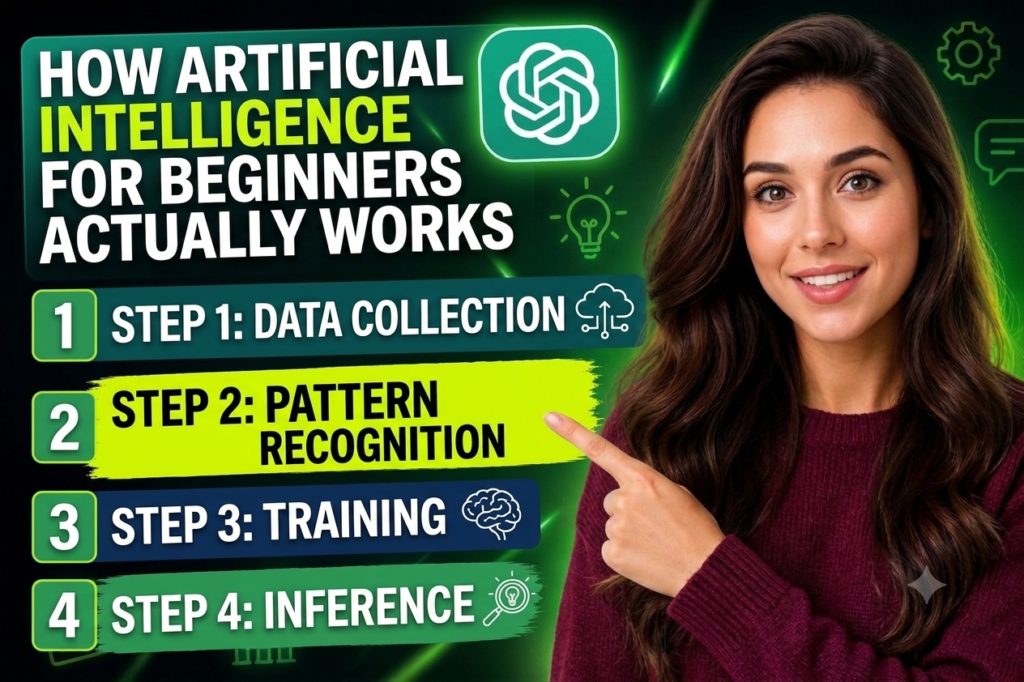
Every AI system follows the same four-step process regardless of how complex the application appears.
Step 1: Data Collection
Artificial intelligence for beginners: systems learn from data. Enormous amounts of it.
Text, images, videos, user behaviour, transaction records — all of this is the raw material AI systems consume and learn from. The more high-quality data an AI system has access to the better it performs. This is why the most capable AI tools today were trained on essentially the entire internet.
Step 2: Pattern Recognition
Once an artificial intelligence system has data, it starts finding patterns.
Patterns in language. Patterns in images. Patterns in human behaviour. Patterns in relationships between different pieces of information. This pattern recognition at a massive scale is the engine powering everything you experience when you use AI tools today.
Step 3: Training
Training is how artificial intelligence systems improve. The system makes predictions, those predictions are compared against correct answers, errors are measured, and the system adjusts itself to reduce those errors.
This process repeats billions of times until the system reaches high accuracy. Training the most capable AI models today took years and enormous computing resources, which is why only a small number of companies have been able to build them.
Step 4: Inference
Inference is what happens when you actually use an artificial intelligence tool. You give it an input, a question, a command, or an image, and it uses everything learned during training to generate a useful output.
When you type a question into Claude or ChatGPT and receive an intelligent response, an inference is happening in real time. The calculations happening behind the scenes are enormous, but the experience for you is almost instant.
Types of Artificial Intelligence for Beginners
Artificial intelligence understanding requires knowing that not all AI is the same.
Narrow AI
Narrow AI is what artificial intelligence encounters in every practical tool available today.
These systems do one specific thing extremely well. Voice assistants like Siri and Alexa. Recommendation engines powering Netflix and YouTube. Spam filters in your email. The autocorrect on your phone. Each is extraordinarily capable within its specific domain.
The AI tools you will use most — Claude by Anthropic, ChatGPT by OpenAI, and Google Gemini — are sophisticated examples of narrow AI. Remarkably capable across a wide range of language tasks but still focused on language rather than all possible domains.
General AI
General AI refers to a hypothetical system that could perform any intellectual task a human can do. A true General AI would learn anything, reason across completely different domains, and apply knowledge from one field to solve problems in another.
For artificial intelligence, it is important to know that General AI does not yet exist. The most impressive AI tools today are still narrow AI systems. What makes them feel so capable is the breadth of their training rather than genuine general intelligence.
Super AI
Super AI is a theoretical concept describing a system that surpasses human intelligence in every domain. It does not exist and remains a topic of ongoing debate among researchers. For artificial intelligence for beginners, this is an interesting context, but not practically relevant to how you use AI tools today.
Real World Examples of Artificial Intelligence for Beginners
The best way to make artificial intelligence for beginners understand concrete is through real-world examples across different industries.
Healthcare: Hospitals use AI to analyse medical scans and identify early signs of cancer and heart disease with accuracy that sometimes exceeds that of experienced radiologists. AI predicts which patients are at the highest risk of complications, helping doctors intervene earlier.
Education: Personalised learning platforms use artificial intelligence for beginners and advanced learners alike to assess individual strengths and weaknesses and adjust the curriculum accordingly. AI tutors provide instant feedback and answer questions around the clock.
Business: Companies use AI to automate customer service, analyse sales data, forecast demand, generate marketing content, and build products faster. The businesses adopting artificial intelligence for beginner tools most effectively are seeing productivity improvements across every department.
Creative Work: Writers use AI writing assistants to draft content faster. Designers use AI image generators to create visual concepts in minutes. Musicians use AI composition tools to explore new creative directions. AI is a creative collaborator not a creative replacement.
Everyday Technology: Every time you unlock your phone with your face, receive a fraud alert from your bank, get a product recommendation online, or see a suggested email reply — that is artificial intelligence for beginners and experts alike working in the background of daily digital life.
Benefits of Artificial Intelligence for Beginners
Understanding artificial intelligence for beginners benefits shows you exactly where to apply it first.
Saves enormous time: Tasks that take hours manually often take minutes with AI assistance. Writing, research, data analysis, documentation, and communication all become dramatically faster for anyone using artificial intelligence for beginner’s tools consistently.
Improves quality: AI systems do not get tired, distracted, or rushed. The quality of AI-assisted work is consistent in a way that purely manual work rarely is.
Available around the clock: Artificial intelligence for beginners tools are available twenty-four hours a day, seven days a week. Your AI assistant never takes a day off.
Completely accessible: The most powerful AI tools in the world are available free or at very low cost to anyone with an internet connection. Claude, ChatGPT, and Google Gemini all have free plans that are genuinely useful for everyday tasks.
Levels the playing field: A solo professional using artificial intelligence for beginner tools can now produce the output quality and quantity of a much larger team. This democratisation of capability is one of the most significant things happening in technology right now.
Limitations of Artificial Intelligence for Beginners
A complete understanding of artificial intelligence for beginners requires honestly acknowledging what AI cannot do.
AI can be wrong: AI systems sometimes generate incorrect information confidently. This is called hallucination. Always verify important facts rather than accepting AI outputs without question.
AI lacks genuine understanding: Despite how sophisticated responses can seem, artificial intelligence for beginners tools do not truly understand information the way humans do. They produce outputs that pattern-match to what a correct response should look like.
AI reflects its training data: If an AI system was trained on biased data it will reproduce those biases. This is an active area of improvement across the industry.
AI requires clear instructions: The quality of artificial intelligence for beginners’ output is directly proportional to the quality of instructions provided. Vague inputs produce vague outputs. This is exactly why learning prompt engineering matters so much. Read our complete Prompt Engineering Guide to master this essential skill.
Artificial Intelligence for Beginners: Your Career Opportunity
Here is the honest truth about why artificial intelligence for beginners career knowledge matters so much right now.
We are not approaching an AI revolution. We are already inside one.
Roles that mention AI skills pay approximately 28% more than equivalent roles without AI skills. Job postings requiring AI knowledge have grown from almost nothing in 2021 to tens of thousands in 2026. Companies are restructuring entire departments around AI capabilities.
Understanding artificial intelligence for beginners is no longer optional for anyone who wants to remain relevant and competitive professionally. It is the foundational digital literacy of this era, as essential as knowing how to use a computer was in the 1990s.
The professionals seeing the best results are those who combine existing domain expertise with practical AI skills.
A writer who understands artificial intelligence for beginners produces ten times more content at a higher quality. A marketer who understands AI builds campaigns that optimise automatically. A tester who understands AI builds systems that generate test cases and document findings without manual effort.
Read our complete guide on How to Become an AI Engineer to see the full career pathway that opens up once you understand AI fundamentals.
How to Start Learning Artificial Intelligence for Beginners Today
Artificial intelligence for beginners learning follows a clear progression. Here is exactly what to do in order.
Stage 1: Start using AI tools today. Do not wait until you feel ready. Open Claude right now for free and give it a real task. Write an email with it. Research a topic with it. Ask it to explain something you do not understand. Daily hands-on use with real tasks is the fastest way to develop genuine AI fluency.
Stage 2: Learn Generative AI. Generative AI is the specific type of artificial intelligence that beginners to understand first because it powers the tools you will use most. Read our Generative AI Beginner Guide to understand this next layer deeply.
Stage 3: Master Prompt Engineering. The skill of communicating with AI effectively separates people who get mediocre results from people who get extraordinary results. Our Prompt Engineering Guide teaches everything from basic prompts to advanced techniques used by professionals.
Stage 4: Understand AI Agents AI agents are the cutting edge of what artificial intelligence for beginners can progress toward. Agents take actions autonomously, complete multi-step tasks, and run continuously. Read our guide on What Are AI Agents? Complete Beginner Guide 2026 to understand this powerful next step.
Stage 5: Start Earning With AI Once you understand and can use artificial intelligence for beginner tools effectively, there are multiple realistic income streams available right now. Our guide on Claude AI to Earn Money Guide: 4 Proven Ways That Actually Work covers every option with honest timelines and real income expectations.
Frequently Asked Questions About Artificial Intelligence for Beginners
What is artificial intelligence for beginners in the simplest terms?
Artificial intelligence for beginners is technology that allows machines to learn from data and perform tasks that normally require human intelligence — understanding language, recognising images, making recommendations, and generating responses. When you talk to Claude or ChatGPT and receive an intelligent answer, that is artificial intelligence for beginners in action.
Do I need a technical background to use artificial intelligence for beginner tools?
Not at all. The most powerful artificial intelligence for beginners tools available today are designed for anyone who can type a clear question. Technical skills become relevant when you want to build with AI but using AI tools effectively requires communication skills not coding skills.
What is the best free artificial intelligence for beginners tool to start with?
Start with Claude by Anthropic. It is completely free to use, handles a wide range of tasks exceptionally well, and produces natural, high-quality responses that feel genuinely helpful. Google Gemini is also excellent and integrates with Google Workspace tools that many people already use daily.
How long does it take to learn artificial intelligence for beginners?
You can start getting genuinely useful results from artificial intelligence for beginners tools within your first hour of use. Basic proficiency, where you feel comfortable using AI for everyday tasks, typically comes within one to two weeks of daily use. Professional-level AI skills that support career advancement usually develop within one to three months of consistent learning and practice.
Can artificial intelligence for beginners help me earn money?
Absolutely. Artificial intelligence for beginners who progress to consistent daily use can offer AI content writing, prompt engineering services, AI automation for businesses, and AI-assisted design services. Real income is possible within the first month for those who commit to learning and applying these skills consistently. Read our complete guide, AI Agents: How to Earn Money While You Sleep with Automation- 3 Proven Ways for detailed breakdowns of every realistic income stream.
Conclusion: Your Artificial Intelligence for Beginners Journey Starts Now
Artificial intelligence for beginners is not complicated when explained the right way.
You now understand what artificial intelligence for beginners actually is, how it works in four clear steps, what types exist, where it is used in the real world, what its genuine benefits and honest limitations are, and exactly how to start building a career with it today.
Three years ago, as a techie and AI enthusiast, I started where you are right now. Curious but uncertain. Interested but unsure where to begin.
The best advice I can give any artificial intelligence for beginners learner is simply this — start today with a real task, not a tutorial. Open Claude and give it something you actually need done. That first genuine interaction is where artificial intelligence for beginners’ understanding transforms from knowledge into capability.
Your artificial intelligence for beginners journey starts with one message. Go send it.
Explore everything at AI Pathway Lab — your complete resource for artificial intelligence for beginners, AI tools, and career guidance.
Explore AI Pathway Lab Articles
- Blog
- 5 AI tools to save time and earn money
- 5 AI Workflow Tools That Will Transform How You Work
- AI Tools
Written by AI Pathway Lab — practical guides for beginners building real AI skills and real careers.
Explore everything at aipathwaylab.com