Table of Contents
Traditional software runs on rules someone wrote down: if an email contains the phrase “win money,” mark it as spam. A machine learning system does not work that way. Instead of following a fixed rule, it learns from thousands of real spam examples and predicts whether a new email looks like the ones it has seen before. That shift, from fixed logic to learned patterns, is exactly why Machine Learning Models AI Testing looks so different from testing a normal application, and it is why testers who understand both worlds are becoming genuinely valuable as AI shows up in more business systems.
This guide covers what a machine learning model actually is, how one gets built and deployed, the different types of models you are likely to encounter, and a full breakdown of Machine Learning Models AI Testing itself: what to check, which metrics actually matter, and how a tester’s existing skills carry over into this newer territory.
If you want to learn basics What Is a Machine Learning Model? How AI Models Learn From Data
What Is a Machine Learning Model?
A machine learning model is an algorithm trained on data to identify patterns and make predictions. Instead of a developer writing explicit rules for every situation, the model is shown a large number of examples and learns the underlying pattern connecting the inputs to the correct outputs on its own. Understanding this distinction is the foundation everything else in Machine Learning Models AI Testing builds on.
A few common examples make this concrete, and each one shows up repeatedly once you start doing Machine Learning Models AI Testing in a real job:
| Model | Used for |
|---|---|
| Spam detection model | Filtering unwanted email |
| Recommendation model | Suggestions on Netflix or YouTube |
| Fraud detection model | Flagging suspicious banking transactions |
| Image recognition model | Detecting faces or objects in photos |
| Chatbot model | Powering AI assistants |
How Machine Learning Models Actually Work
Every model, regardless of what it is used for, moves through roughly the same lifecycle before it ever reaches a real user, and knowing this lifecycle well is essential background for effective Machine Learning Models AI Testing.
ml_model_lifecycle – shows the flow from data collection, through data preparation, model training, model validation, model deployment, to ongoing model monitoring)
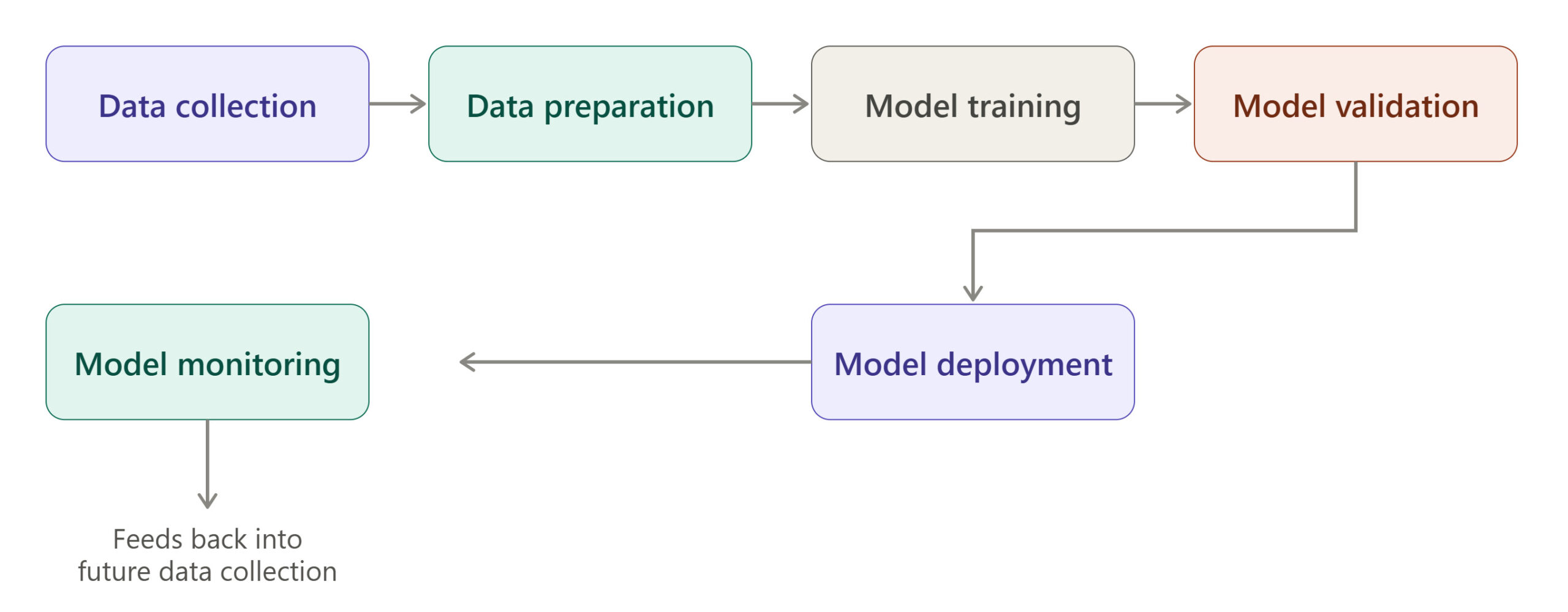
Data Collection is exactly what it sounds like: gathering the raw examples the model will learn from. The quality and quantity of this data have a significant impact on how well the model performs.
Data Preparation cleans and organizes the collected data before it is used for training. This includes handling missing values, removing duplicate records, correcting inconsistencies, and converting the data into a format the model can understand.
Model Training is where the learning happens. During this stage, the machine learning model repeatedly analyzes the training data and adjusts its internal parameters to make predictions that are as close as possible to the correct answers.
Model Validation evaluates how well the trained model performs using data it has never seen before. This is a critical step because it shows whether the model has genuinely learned useful patterns or has simply memorized the training data, a problem known as overfitting.
Model Deployment is the process of moving the validated model into a production environment, where it begins making real-world predictions and supporting business applications.
Model Monitoring continues long after deployment. As new data becomes available, the model’s performance can change over time due to data drift or changing user behavior. Continuous monitoring helps identify these issues early, ensuring the model remains accurate, reliable, and trustworthy. This is where Machine Learning Models AI Testing provides ongoing value, helping organizations detect performance degradation and maintain high-quality AI systems throughout their lifecycle.
Types of Machine Learning Models
Supervised Learning
A supervised model learns from labeled data, meaning every training example already comes with the correct answer attached. Classification and regression are the two most common types, covering tasks like sorting customers into categories or predicting a numeric value like a price. This is usually the easiest category to start Machine Learning Models AI Testing on, since the correct answer is already known for every training example.
Testing questions here look like: does the model correctly classify customers into the right segment? Are the predictions actually accurate when checked against real outcomes?
Unsupervised Learning
An unsupervised model works with unlabeled data and looks for hidden structure on its own, rather than being told the correct answer in advance. Customer segmentation and anomaly detection are common applications, and both require a more judgment based approach to Machine Learning Models AI Testing than supervised models do.
Testing questions shift here: are the clusters the model found actually meaningful to a human reviewing them, or just statistical noise? Are the anomalies it flags genuinely unusual, or is it flagging normal variation as suspicious?
Reinforcement Learning
A reinforcement learning model learns through trial and error, receiving rewards or penalties based on the outcomes of its actions. Robotics and game playing AI are the classic examples, and Machine Learning Models AI Testing for this category focuses heavily on safety since the model is actively taking actions rather than just returning a static prediction.
Testing questions here focus on safety and improvement over time: does the model make safe decisions even in situations it was not explicitly trained on? Does its performance actually improve with more experience, or does it plateau or regress?
Machine Learning Models AI Testing Explained
This is where a tester’s existing instincts have to adapt. Traditional software testing works on a simple formula: input plus expected result equals pass or fail. Machine Learning Models AI Testing works differently: input plus model prediction plus accuracy metrics equals an evaluation, not a binary pass or fail.
The reason for this difference is that AI does not always produce the same deterministic output. Two nearly identical inputs might get slightly different predictions, and a model can be “working correctly” while still being wrong on any individual case. The question shifts from “did this match the expected output exactly” to “is this model accurate and fair often enough, across enough cases, to trust in production.”
Types of Machine Learning Models AI Testing
Data Testing
Since a model is only as good as what it learned from, checking the training data itself is a real form of Machine Learning Models AI Testing. This means looking at data quality, missing values, duplicate records, and bias in how the dataset was assembled.
A loan approval model trained mostly on applicants from one demographic group is a good cautionary example. Even if the model performs well on paper, it may produce unfair results for groups underrepresented in its training data, a problem that data testing is specifically meant to catch before it reaches production.
Model Accuracy Testing
A handful of standard metrics cover most of what matters in this part of Machine Learning Models AI Testing. Accuracy measures how many predictions overall are correct. Precision measures how many of the positive predictions the model made were actually correct. Recall measures how many of the actual positive cases the model successfully caught. F1 score balances precision and recall into a single number, useful when neither metric alone tells the full story.
Which metric matters most depends heavily on the use case. A fraud detection model that misses real fraud (low recall) is often more dangerous than one that occasionally flags a legitimate transaction (lower precision), so the right balance is a business decision as much as a technical one.
Performance Testing
Beyond accuracy, a model needs to actually perform well under real conditions as part of thorough Machine Learning Models AI Testing: response time, scalability, handling large volumes of data, and behaving correctly under concurrent load. A chatbot that responds in two seconds during a controlled test but takes twenty seconds once ten thousand real users hit it at once has a performance problem no accuracy metric would have caught.
Bias and Fairness Testing
This asks a different kind of question than accuracy testing, but it is just as central to real Machine Learning Models AI Testing: does the model treat different groups differently in ways that are not justified by the actual task? Does the training data itself encode unfair patterns that the model then learns and repeats? A model can score well on standard accuracy metrics while still failing this kind of test badly.
Security Testing for AI Models
AI systems introduce attack surfaces that do not exist in traditional software, which makes security a real part of Machine Learning Models AI Testing rather than an afterthought. Data poisoning, where an attacker deliberately corrupts training data to manipulate future predictions, is one example specific to machine learning. Prompt injection, unauthorized data exposure through a model’s outputs, and direct attacks on the model itself are all worth testing for, particularly as more AI systems get exposed through public facing interfaces. This overview of the challenges and risks of AI covers several of these security concerns in more depth from a broader perspective.
Traditional Testing vs. Machine Learning Models AI Testing
| Traditional testing | AI testing |
|---|---|
| Rules are predefined | Model learns patterns |
| Expected output is known | Output can vary |
| Defects live in code | Defects can live in data or the model itself |
| Functional testing | Accuracy and fairness testing |
| Built from test cases | Built from test datasets |
Tools Worth Knowing for Machine Learning Models AI Testing
Great Expectations is a widely used open source framework for data validation, letting a team define explicit expectations about what clean data should look like and automatically check incoming data against them. MLflow handles model tracking, logging experiments, versions, and evaluation results so a team can compare model performance over time rather than losing track of what changed between versions. Evidently AI focuses on model monitoring in production, watching for data drift and performance degradation after a model has already been deployed. TensorFlow, better known as a model development framework, also includes testing and evaluation utilities that fit naturally into this same workflow.
Real-World Example: Machine Learning Models AI Testing for Fraud Detection
A bank using AI to detect fraudulent transactions is a good scenario to walk through end to end, since it touches nearly every testing type covered above.
The model takes in transaction amount, location, and patterns of user behavior as input. Testing that model well as part of thorough Machine Learning Models AI Testing means validating several things at once: whether it correctly catches genuinely fraudulent transactions, how often it produces false positives that inconvenience legitimate customers, whether it responds fast enough to not delay a real transaction, whether it treats different customer groups fairly, and whether the system around it is secure against manipulation.
None of these checks alone is sufficient. A model with perfect fraud detection but a flood of false positives would frustrate every legitimate customer. A fast, accurate model with a security hole is a liability waiting to happen. Machine Learning Models AI Testing done properly means covering all of these angles together, not picking one and calling it done.
How Testers Can Move Into Machine Learning Models AI Testing
The path into Machine Learning Models AI Testing builds directly on skills that most software testers already have rather than requiring a complete career restart.
Software testing fundamentals remain the foundation. A working understanding of data—being comfortable with how datasets are structured and where quality issues tend to hide—comes next.
Basic Python is worth learning, since most machine learning tools assume at least some familiarity with it. Core machine learning concepts, like the ones covered in this guide, complete the technical foundation.
API testing and automation testing skills, which many testers already possess, transfer almost directly because much of AI model testing is performed through APIs and automated evaluation pipelines.
Writing clear, specific prompts also matters more than many people expect, particularly when testing systems that respond to natural language input. A solid understanding of prompt engineering can significantly improve the quality and consistency of Machine Learning Models AI Testing.
A realistic progression looks something like this: manual tester, to automation tester, to AI tester, to AI quality engineer, with Machine Learning Models AI Testing skills layered in at each stage rather than picked up all at once. Each step builds on the last rather than requiring a clean break from testing experience already built up. Anyone looking to build the broader AI skill set alongside this specific testing path can find a useful starting point in this AI automation guide and this overview of AI based testing tools worth knowing generally.
The Future of Machine Learning Models AI Testing
A few trends are already reshaping what this role looks like. More applications are being built with AI components integrated from the start rather than added to existing systems later. As a result, Machine Learning Models AI Testing is becoming part of everyday QA work instead of a specialized discipline.
AI agents that perform multi-step tasks require a different type of validation than models that simply return a single prediction. Testers must evaluate an entire sequence of decisions rather than just one output.
Human-in-the-loop testing, where people review and correct AI decisions as part of the normal workflow, is also becoming a standard practice instead of an exception.
At the same time, AI governance—the policies and oversight that guide how AI systems are built, deployed, and monitored—is becoming increasingly important. Testers are playing a larger role because governance relies heavily on the same validation, evidence gathering, and quality assurance skills they already use.
This broader shift is covered in more depth in this overview of the future of AI, which explores Machine Learning Models AI Testing as one of fifteen major trends reshaping how AI is developed and used.
Explore related posts
- AI for Testers
- AI Agents
- Prompt Engineering for QA Agents – Best Practices Complete Guide-10x faster Work
- AI Workflows for QA Automation: How to Integrate
- Blog
- AI Test Case Generation Guide for QA Engineers Using ChatGPT and Claude
- 10 Best AI Based Testing Tools That Will Transform Your QA Career – Don’t Get Left Behind
- AI Tester Workflow That Makes You 10x Faster – Stop Manual
- Explore AI Learning Hub Subscribe to AI Pathway Lab for more AI guides and AI tutorials
Frequently Asked Questions
Do I need a data science background to do Machine Learning Models AI Testing?
No, a data science background helps but is not required. A tester who understands data quality, learns the key accuracy metrics, and picks up basic Python can move into this space using skills already built through traditional software testing.
What is the biggest difference between traditional software testing and Machine Learning Models AI Testing?
Traditional testing checks whether an output exactly matches an expected result. Machine Learning Models AI Testing evaluates accuracy, fairness, and performance across many cases, since AI outputs are not always deterministic the way traditional software output is.
Which accuracy metric matters most when doing Machine Learning Models AI Testing?
It depends on the use case. A fraud detection system generally prioritizes recall, catching as much real fraud as possible, while a system where false positives are especially costly might prioritize precision instead. There is rarely a single metric that fits every situation.
Can bias in a model be fully eliminated through Machine Learning Models AI Testing?
Testing can catch and reduce bias significantly, but it rarely eliminates it completely, since bias often originates in the training data itself rather than the model’s logic. Ongoing monitoring after deployment matters just as much as testing before launch.
What tools should a beginner start with for Machine Learning Models AI Testing?
Great Expectations is a solid starting point for data validation, since it is well documented and widely used. MLflow is worth learning next for tracking model versions and evaluation results as a project grows beyond a single experiment.