Table of Contents
Prompt Engineering for QA Agents- I have been in software testing for years, and I will be honest with you – there was a time when I thought AI in QA was just another buzzword that would fade out in six months.
Then I actually tried it.
I started experimenting with prompt engineering for QA agents’ testing tasks. Login flows. Regression cycles. API test cases. Edge case discovery. What happened next genuinely surprised me. Tasks that used to take me half a day were done in under an hour. Not because I worked harder. Because I learned how to communicate with AI properly.
That is what prompt engineering for QA testers actually is. Not a tool. Not a plugin. A skill. And in 2026, it is one of the most valuable skills a tester can have.
This Prompt engineering for QA agents guide covers everything — manual testing, AI-assisted testing, autonomous QA agents, prompt templates, workflow steps, and best practices. Whether you write manual test cases, build automation frameworks, work with APIs, or run end-to-end testing, there is something here for you.
Let us get into it.
What Is Prompt Engineering for QA Agents?
Prompt engineering for QA testers is the practice of writing structured, specific instructions that guide AI models to produce useful testing outputs — test cases, bug analyses, regression scripts, edge case lists, and more.
A prompt is simply what you type into an AI tool. But the difference between a vague prompt and a well-engineered one is enormous.
Vague prompt: “Write test cases for login.”
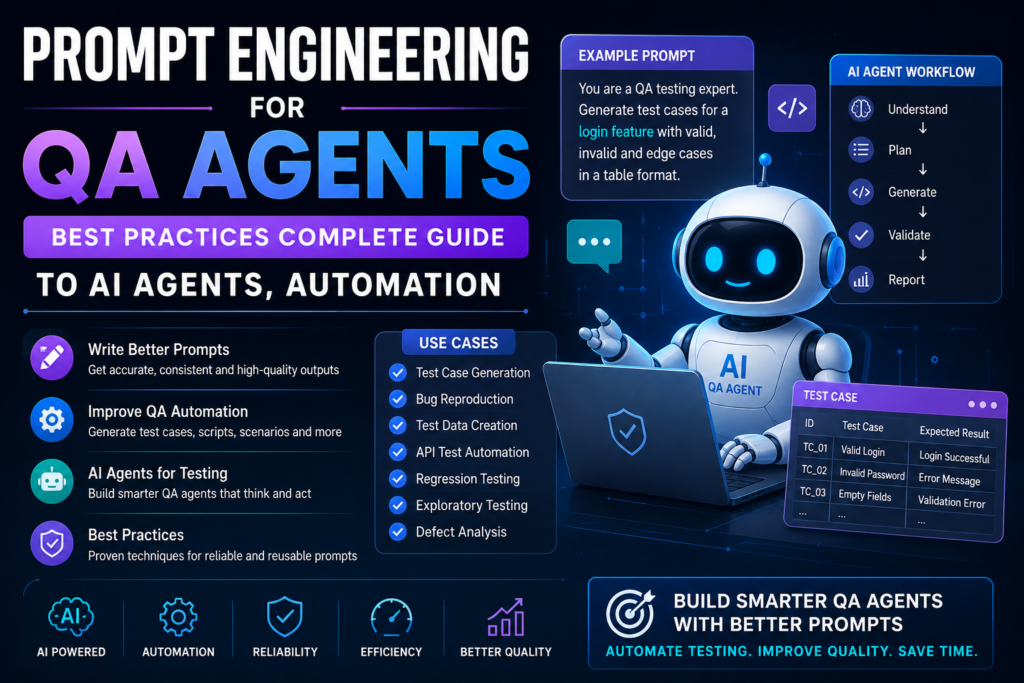
Engineered prompt: “Act as a senior QA engineer (your role). Write test cases for a login feature, including positive scenarios, negative scenarios, boundary conditions, and security edge cases. Format the output as a table with columns: Test Case ID, Description, Steps, Expected Result, Priority.”
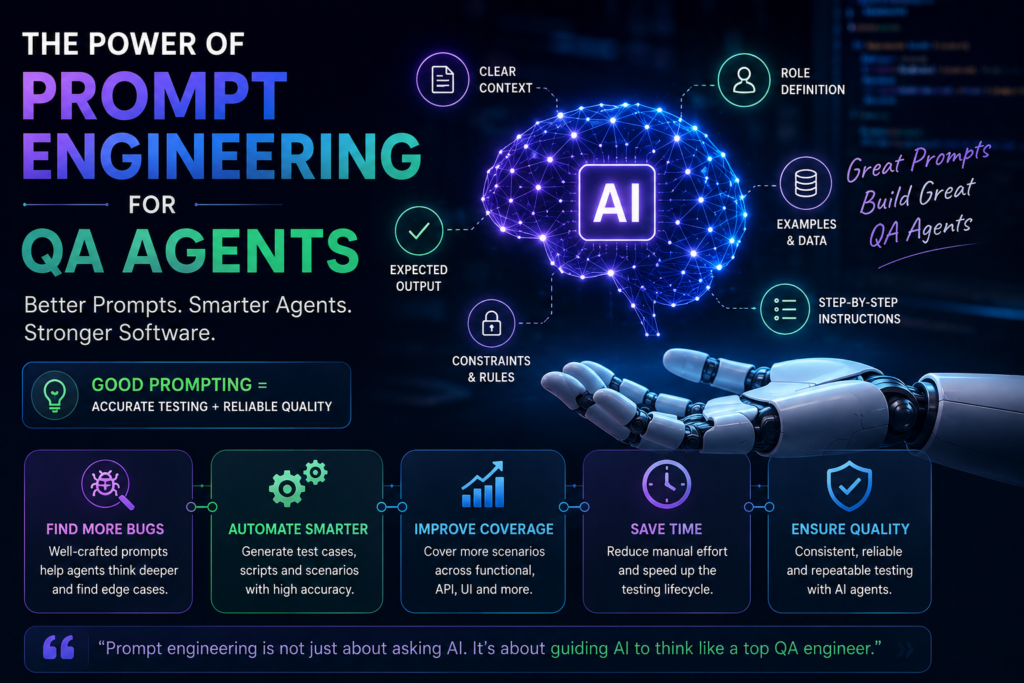
The second prompt gives the AI everything it needs — role, task, context, format, and scope. That is prompt engineering for QA agents in action.
The shift in QA testing right now looks like this: manual testing has moved to automation, and automation is now moving toward AI-assisted and fully autonomous testing. Prompt engineering for QA Agents and Testers is the bridge between where most testers are today and where the industry is heading.
Why QA Testers Need Prompt Engineering in 2026
AI is not replacing QA engineers. But it is absolutely replacing the repetitive parts of the job — and that changes everything about how testers need to work.
Here is what prompt engineering for QA agents makes possible right now:
Faster test case generation. Writing test cases manually for a complex feature can take hours. With a well-structured prompt, an AI agent produces a comprehensive test case set in minutes. I tried this on a payment flow with 12 user scenarios. The AI covered all 12 and found 3 edge cases I had missed.
Smarter bug detection. Prompt engineering for QA testers allows you to direct AI to analyse a feature description and identify failure points, race conditions, and security vulnerabilities before a single line of test code is written.
Regression testing at scale. Regression cycles that consumed entire sprints can now run with AI-generated test suites that cover existing functionality systematically. Prompt engineering for QA agents makes this structured and repeatable.
API testing efficiency. Instead of manually writing request/response validation scenarios, prompt engineering for QA testers lets you generate complete API test suites from endpoint documentation in minutes.
Cost and time reduction. Companies using AI-assisted QA workflows report significant reductions in testing cycle time. For individual testers, this means more capacity for strategic work — exploratory testing, test architecture, and quality advocacy.
The teams not investing in prompt engineering for QA agents today will feel that gap sharply within the next 12 months.
Manual Testing vs AI-Assisted Testing
Understanding where prompt engineering for QA testers fits means understanding the full picture of how testing has evolved.
Manual Testing
Manual testing is where most QA careers begin. A human tester reads requirements, writes test cases from experience and intuition, executes them by hand, and logs defects. It is thorough when done well. It is also time-consuming, inconsistent under pressure, and difficult to scale.
Manual testing still matters — especially for exploratory testing, usability evaluation, and complex user journey validation. Prompt engineering for QA testers does not eliminate manual testing. It eliminates the tedious parts of it.
AI-Assisted Testing
AI-assisted testing is where most forward-thinking QA teams are moving right now. A human tester uses prompt engineering for QA agents to generate test cases, identify edge cases, and structure regression suites — then reviews, refines, and executes with human judgment applied at the right moments.
This is faster than pure manual testing and smarter than pure automation. It combines AI speed with human insight.
The Hybrid Approach
This is the model I believe in most strongly after experimenting with it myself.
Human QA engineers handle strategy, exploratory testing, risk assessment, and validation. AI agents handle repetitive generation, coverage analysis, and structured test documentation. Prompt engineering for QA testers is the communication layer between the human and the agent.
The hybrid approach is not about replacing QA engineers. It is about making them significantly more effective. A tester who understands prompt engineering for QA agents can do the work of two or three testers working the old way — and do it with better coverage.
If you are a QA professional exploring this transition, the AI for Testers hub breaks down this journey step by step.
What Are AI QA Agents?
AI QA agents are autonomous or semi-autonomous AI systems that can perform testing tasks independently — receiving a prompt, reasoning through requirements, generating test cases, suggesting execution steps, and identifying failure points without constant human direction.
The difference between a basic AI chatbot and an AI QA agent is autonomy and context awareness. An AI QA agent does not just answer a question. It plans, reasons, and produces structured testing outputs that feed directly into your workflow.
Here is how prompt engineering for QA agents works in practice:
Input prompt: “Act as a QA agent. Analyse this login feature and generate a complete test suite covering functional, negative, boundary, and security scenarios.”
Reasoning: The AI agent processes the feature context, identifies testable conditions, applies QA logic, and structures the output.
Output: A complete test case table with IDs, descriptions, steps, expected results, and priority levels — ready to import into your test management tool.
Execution suggestions: The agent can also suggest test execution order, identify the highest-risk scenarios, and flag areas needing human exploratory testing.
This is prompt engineering for QA testers at its most powerful — turning a single structured instruction into a full testing deliverable. For a deeper dive into how AI agents work at a foundational level, the What Are AI Agents? Complete Beginner Guide 2026 is worth reading before you go further.
Prompt Engineering for QA Agents and Testers Workflow
This is the step-by-step workflow I use personally. It works for manual test generation, automation script creation, API testing, and end-to-end flows.
Step 1 — Define the requirement clearly. Before you write a single prompt, be clear on what you are testing. Feature name, user journey, system context, and known constraints. Vague requirements produce vague test cases even with the best prompt engineering for QA agents.
Step 2 — Write a structured prompt Use the role-task-context-format structure. Assign the AI a QA role, specify the task precisely, provide the feature context, and define the output format you need.
Step 3 — Ask for positive test cases first Start with the happy path. “Generate positive test cases for [feature] where all inputs are valid and the system behaves as expected.” Prompt engineering for QA testers works best when you build coverage layer by layer.
Step 4 — Ask for negative scenarios separately. “Now generate negative test cases for the same feature — invalid inputs, missing fields, incorrect formats, and unauthorised access attempts.” Separating positive and negative prompts produces more thorough coverage than asking for everything at once.
Step 5 — Ask for edge cases: “Identify boundary conditions and edge cases for this feature that are commonly missed in manual testing.” This is where prompt engineering for QA agents genuinely outperforms manual test case writing — AI finds boundaries systematically.
Step 6 — Ask for automation suggestions: “Which of these test cases are the highest priority for automation? Suggest a test execution order based on risk.”
Step 7 — Validate all outputs manually. Always review AI-generated test cases with your domain knowledge. Prompt engineering for QA testers produces speed; human judgement produces quality. You need both.
Best Prompt Engineering for QA Agents and Testers Practices
After months of experimenting with prompt engineering for QA agents across different project types, these are the practices that consistently produce the best results.
1. Be specific in your requirements. Every detail you provide improves the output. Feature name, user role, system type, technology stack — include what is relevant. Prompt engineering for QA Agents and testers rewards specificity every time.
2. Define input and output clearly. Tell the AI exactly what you are giving it and exactly what you want back. “Given this API endpoint documentation, generate test cases in JSON format with request, expected response, and validation criteria.”
3. Ask for edge cases in a separate prompt. Edge cases need focused attention. A dedicated edge case prompt in your prompt engineering for QA agents workflow consistently surfaces scenarios that combined prompts miss.
4. Request structured formats: Tables, JSON, numbered lists, markdown — specify the format. Prompt engineering for QA testers that outputs structured data integrates directly into tools like Jira, TestRail, and Azure DevOps without reformatting.
5. Break complex features into steps Do not try to generate test cases for an entire e-commerce checkout flow in one prompt. Break it into login, cart, payment, confirmation, and error handling. Prompt engineering for QA agents works better with focused scope.
6. Use role-based prompts consistently. Starting every prompt with “Act as a senior QA engineer with expertise in [domain]” activates deeper QA-specific reasoning in the AI. This single habit improves prompt engineering for QA testers output quality noticeably.
7. Always validate AI output with human review Prompt engineering for QA agents is a force multiplier — not an autonomous replacement for QA expertise. Review every output. Add domain-specific scenarios the AI missed. Apply your understanding of the system under test.
Prompt Templates for QA Agents and Testing
These are ready-to-use templates. Copy, customise, and use them directly with Claude, ChatGPT, or GitHub Copilot.
Test Case Generation Prompt Act as a senior QA engineer. Generate test cases for [feature name] in a [web/mobile/API] application. Include positive scenarios, negative scenarios, boundary conditions, and edge cases. Format as a table with columns: Test Case ID, Test Description, Preconditions, Test Steps, Expected Result, Priority (High/Medium/Low).
Bug Detection Prompt Act as a QA tester with expertise in [application type]. Analyse this feature description: [paste feature]. Identify potential bugs, failure points, edge cases, and security vulnerabilities. Group findings by severity: Critical, Major, Minor.
Regression Testing Prompt Act as a QA engineer. Generate regression test cases for [feature update] to ensure existing functionality is not broken. Focus on: core user journeys, integration points, and previously reported defect areas. Format as a numbered test checklist.
API Testing Prompt Act as an API QA engineer. Given this endpoint: [paste endpoint details], generate test cases covering: successful requests, error responses, authentication failures, rate limiting, invalid parameters, and boundary values. Format as a table with request details and expected responses.
End-to-End Testing Prompt Act as a QA automation engineer. Create an end-to-end test scenario for [user journey — e.g. new user registration through first purchase]. Include all steps, validation checkpoints, data requirements, and potential failure points across the full flow.
Automation Script Prompt Act as a QA automation engineer using [Selenium/Playwright/Cypress]. Write a test script for [test case description]. Include setup, test steps, assertions, and teardown. Add inline comments explaining each section.
For more structured workflow templates, the AI Tester Workflow That Makes You 10x Faster – Stop Manual guide covers how to connect these prompts into complete testing pipelines.
AI Tools for QA Testers in 2026
Prompt engineering for QA agents works across multiple tools. Here are the ones worth knowing:
Claude by Anthropic — exceptional for long document analysis, structured test case generation, and complex reasoning tasks. Handles large feature specifications and requirement documents better than most models. Prompt engineering for QA testers who work with detailed documentation gets strong results here.
ChatGPT by OpenAI — strong for creative test scenario generation and conversational iteration. Good for exploratory prompt engineering for QA agents when you are refining test coverage through back-and-forth dialogue.
GitHub Copilot — directly integrated into VS Code and JetBrains. Ideal for automation engineers using prompt engineering for QA testers within the code editor itself. Generates test scripts, suggests assertions, and completes automation code in real time.
Testim — AI-powered test automation platform that uses machine learning to create and maintain stable automated tests. Reduces test flakiness significantly.
Mabl — intelligent test automation with built-in AI that auto-heals tests when UI changes occur. Strong for teams running continuous testing in CI/CD pipelines.
Applitools — visual AI testing platform that detects UI regressions across browsers and devices automatically. Prompt engineering for QA agents pairs well with Applitools for visual test coverage.
Selenium with AI extensions — the classic automation framework now enhanced by AI tools that generate selectors, suggest test improvements, and identify flaky tests.
Real-World Example of AI QA Workflow
Here is a real scenario I worked through using prompt engineering for QA agents — an e-commerce checkout flow.
The feature: A checkout page with product selection, address entry, payment processing, and order confirmation.
Step 1 — Positive test cases prompt: “Act as a senior QA engineer. Generate positive test cases for an e-commerce checkout flow covering product selection, address entry, payment with valid card, and order confirmation. Table format with ID, description, steps, expected result.”
Result: 14 positive test cases generated in under 60 seconds covering the core happy path completely.
Step 2 — Negative scenarios prompt: “Now generate negative test cases for the same checkout flow — invalid card details, expired cards, incorrect address formats, empty required fields, and session timeout during payment.”
Result: 11 negative test cases including 2 scenarios I had not initially considered — concurrent session handling and payment gateway timeout recovery.
Step 3 — Edge cases prompt: “Identify edge cases and boundary conditions for this checkout flow that are commonly missed — focus on payment amount boundaries, special characters in address fields, and international address formats.”
Result: 8 edge cases surfaced, including unicode characters in name fields and maximum cart value limits.
Step 4 — Automation priority prompt: “Which of these test cases have highest automation ROI? Rank by regression value and execution frequency.”
Result: A prioritised automation list with the top 8 candidates for immediate scripting.
Total time for this entire workflow using prompt engineering for QA agents: 25 minutes. Manual equivalent: 3 to 4 hours.
Common Mistakes in Prompt Engineering for QA
Even experienced testers make these mistakes when starting with prompt engineering for QA agents.
Writing vague prompts. “Test this feature” tells the AI nothing useful. Every prompt needs role, task, context, and format to produce quality output from prompt engineering for QA testers.
Providing no feature context. The AI cannot generate meaningful test cases for a system it knows nothing about. Paste the requirement, user story, or feature description into every prompt.
Not validating AI output. Prompt engineering for QA agents produces fast results — not always perfect ones. AI can miss domain-specific business rules and system-specific constraints that only a human tester knows.
Asking for everything in one prompt. Positive cases, negative cases, edge cases, automation scripts, and priority ranking in a single prompt produces mediocre results across all of them. Prompt engineering for QA testers works better one layer at a time.
Over-relying on AI for exploratory testing. Exploratory testing requires human intuition, domain knowledge, and creative thinking. Prompt engineering for QA agents excels at structured, systematic coverage — not at the unexpected discoveries that come from human exploration.
Ignoring output format. Unstructured AI output is hard to use. Always specify whether you need a table, JSON, numbered list, or markdown in your prompt engineering for QA testers workflow.
Future of QA Testing with AI Agents
The direction is clear. Prompt engineering for QA agents today is laying the foundation for what becomes standard QA practice within 2 to 3 years.
Autonomous testing systems are already emerging — platforms where AI agents write tests, execute them, analyse results, and file defect reports with minimal human instruction. The testers who understand prompt engineering for QA agents now will be the ones directing these systems in the near future.
Repetitive QA tasks — basic test case writing, regression script maintenance, standard API validation — are increasingly handled by AI. The human QA role is shifting toward strategy, architecture, risk assessment, and validation of AI outputs.
AI-first QA pipelines are being built right now at forward-thinking companies. These pipelines use prompt engineering for QA agents at every stage — from requirement analysis through test generation, execution, and defect triage.
The testers who thrive in this environment will not be the ones who know the most tools. They will be the ones who know how to direct AI agents effectively — which means mastering prompt engineering for QA testers is not optional anymore.
For a broader view of how AI agents are reshaping work across industries, the What Are AI Agents Complete Guide gives strong context.
FAQ – Prompt Engineering for QA Agents
Q1: What is prompt engineering for QA Agents? Prompt engineering for QA testers is the skill of writing structured, specific instructions that guide AI tools to generate test cases, identify bugs, build regression suites, and support QA workflows. It requires no coding knowledge and is learnable by any tester willing to practise.
Q2: How do AI agents help in QA testing? AI QA agents take a structured prompt as input, reason through testing requirements, and produce test cases, edge case lists, automation suggestions, and defect analyses as output. They work fastest on structured, well-defined testing tasks and pair best with human review and exploratory testing.
Q3: Can AI replace manual testing completely? Not completely — and not any time soon. AI handles repetitive, structured test generation very well. But exploratory testing, usability evaluation, and complex user journey assessment still require human judgment. The hybrid approach — human strategy plus AI execution — is the most effective model in 2026.
Q4: What are the best AI tools for QA engineers? Claude, ChatGPT, and GitHub Copilot are the most versatile for general prompt engineering for QA agents work. For specialised testing, Testim and Mabl handle automated test maintenance, Applitools covers visual testing, and Selenium with AI extensions supports automation framework work.
Q5: Is prompt engineering useful for automation engineers specifically? Absolutely. Automation engineers use prompt engineering for QA agents to generate test scripts, suggest selector strategies, write assertion logic, and identify automation candidates from manual test suites. GitHub Copilot integrated into the code editor makes this workflow seamless.
What to Read Next
If this guide has been useful, these resources go deeper into the skills and tools covered here:
- AI Workflows for QA Automation: How to Integrate — the complete AI QA flow framework explained stage by stage
- AI Workflows for QA Automation — how to integrate AI into your existing QA pipeline
- What Are AI Agents? Complete Beginner Guide 2026 — a foundational guide to understanding the agents you are prompting
- AI Automation and Workflows — connecting testing prompts into full automation pipelines
- How to Become an AI Engineer — the career path from QA tester to AI Engineer
Final Thought
I started this journey as a tester who was curious about AI. What I found was not just a faster way to write test cases. I found a completely different way of thinking about quality assurance — one where human expertise and AI capability work together rather than compete.
Prompt engineering for QA agents is not complicated. It is a communication skill built on clarity, structure, and practice. Every tester already has the foundational thinking — systematic, detail-oriented, focused on coverage and edge cases. That thinking translates directly into effective prompting.
Start with one feature you are testing this week. Write a structured prompt using the templates in this guide. See what the AI produces. Refine it. Validate it. Add what it missed.
That single practice session will show you more about prompt engineering for QA testers than any amount of reading.
Explore more AI testing resources and career guides at AI Pathway Lab — practical AI education for testers, developers, and professionals building skills for 2026 and beyond.