Table of Contents
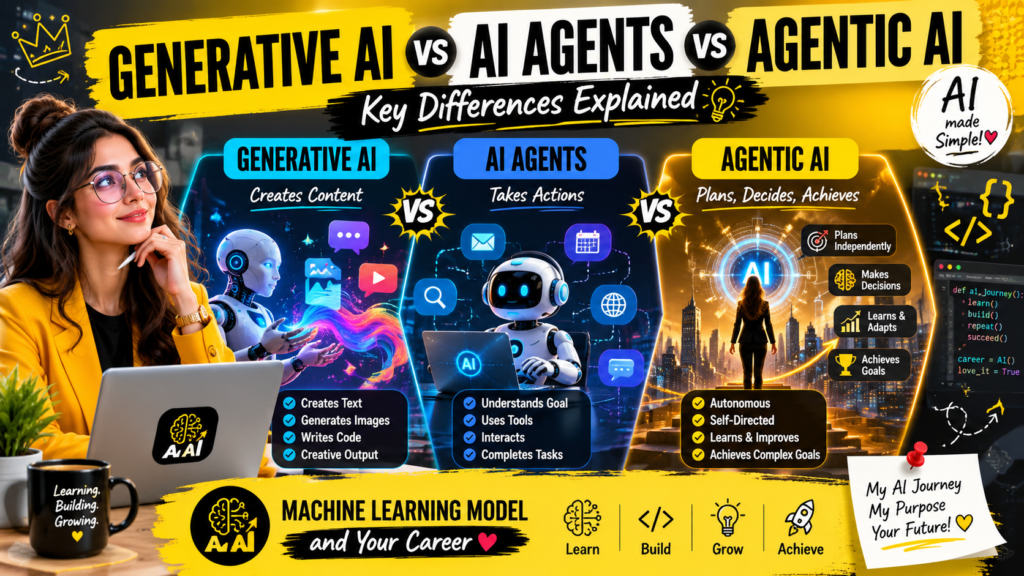
Understanding generative AI vs AI agents vs agentic AI is one of the most valuable things any AI learner can do right now.
These three terms get used interchangeably in conversations, articles, and job descriptions. But they are not the same thing. They represent three distinct levels of AI capability, and confusing them leads to misunderstandings about what AI can actually do, which tools to use, and which skills are worth learning.
The difference between generative AI vs AI agents vs agentic AI is not just technical. It is practical. Understanding it tells you what to expect from each type of system, how to use each one effectively, and where the future of AI is heading.
This guide breaks down all three clearly, with real examples, honest comparisons, and practical guidance on when each one matters. By the end, you will understand generative AI vs AI agents vs agentic AI completely and know exactly how to apply that understanding to your work and learning.
Read our complete guide on Generative AI for Beginners before diving deeper into the generative AI vs AI agents vs agentic AI comparison if you want foundational context first.
Why Understanding Generative AI vs AI Agents vs Agentic AI Matters
Before getting into definitions, it helps to understand why the generative AI vs AI agents vs agentic AI distinction matters so much right now.
In 2026, the AI landscape is evolving faster than most people can track. New tools launch weekly. Job descriptions mention these terms constantly. Businesses are investing in all three types of systems simultaneously.
Professionals who understand generative AI vs AI agents vs agentic AI clearly can make better decisions about which tools to use, which skills to develop, and which opportunities to pursue. Professionals who confuse these terms waste time learning the wrong things and building the wrong systems.
The generative AI vs AI agents vs agentic AI distinction also matters for career positioning. These three types of AI require different skills to build, different knowledge to use effectively, and different roles to work with professionally. Knowing which is which helps you target your learning and your career development with precision.
What Is Generative AI?
The starting point for understanding generative AI vs AI agents vs agentic AI is a clear definition of the first term.
Generative AI is artificial intelligence that creates new content based on patterns learned from existing data. Give it an input, and it generates an output. That output can be text, images, code, audio, or video, depending on what the system was trained to produce.
When you type a question into Claude and receive a detailed written answer, that is generative AI. When you describe an image to Midjourney, and it creates the visual, that is generative AI. When Google Gemini summarises your emails, that is generative AI.
At the heart of most generative AI systems is a Large Language Model, commonly called an LLM. The LLM is trained on enormous amounts of data — text from websites, books, articles, and code — and it learns the patterns in that data well enough to generate new content that feels natural and intelligent.
Here is the critical limitation that the generative AI vs AI agents vs agentic AI comparison reveals about this first category. Generative AI with only an LLM has a knowledge cutoff. It knows everything up to the date its training data ends. Ask it about something that happened after that date and it either cannot answer or makes something up.
A real-world example makes this concrete. Imagine you are planning a trip from Chicago to Vancouver. You ask a generative AI system what flights are available tomorrow. A pure generative AI with no additional tools cannot answer this accurately because it has no access to live flight data. It can tell you about airlines that fly that route based on its training data but it cannot tell you actual prices, seat availability, or schedule changes from today.
This limitation is exactly what distinguishes generative AI from the next level in the generative AI vs AI agents vs agentic AI progression.
Read our complete Machine Learning Model guide to understand the technical foundation powering generative AI systems.
What Is an AI Agent?
The second level in the generative AI vs AI agents vs agentic AI spectrum is the AI agent.
An AI agent is a program that takes input, thinks about it, and takes action to complete a task. It is not just a question-and-answer system. It is a system capable of using tools, accessing real-time information, and performing actions on your behalf.
The key difference in the generative AI vs AI agents vs agentic AI comparison at this level is the word action. A generative AI system responds. An AI agent acts.
Going back to the Chicago to Vancouver travel example. Instead of just telling you about airlines that fly this route, an AI agent with access to a flight booking API can actually search live flight data, find current prices and availability, and present you with real options from today. If you ask it to book the cheapest option, it can execute that booking on your behalf.
The AI agent has the same LLM brain as the generative AI system. But you have given it tools. Think of it like a brilliant person. Give that person access to a hammer and a screwdriver and they can do far more than thinking alone allows. Give an LLM access to tools like flight APIs, weather services, calendar systems, and email platforms, and it becomes dramatically more capable.
An AI agent works using three components. The brain is the LLM that handles reasoning and decision-making. Memory allows the agent to remember context from earlier in a conversation or task. Tools are the external systems that the agent can access and use to take real actions.
Here is what makes an AI agent different from a simple automation in the generative AI vs AI agents vs agentic AI framework. Automation follows fixed, predefined rules. An AI agent reasons. It makes decisions. When it searches for flights from Chicago to Vancouver, it does not just return a list mechanically. It evaluates options, compares prices, considers your stated preferences, and selects the best match. That is reasoning, not rule following.
Read our complete guide on What Are AI Agents? Complete Beginner Guide 2026 to understand the full capability of AI agents and how to build them.
What Is Agentic AI?
The third and most advanced level in the generative AI vs AI agents vs agentic AI progression is agentic AI.
Agentic AI is a system where one or more AI agents work autonomously on complex, multi-step goals, making decisions, using tools, and sometimes coordinating with other specialised agents to reach an outcome.
The generative AI vs AI agents vs agentic AI distinction at this level is about complexity, autonomy, and multi-step planning. An AI agent handles a relatively simple, focused task. Agentic AI handles complex goals that require multiple steps, multiple decisions, and sometimes multiple specialised agents working together.
Returning to the travel example brings this distinction to life. A simple AI agent can search for flights from Chicago to Vancouver and book the cheapest one. That is a single-focused task.
Now imagine asking a more complex question. You want to travel to Vancouver in August for a seven-day trip. The weather should be sunny on most days. Your total flight budget is under $900. You prefer direct flights. You need hotel recommendations near the waterfront. And you want suggestions for day trips from the city.
This is the kind of request you would make to a professional travel agent. And agentic AI can handle it.
The agentic AI system in this scenario performs multiple coordinated steps. It checks the weather data for Vancouver in August to find seven consecutive days with favourable conditions. For those dates, it searches live flight data, filters for direct flights under $900, and identifies the best options. It then searches hotel availability near the Vancouver waterfront for those dates and filters by rating and price. Finally, it researches day trip options from Vancouver and compiles recommendations based on your interests.
But it can go further still. Because international travel from the United States to Canada may involve border crossing requirements, the agentic AI system might call a separate specialised agent, an immigration or travel documentation agent, who checks your citizenship, current passport validity, and any entry requirements. If something needs attention, like an expired passport or required travel documents, the system flags this before you book anything.
This is agentic AI in action. Multiple agents. Multiple steps. Complex goal. Autonomous coordination.
The generative AI vs AI agents vs agentic AI difference at this level is summarised clearly. Generative AI answers questions. An AI agent takes focused action. Agentic AI executes complex multi-step goals autonomously.
Read our complete guide on How to Build a No-Code AI Agent: From Zero to First Automation to understand how to start building these systems yourself.
Generative AI vs AI Agents vs Agentic AI: Side-by-Side Comparison
Now that you understand each level individually, the generative AI vs AI agents vs agentic AI comparison becomes clear when laid out side by side.
| Feature | Generative AI | AI Agent | Agentic AI |
|---|---|---|---|
| Primary function | Creates content | Takes focused action | Executes complex goals |
| Uses tools | No | Yes | Yes — multiple |
| Memory | Limited | Yes | Yes — extended |
| Decision making | Minimal | Single task | Multi-step planning |
| Autonomous action | No | Narrow | Broad and complex |
| Multiple agents | No | No | Often yes |
| Example | Answering a question | Booking a flight | Planning an entire trip |
| Complexity | Low | Medium | High |
The generative AI vs AI agents vs agentic AI progression is not about one replacing another. Each level builds on the previous one. Generative AI is the brain inside every AI agent. AI agents are the components that make up agentic AI systems. Understanding all three levels of generative AI vs AI agents vs agentic AI helps you see how they work together rather than viewing them as competing alternatives.
Generative AI vs AI Agents vs Agentic AI: Real World Business Applications
Understanding the generative AI vs AI agents vs agentic AI distinction becomes immediately practical when you apply it to real business scenarios.
Customer service example:
A generative AI system answers customer questions from a knowledge base. It can explain policies, describe products, and provide information. But it cannot access your account, check your order status, or process a refund.
An AI agent in the same context can access your order management system, check your specific account, look up your order status in real time, and process a refund if your request meets the policy criteria.
An agentic AI system handles the entire customer journey. It answers your initial question, accesses your account, identifies that you have had three issues in the past month, escalates your case to priority status, processes your refund, schedules a follow-up call with a specialist, and sends you a confirmation email with a discount code for your loyalty. All autonomously.
Content creation example:
A generative AI system writes a blog post when you give it a topic and a brief.
An AI agent researches the topic using live web search, finds current statistics and examples, writes the post incorporating real data, and saves the draft to your Google Doc automatically.
An agentic AI content system researches ten topics, identifies which has the highest search demand, writes the article, optimises it for SEO, schedules it for publication, creates social media posts promoting it, and monitors performance data over the following week to suggest improvements.
The generative AI vs AI agents vs agentic AI distinction changes what is possible in every professional context.
Which Level Should You Learn First?
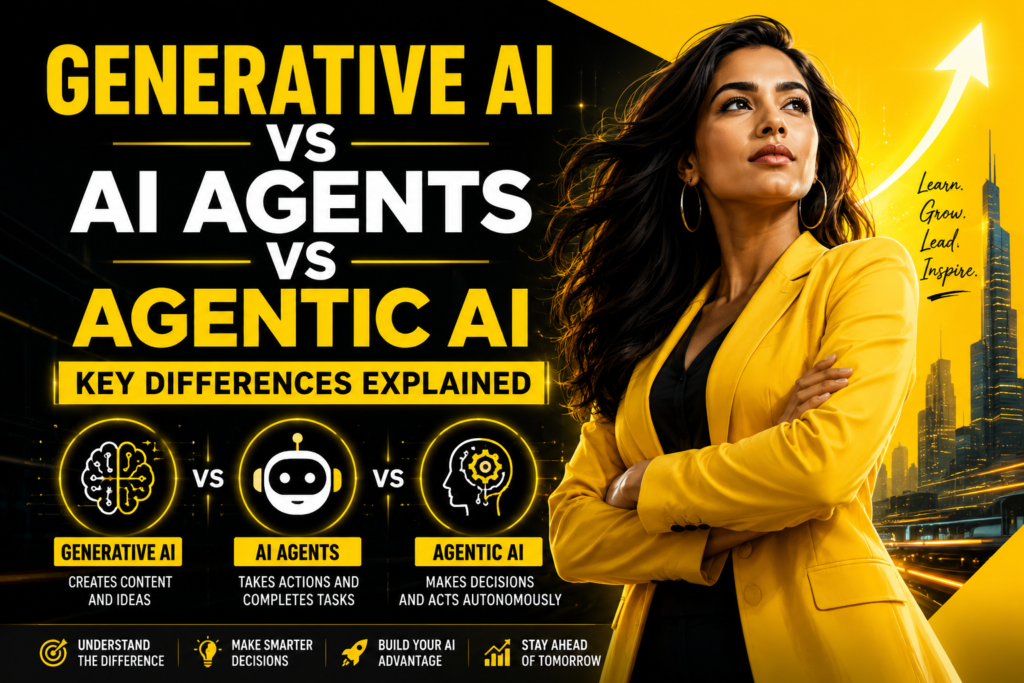
Understanding the generative AI vs AI agents vs agentic AI spectrum is one thing. Knowing where to focus your learning is another.
Start with generative AI if you are completely new to AI tools. Learn to use Claude and Google Gemini effectively for real daily tasks. Develop your prompt engineering skills. This foundation makes everything that follows significantly easier. Read our Prompt Engineering Guide – The Skill That Makes You 10x Faster to master this foundational skill.
Move to AI agents once you are comfortable with generative AI tools. Learn how agents are built using platforms like n8n and Make.com. Build your first simple agent that connects an LLM to one or two tools. Understand how memory and tool use work in practice.
Progress to agentic AI as your confidence and skills grow. Start designing multi-step workflows. Learn how different agents can be coordinated to handle complex goals. This is the level that commands the highest professional value and the most interesting career opportunities.
The generative AI vs AI agents vs agentic AI progression is not a race. Each level has genuine practical value. Many professionals earn significant income working primarily at the AI agent level without ever building complex agentic systems.
Read our guide on How to Earn Money While You Sleep Using AI Agents to understand the income opportunities at the agent level specifically.
Generative AI vs AI Agents vs Agentic AI: Career Implications
The generative AI vs AI agents vs agentic AI distinction has direct implications for career development and income potential.
Professionals who can use generative AI tools effectively earn approximately 28% more than equivalent professionals who do not. This baseline premium is available to anyone willing to develop consistent daily AI tool habits.
Professionals who can build and deploy AI agents earn significantly more than generative AI users alone. The ability to connect LLMs to real systems, create automated workflows, and deliver working agent solutions to businesses is a premium skill with strong demand and limited supply.
Professionals who can design and build agentic AI systems, coordinating multiple agents toward complex business goals, represent the highest value AI professionals in the market right now. These roles command salaries and consulting rates that reflect the genuine scarcity of this expertise.
Understanding generative AI vs AI agents vs agentic AI helps you identify exactly which rung of this ladder you are currently on and what skills to develop to move up.
Read our complete guide on How to Become an AI Engineer to map out the full career pathway that the generative AI vs AI agents vs agentic AI spectrum supports.
Frequently Asked Questions About Generative AI vs AI Agents vs Agentic AI
What is the simplest way to explain generative AI vs AI agents vs agentic AI?
Generative AI creates content by answering questions and generating text. An AI agent takes action on your behalf using tools like web search or code execution. Agentic AI coordinates multiple agents to complete complex multi-step goals autonomously. The generative AI vs AI agents vs agentic AI progression represents increasing levels of capability and autonomy.
Is ChatGPT or Claude a generative AI, AI Agent, or an Agentic AI?
Claude and ChatGPT in their basic form, are generative AI systems. When given tools like web search or code execution they become AI agents. When multiple specialised versions coordinate toward a complex goal, they become part of an agentic AI system. The generative AI vs AI agents vs agentic AI distinction depends entirely on which tools and capabilities the system has access to.
Do I need coding skills to work with AI agents or agentic AI?
No coding skills are required to get started with AI agents or agentic AI. Platforms like n8n and Make.com offer visual no-code interfaces that let you build agents and basic agentic systems without writing a single line of code. In the generative AI vs AI agents vs agentic AI spectrum, all three levels are accessible to motivated learners regardless of technical background.
Which is more powerful, an AI agent or agentic AI?
Agentic AI is more powerful for complex multi-step goals, while a single AI agent is the better choice for focused, well-defined tasks. In the generative AI vs AI agents vs agentic AI comparison, matching the right level of capability to the specific task matters more than always choosing the most powerful option. Find all related terms in our Top 100 AI Words Guide.
How does generative AI fit inside an agentic AI system?
Generative AI acts as the reasoning brain inside every AI agent and agentic AI system. It provides the language understanding, decision-making, and response generation that makes the system intelligent. In the generative AI vs AI agents vs agentic AI framework, the agent or agentic layer adds tools, memory, and coordination around that generative AI core. Read our Artificial Intelligence for Beginners guide for foundational context.
What is the difference between an AI agent and agentic AI?
An AI agent is a single autonomous system that uses tools to complete a specific task on your behalf. Agentic AI refers to a broader architecture where multiple AI agents collaborate, communicate, and coordinate to achieve complex goals. In the generative AI vs AI agents vs agentic AI framework, agentic AI is the most advanced and autonomous level of the three.
Can generative AI become an AI agent?
Yes. Generative AI becomes an AI agent when it is given access to external tools such as web search, calendar access, file management, or code execution. Without tools, it only generates responses. With tools, it takes real-world actions. This tool-use capability is the defining line in the generative AI vs AI agents vs agentic AI distinction.
What are real-world examples of agentic AI?
Real-world agentic AI examples include autonomous research assistants that search, summarise, and compile reports without human input, AI coding systems like Devin that plan and write entire codebases, and multi-agent customer service pipelines that route, resolve, and escalate tickets automatically. These systems sit at the top of the generative AI vs AI agents vs agentic AI capability ladder.
Conclusion
The generative AI vs AI agents vs agentic AI distinction is one of the most practically important things an AI learner can understand in 2026.
Generative AI creates content from patterns learned in training data. AI agents take focused autonomous action using tools and memory. Agentic AI coordinates multiple agents toward complex multi-step goals with broad autonomy.
Each level in the generative AI vs AI agents vs agentic AI spectrum builds on the previous one. Generative AI is the brain inside every agent. Agents are the building blocks of agentic systems. Understanding all three helps you see the full picture of what AI can do today and where it is heading.
Whether you are using AI tools in your daily work, building AI solutions for clients, or developing a career in the AI field, the generative AI vs AI agents vs agentic AI distinction gives you a clear framework for understanding what you are working with and what is possible.
Start with generative AI. Build toward agents. Progress toward agentic systems. Each step makes you more capable and more valuable in an AI-driven world.
Explore more at AI Pathway Lab — your complete guide to understanding and working with AI.
Written by AI Pathway Lab — practical guides for building real AI knowledge and real careers.
Explore everything at aipathwaylab.com. Explore Blog AI Agents