Table of Contents
Introduction Playwright AI Agents
Playwright AI Agents, Picture two testers starting the same task: verify that a newly redesigned checkout flow actually works. The first opens a spec file and writes the exact steps by hand, click here, fill this field, assert that price, then runs it and moves on. The second opens a conversation with an AI agent, describes the goal in plain language, “make sure a user can complete checkout without errors,” and watches the agent explore the page on its own, deciding what to click, noticing when something looks wrong, and reporting back what it found. Only one of those two testers is doing agentic testing. The other, however AI-assisted their workflow might be, is still writing a script.
That distinction is the entire subject of this article, and it is more consequential than it might first appear. The AI-Powered Test Automation with Playwright guide earlier in this series introduced a five-stage maturity model and named autonomous Playwright AI agents as Stage 5, deliberately described as early and not yet mature. That was the right call for an article covering the whole landscape in one pass.
This article exists because Stage 5 deserves more than a paragraph. It picks up exactly where that guide stopped short, going deep on what Playwright AI agents actually are, how the underlying loop works, where MCP fits as the connective layer holding it together, and—most importantly—a genuinely honest split between what is usable today and what is still mostly demo footage on a vendor’s landing page.
This distinction matters more than it might seem, and getting it wrong carries a real cost either way. The term “AI agent” gets used loosely across the testing industry right now, applied to everything from a single AI-suggested locator fix, the kind covered in the Locators tutorial earlier in this series, to a system that autonomously explores an entire unfamiliar application for hours without a person directing a single step.
Those are fundamentally different things, built on different mechanisms, carrying different risks, and requiring different levels of trust. Treating them as interchangeable is exactly how teams end up in one of two bad places: dismissing genuinely useful Playwright AI agents as overhyped nonsense because a vendor oversold a narrower feature as something bigger, or over-trusting a tool that is not remotely ready for the autonomy a team hands it, then being surprised when it fails in a way a simple script never would have.
The rest of this article is built to prevent both mistakes, by being specific about what is actually happening inside an agentic loop, rather than treating “AI agent” as a single, vague category.
Before diving into the full article, explore these essential beginner-f articles first.
Playwright Automation Testing with AI: Complete JavaScript & TypeScript Framework From Scratch
Playwright Locators Tutorial with Examples: Use AI to Build Better Test Automation
Playwright Page Object Model Tutorial: Build a Scalable Test Framework with AI
Playwright Assertions Tutorial with Examples: Validate Your Tests with AI
Playwright API Testing Tutorial: Test REST APIs with JavaScript and AI
Playwright Test Automation Framework Structure: Build a Scalable Setup with AI
What Actually Makes Something a Playwright AI Agents
Every earlier article in this series covered AI-assisted authoring: a person describes what they need, an AI assistant generates a locator, a page object, or a test case, and a human reviews the output before it ships. That pattern, however useful, is not agentic. It is a single request followed by a single response.
Playwright AI agents, in the stricter sense, are systems that operate in a loop, taking a goal rather than a single instruction, then autonomously deciding a sequence of actions to pursue it, observing the results of each action, and adjusting the next step based on what actually happened. The distinction is autonomy over multiple steps, not just AI involvement in one step. Asking an AI assistant to write a login test is AI-assisted authoring. Asking a Playwright AI agents to explore an unfamiliar application and independently identify and test its critical user flows, without a human specifying which flows those are, is agentic.
How the Playwright AI Agents Loop Actually Works
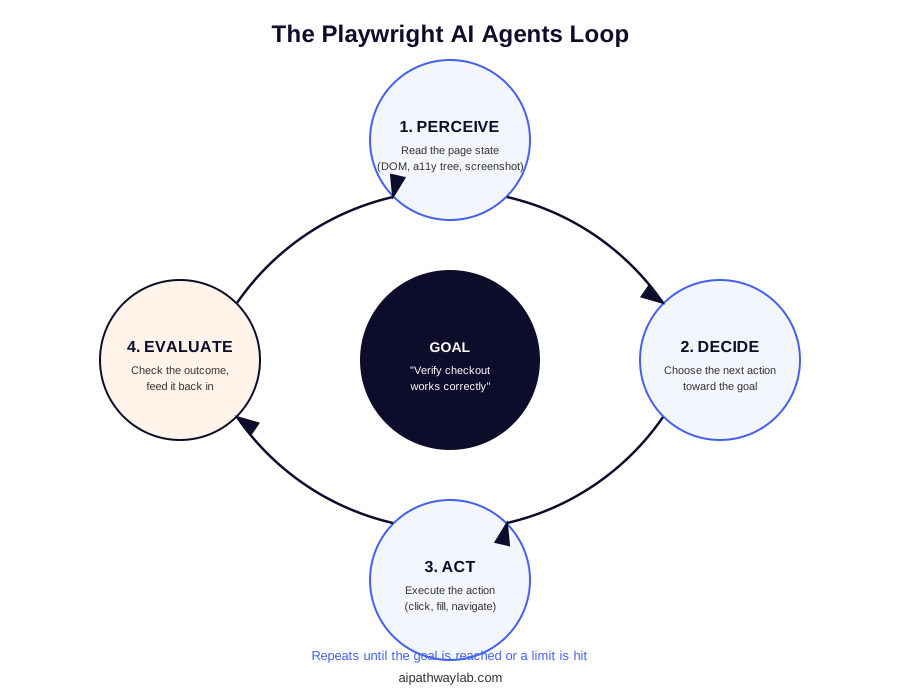
Most Playwright AI agents follow some version of a perceive, decide, act, evaluate cycle, running repeatedly until a goal is reached or a limit is hit.
Perceive. The agent inspects the current state of the page, typically through the accessibility tree, the DOM, or a screenshot, building an understanding of what is actually on screen right now, similar in spirit to how a locator strategy prioritizes accessible roles over raw markup.
Decide. Based on the current goal and what it perceives, the agent chooses a next action, clicking a button, filling a field, or navigating to a new page, reasoning about which action moves it closer to the goal rather than following a fixed, pre-written script.
Act. The agent executes that action against the real application, the same underlying browser automation covered throughout this series, just triggered by the agent’s own decision rather than a line in a spec file.
Evaluate. The agent checks what happened as a result, did the expected content appear, did an error show up, did the page navigate correctly, and feeds that outcome back into the next decision.
This loop is what separates Playwright AI agents from a script, even a very sophisticated one. A script executes a predetermined sequence regardless of what it encounters. An agent adapts its next step based on what the previous step actually produced, which is genuinely powerful for exploratory testing and genuinely risky when the goal or the guardrails around it are not well defined.
Returning to the checkout example from the introduction makes this loop concrete rather than abstract. Given the goal “verify a user can complete checkout without errors,” a Playwright AI agents might run something like this on its first pass:
- Perceive the cart page, noticing a “Proceed to Checkout” button identified by its accessible role.
- Decide to click it, since that action clearly moves toward the stated goal.
- Act by clicking the button, the same underlying browser action covered throughout this series, just chosen by the agent rather than written into a spec file.
- Evaluate the result, the page navigated to a shipping form, no error appeared, so the step succeeded.
- Perceive the new page, this time noticing a required field with no visible label, a common real-world accessibility gap.
- Decide how to proceed, perhaps falling back to a less ideal locator strategy, or flagging the missing label as a finding worth surfacing to a human, depending on how the agent is configured to handle ambiguity.
Every one of those six steps depends on the step before it. A traditional script would have failed outright at step five if it were hardcoded to expect a labeled field. An agent can adapt, but notice that step six is also exactly where things can go quietly wrong, a topic covered in more depth in the failure modes section below.
Where MCP Fits as the Connective Layer
The Playwright CI/CD setup with GitHub Actions covered MCP, the Model Context Protocol, as the mechanism that lets an AI assistant read a repository directly and help generate or troubleshoot a pipeline. The same underlying protocol plays a different but related role for Playwright AI agents specifically: it is the standardized way an agent connects to the tools and data it needs to actually operate, the browser itself, a test management system, a bug tracker, or a codebase, rather than each agent platform building custom, incompatible integrations for every tool it touches.
This matters more for Playwright AI agents than for single-shot AI assistance, because its usefulness depends entirely on what it can actually perceive and act on. One that can only see a screenshot is far more limited than one connected, through MCP or a similar protocol, to the actual accessibility tree, the network layer, and a way to log findings directly into a tracked issue. As agentic testing tools mature, MCP and protocols like it are becoming the plumbing that makes an agent’s perceive-decide-act-evaluate loop actually work against real systems, not a common feature, but the connective tissue underneath the feature.
Made concrete, an MCP-connected agent exploring the checkout flow from earlier could do several things a screenshot-only agent cannot: read the actual accessibility tree to find the missing label mentioned in the walkthrough above, rather than guessing from pixels; query the application’s own API directly to confirm whether an order was genuinely created in the backend, not just that a confirmation message appeared on screen; and file a ticket directly in a connected tracker describing exactly what it found, with a trace attached, instead of producing a result a human has to manually transcribe into a bug report.
Each of those depends on a standardized connection to a different external system, which is precisely the problem MCP was built to solve.
What Is Realistically Usable Today
Adoption of agentic approaches in QA is moving quickly, and it is worth being specific about where that adoption actually stands rather than treating “the future of testing” as a vague, distant claim. Industry analysis in 2026 points to task-specific AI agents becoming meaningfully more common in enterprise software over a short window, and a hybrid model, agentic systems handling broad exploratory coverage and maintenance-heavy regression work, while scripted automation continues to handle precise, compliance-critical checks, is what most mature QA organizations are actually running today, according to Tricentis’s 2026 QA trends coverage.
Genuinely usable today: Playwright AI agents that explore an application to surface untested flows or generate an initial draft of test coverage for a new feature, with a human reviewing and refining that output before it becomes part of a permanent suite. Self-healing locators and automated flaky test triage, covered in the capstone article, also fall into this category, narrow, well-scoped agentic behavior with clear boundaries.
Still mostly experimental: Playwright AI agents fully replacing a human-designed test strategy, autonomously deciding what matters to test without any human-defined scope, or running unsupervised in production-adjacent environments without a review step. These exist in early or pilot form at some organizations, but treating them as a mature, dependable practice for most teams today would be premature.
Real Limitations and Failure Modes Specific to Playwright AI Agents
An AI assistant suggesting the wrong locator for a human to review is a low-stakes mistake, caught before it matters. A Playwright AI agent autonomously making a wrong decision across several chained steps is a different risk profile entirely, since each step compounds on the last before a human ever sees the outcome.
Compounding errors. If an agent misperceives the page state at step two, every subsequent decision in that run is built on a wrong premise, which can produce a confidently wrong result that looks plausible without careful review. Extending the checkout walkthrough from earlier: if the agent misreads a disabled “Place Order” button as clickable, because a loading spinner briefly changed its visual state without changing its accessible role, it might report a successful order that never actually happened, and every step after that misreading inherits the same false premise.
Scope drift. Without a tightly defined goal, an exploratory Playwright AI agents can wander into parts of an application that were never meant to be part of the current testing effort, consuming time and generating noise rather than useful coverage.
False confidence from passing agent-generated coverage. A suite of tests an agent generated and that all pass is not automatically equivalent to a suite that actually protects against the failures a business cares about, the same theme raised in the capstone article, just more acute here because the human review step is easier to skip when the process feels more automated.
Unclear accountability. When a Playwright AI agents makes a sequence of autonomous decisions that leads to a bad outcome, understanding exactly which step went wrong is harder than debugging a single AI-suggested locator, simply because there are more autonomous decision points in the chain.
None of this is an argument against using Playwright AI agents. It is an argument for using them with the same review discipline covered throughout this series, applied more carefully given the larger blast radius of an autonomous multi-step process compared to a single suggestion.
What This Means for a QA Career
For anyone building QA skills right now, agentic testing is worth understanding conceptually well before it is worth depending on operationally. The engineers who get real value from Playwright AI agents early are the ones who already understand locators, assertions, framework structure, and CI/CD deeply enough to recognize when its output is actually correct versus superficially plausible.
This is genuinely good news for anyone following this series in order. Every skill covered in the earlier tutorials, priority-ordered locators, clean page object design, thorough assertions, solid framework structure, is exactly what makes someone capable of reviewing and trusting, or correctly distrusting, what a Playwright AI agents produces. These tools are not replacing that foundation. They are raising the value of having it, since reviewing an agent’s autonomous decisions well requires the same judgment that writing good tests by hand always has.
One additional skill worth deliberately building now, ahead of most of the field: reading an agent’s full decision trace, not just its final result. When an agent reports “checkout flow verified successfully,” the useful question is not whether to trust that summary, but whether the step-by-step reasoning behind it holds up under inspection, the same instinct that made the Trace Viewer valuable in the CI/CD article, applied to a chain of autonomous decisions instead of a single failed assertion. Testers comfortable doing that kind of review will be the ones organizations trust to actually run Playwright AI agents at scale.
How to Start Experimenting Safely
- Start with exploration, not production coverage. Let a Playwright AI agents surface untested flows or generate draft coverage for review, rather than trusting its output directly into a release-blocking suite.
- Define a narrow, specific goal. A tightly scoped goal, “find broken links on the checkout flow,” produces far more useful and reviewable results than an open-ended instruction to “test the application.”
- Review every generated test before it becomes permanent, the same discipline covered in every earlier article in this series, applied to a larger batch of output at once.
- Watch for scope drift, particularly in longer Playwright AI agent runs, and be willing to stop and redirect rather than letting an exploratory session wander indefinitely.
- Keep agentic and scripted approaches side by side rather than replacing one with the other outright, using each where it is actually the stronger fit.
Frequently Asked Questions
What is the real difference between AI-assisted testing and an AI agent?
AI-assisted testing involves a single request and a single AI-generated response, reviewed by a human before use. An AI agent operates in a loop across multiple steps, autonomously deciding its next action based on the outcome of the last one, with review typically happening after a full run rather than after each individual step.
Are Playwright AI agents ready to replace manual test design?
Not yet, for most teams. They are genuinely useful for exploratory coverage and generating draft test cases, but deciding what actually matters to test, tied to real business risk, remains a task better suited to human judgment today.
How does MCP relate to AI agents specifically, as opposed to AI-assisted authoring?
MCP provides a standardized way for an agent to connect to the tools and data it needs to actually operate, the browser, a tracker, a codebase, which matters more for an agent running an autonomous multi-step loop than for a single AI-assisted suggestion reviewed by a person.v
What is the biggest risk unique to using AI agents in testing?
Compounding errors across a multi-step autonomous run, where an early wrong decision shapes every step that follows before a human reviews the outcome, combined with the temptation to skip that review because the process already feels automated.
Should someone new to QA learn traditional Playwright skills before exploring Playwright AI agents?
Yes. Understanding locators, assertions, and framework structure well enough to judge whether an agent’s output is actually correct is what makes working with agentic tools valuable rather than risky.
Is agentic testing actually being used in production today, or is it mostly hype?
Both, depending on the specific application. Exploratory coverage generation and maintenance-focused agentic behavior are seeing real adoption. Fully autonomous, unsupervised test strategy is still largely experimental at most organizations.
Conclusion
Playwright AI agents represent a genuine shift, not just another incremental AI feature layered onto existing tools. The loop that defines them, perceiving a page, deciding an action, executing it, and evaluating the result, is fundamentally different from the single-request, single-response pattern covered everywhere else in this series, and it comes with a correspondingly different risk profile that deserves honest treatment rather than either dismissal or hype.
The most useful way to think about where this stands today: genuinely valuable for exploration and draft coverage generation, still early for fully autonomous test strategy, and, in both cases, most valuable in the hands of someone who already understands the fundamentals well enough to know when an agent’s confident output is actually right.
Explore more articles from AI blogs AI Learning Hub, AI tools pagesubscribe to AI Pathway Lab AI for Testers
Explore Top Playwright Interview Questions: JavaScript, TypeScript, and AI-Powered Testing
- Prompt Engineering Guide – The Skill That Makes You 10x Faster
- What Are AI Agents? Complete Beginner Guide 2026
- 12 Proven Ways to Make Money With AI That Actually Work
- Claude AI to Earn Money Guide: 4 Proven Ways That Actually Work
- Free AI Courses with Certificate in 2026
- AI Test Case Generation Guide for QA Engineers Using ChatGPT and Claude
3 Proven Ways AI Accelerates Software QA Workflows
Automation with AI, Write Test Scripts 10x Faster in 2026
AI Workflows for QA Automation, How to Integrate
Explore AI Automation & Workflows
For further reading on where the wider industry stands, Tricentis’s 2026 QA trends coverage and this detailed 2026 guide to agentic testing go deeper into adoption patterns and MCP’s role across the industry, and the Model Context Protocol specification remains the primary technical reference for how the underlying connective layer actually works.