Table of Contents
AI in education is no longer a futuristic idea confined to conference talks; it is already showing up in real classrooms, homework routines, and teacher workflows across the country. From AI tutors that walk a student through a tricky math problem to tools that draft an entire lesson plan in minutes, AI in education is changing what a typical school day actually looks like. This guide walks through how these tools work, the specific platforms teachers and students are using right now, and what the shift toward personalized learning means for the classroom of the near future.
What AI in Education Actually Means
At its core, AI in education refers to software that adapts to an individual learner, automates routine teaching tasks, or supports decision making around student progress. This is a broad category, covering everything from an AI tutor answering a homework question at midnight to a district level system flagging which students may need extra support before a test.
Unlike a textbook or a one-size-fits-all worksheet, AI in education tools respond to what a specific student already knows and adjust the next question or explanation accordingly. This adaptive quality is what separates modern AI in education platforms from earlier generations of educational software, which mostly followed a fixed sequence regardless of how a student was actually performing. The distinction matters because it changes what AI in education can realistically promise: not a shortcut to learning, but a more responsive path through material a student already needs to cover.
How AI Tutors Work
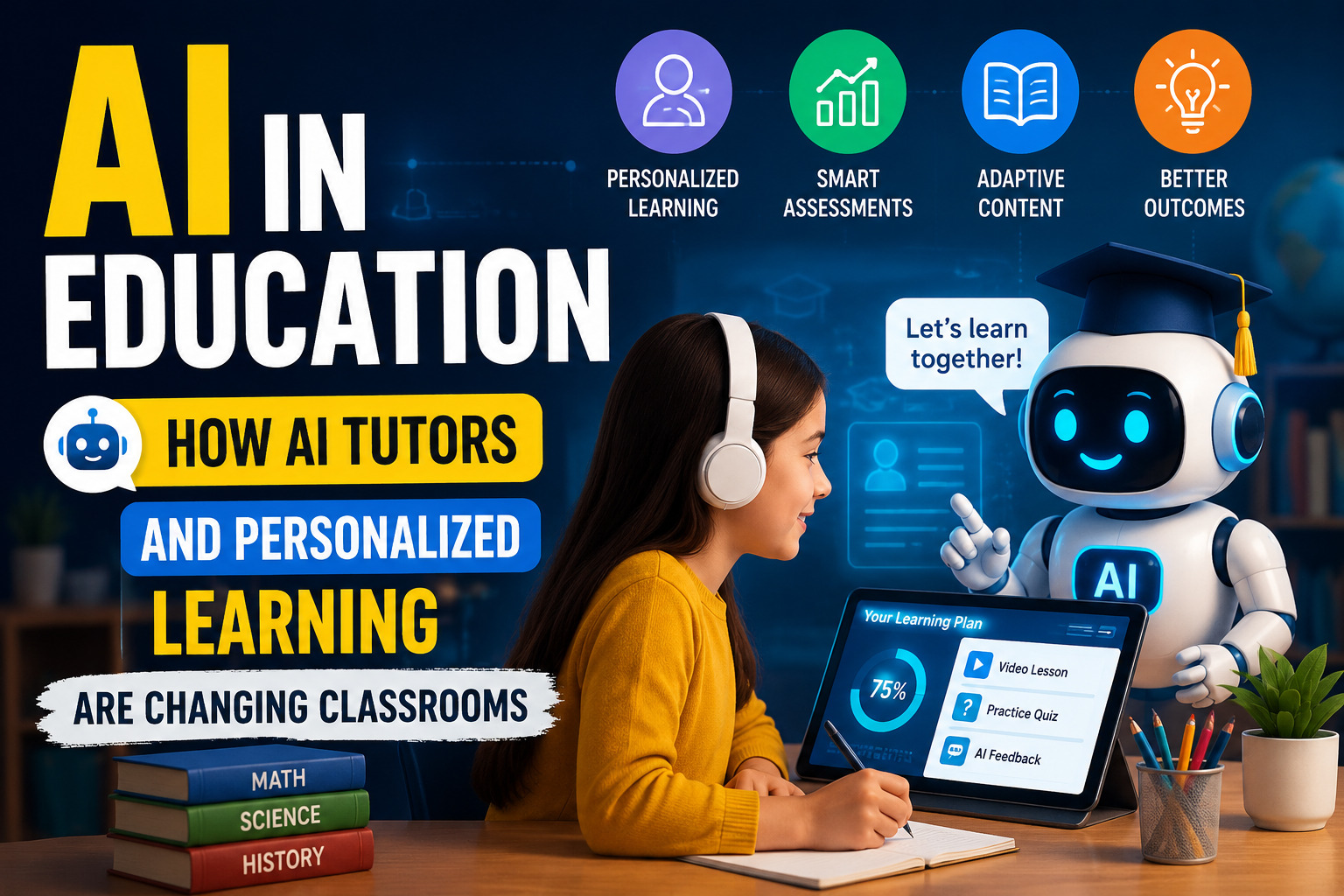
An AI tutor is designed to guide a student toward an answer rather than simply providing it. Khanmigo, built by the nonprofit Khan Academy, is one of the most widely used examples of AI in education working this way. Instead of solving a math problem outright, Khanmigo asks leading questions, offers hints, and adjusts its approach based on where a student gets stuck, mirroring how a human tutor would handle the same situation.
Rachel Bennett, a seventh-grade math teacher in Columbus, Ohio, started using Khanmigo with her students during independent practice time. She noticed that students who used to raise their hands and wait several minutes for help were instead getting immediate, guided support, which freed her up to work directly with the small group of students who needed the most attention that day.
This kind of AI tutor is available for Khanmigo directly, and similar guided tutoring approaches are appearing in other subject-specific tools as well, including language learning apps and coding platforms that walk a learner through debugging their own code rather than fixing it for them. The guided rather than answer giving approach is quickly becoming the standard expectation for AI in education tools built specifically for younger learners.
Personalized Learning at Scale
Personalized learning used to mean a teacher manually adjusting assignments for each student, a task that becomes nearly impossible in a classroom of thirty with wildly different skill levels. AI in education has made a version of this personalization possible at a scale no individual teacher could manage alone.
Adaptive platforms track which concepts a student has mastered and which ones need more practice, then quietly adjust the difficulty and type of question presented next. A student who breezes through fractions moves ahead to the next topic, while a student still struggling gets more targeted practice on that specific skill instead of moving forward regardless of readiness.
Diego, a ninth grader in San Antonio, used to fall behind in algebra because the class moved at a pace that did not match how he learned the material. After his school introduced an adaptive learning platform, he was able to spend extra time on the specific concepts that were tripping him up without feeling singled out in front of his classmates, since every student’s practice set looked slightly different by design.
AI Tools for Teachers
Lesson planning, grading, and differentiation are among the most time-consuming parts of teaching, and this is where AI in education has produced some of the most immediately useful tools for educators. MagicSchool is one of the most widely adopted platforms in this category, offering more than fifty specialized tools covering lesson plans, rubrics, quiz generation, and individualized education program drafts.
Teachers using MagicSchool report saving several hours a week on planning and administrative work, time that can be redirected toward actually working with students or preparing more engaging activities. The platform is built specifically with student data privacy in mind, since anything touching a classroom needs to meet a higher bar than a typical consumer AI tool.
Beyond lesson planning, teachers are also using generative AI tools to draft parent communications, translate materials for multilingual families, and generate differentiated versions of the same assignment for students working at different levels, all tasks that used to eat into evenings and weekends. Teachers who write their own custom prompts for these tools, rather than relying only on built in templates, tend to get noticeably better results, and this prompt engineering guide covers the wording techniques that make the biggest difference.
AI Tools for Students
Students are encountering AI in education from the other direction as well, through tools built directly for studying and homework support. Quizlet’s Magic Notes and Quick Summary features generate practice questions and condensed study material automatically from uploaded class notes, saving the time it used to take to build a study set by hand.
Language learning apps have also leaned heavily into AI in education. Duolingo Max offers AI-powered video call and Roleplay features that let a learner hold a real-time conversation with an AI character in a specific scenario, such as ordering coffee or checking into a hotel, then receive feedback on accuracy afterward. Writing support tools like Grammarly go beyond simple spell check, offering suggestions on clarity, tone, and structure that help a student improve their own writing rather than just catching typos.
Jordan, a high school junior in Sacramento, uses an AI study tool to turn dense chapters from a history textbook into a set of practice questions before every test. Rather than replacing the reading itself, the tool has become a way to check whether the reading actually stuck, catching gaps a day or two before an exam instead of discovering them during the test itself.
Examples of AI in Education Across Grade Levels
AI in education looks different depending on the age group involved. In elementary classrooms, AI in education tools tend to focus on reading support, basic math practice, and simple adaptive games that keep young learners engaged while quietly tracking which skills need reinforcement. Teachers at this level often use AI mainly for behind the scenes tasks like generating differentiated reading passages rather than putting a chat interface directly in front of very young students.
Middle school is where AI tutors like Khanmigo tend to see the heaviest use, since students at this age are developmentally ready to work somewhat independently but still benefit enormously from the guided, question-based approach these tools are built around. High schools are seeing the widest range of AI in education applications, from exam preparation tools to AI-assisted college essay feedback, reflecting the more varied and self-directed nature of a typical high schooler’s workload.
Higher education has embraced AI in education differently again, with university students using AI research assistants to summarize academic papers and professors using AI tools to generate practice problem sets for large lecture courses where individual attention is harder to provide at scale.
Benefits of AI in Education
The clearest benefit of AI in education is time. Teachers spend less time on repetitive administrative work and more time on direct instruction, while students get immediate feedback instead of waiting until an assignment is graded days later. This immediacy matters enormously for learning, since catching a misunderstanding right after it happens is far more useful than catching it a week later.
Accessibility is another significant benefit. Students with different learning needs, including those who benefit from text-to-speech, extra repetition, or a slower pace, can get support tailored to how they actually learn rather than a generic approach designed for an average student who does not really exist in any single classroom.
AI in education also extends learning support beyond school hours. A student stuck on homework at nine in the evening no longer has to wait until the next school day for help, which particularly benefits students whose parents may not be able to assist with the specific subject matter. This around the clock availability is one of the most consistently cited advantages whenever teachers describe what AI in education has changed about their students’ study habits.
Challenges and Concerns With AI in Education
None of this comes without real concerns. Data privacy is a serious issue when the users are minors, which is why responsible platforms in this space build in stricter safeguards than typical consumer AI products. Overreliance is another concern, since a student who leans on an AI tool for every answer may not build the underlying skill the assignment was meant to develop in the first place.
Equity is a related worry, since access to strong AI in education tools still depends heavily on a school’s budget and technology infrastructure, potentially widening the gap between well-resourced and under-resourced districts rather than closing it. These concerns echo many of the broader issues covered in this guide to the challenges and risks of AI, including bias, transparency, and the importance of keeping a human reviewer in the loop for consequential decisions.
The Role of Teachers in an AI Classroom
None of these tools are designed to replace the teacher, and the classrooms seeing the best results treat AI in education as an assistant rather than a substitute. A teacher’s judgment about a specific student’s emotional state, motivation, and classroom dynamics is something no current AI system can replicate.
What changes is where a teacher spends their time. Less time goes toward repetitive grading and worksheet creation, and more time goes toward the relationship building and real-time coaching that actually requires a human in the room. Schools that introduce AI in education successfully tend to frame it explicitly this way from the start, rather than letting teachers discover the shift on their own.
Getting Started: How Schools Can Introduce AI Responsibly
Schools considering AI in education for the first time generally do best starting with a single, well-defined use case rather than rolling out every available tool at once. A pilot program in one grade level or subject area, with clear feedback loops from both teachers and students, tends to surface problems early before a wider rollout multiplies them.
Writing a clear AI use policy before adoption, rather than after a problem occurs, also matters. This includes decisions about what student data can be shared with a given tool, which grade levels get access to which features, and how teachers are trained to use the tools effectively rather than assuming the software explains itself. Schools that skip this step tend to see uneven adoption of AI in education across different classrooms, with some teachers embracing it fully and others avoiding it out of uncertainty about what is actually allowed. The UNESCO guidance on AI in education offers a useful starting framework for schools and districts working through these policy questions for the first time.
What Comes Next for AI in Education
The trends shaping classrooms today connect to much broader shifts happening across the wider technology landscape. This overview of the future of AI explores how personalized learning fits into fifteen larger trends reshaping work, careers, and daily life over the next decade. Many of the same underlying technologies, including the generative AI systems powering today’s AI tutors, are advancing quickly enough that the tools available in a classroom two years from now will likely look noticeably more capable than what is available today.
Educators interested in experimenting with these tools directly, rather than waiting for a district-wide rollout, can start with this practical overview of Google NotebookLM: The Complete Guide for Students, Researchers, and Professionalsv, which covers accessible starting points across several categories.
Conclusion
AI in education has moved from an experimental idea to a set of tools already shaping how millions of students learn and how their teachers spend their time. AI tutors like Khanmigo, planning platforms like MagicSchool, and countless smaller tools built for specific subjects are giving both students and educators more personalized support than a traditional classroom could offer on its own. The schools and teachers getting the most value from AI in education are the ones treating it as a thoughtful addition to good teaching, not a replacement for it. As these tools continue maturing, the gap between classrooms that use AI in education well and those that avoid it altogether is likely to grow more noticeable over time.
Explore more articles from AI Pathway Lab AI Learning Hub Blogs
- Prompt Engineering for QA Agents
- What Are AI Agents? Complete Beginner Guide 2026
- How to Become an AI Engineer in 2026: Complete Roadmap
- Free AI Courses with Certificate in 2026
- Claude AI to Earn Money Guide: 4 Proven Ways That Actually Work
- Perplexity AI Guide: Features, Uses & More in Under 10 Minutes
Frequently Asked Questions
What is the most popular AI tutor for students?
Khanmigo, built by Khan Academy, is one of the most widely used AI tutors in schools today. It guides students toward answers through hints and questions rather than simply providing solutions.
Is AI in education safe for students to use?
Reputable AI in education platforms build in stricter data privacy protections specifically because their users are minors. Schools should still review a tool’s data policy carefully before adoption, since protections vary between platforms.
Will AI replace teachers in the classroom?
No, AI in education tools are designed to handle repetitive tasks like grading and lesson planning, not to replace the relationship and judgment a teacher brings to a classroom. Most successful implementations position AI as an assistant rather than a substitute.
How does personalized learning with AI actually work?
Personalized learning platforms track which concepts a student has mastered and adjust the difficulty and type of practice presented next. This allows each student to move at their own pace instead of following a single fixed sequence for the entire class.
What tools do teachers use most for AI in education?
Teachers commonly use platforms like MagicSchool for lesson planning, rubric creation, and differentiation, alongside AI tutors like Khanmigo that support students directly. Many teachers also use general purpose AI tools for drafting parent communications and administrative writing.
Does AI in education work for every subject?
AI in education tools are most mature in math, language learning, and writing support, though new tools are expanding into science, history, and other subjects quickly. The underlying adaptive approach applies broadly, even as specific tools continue to catch up across less developed subject areas.