Table of Contents
A machine learning model is the reason AI feels intelligent.
As a techie who has completed AI courses and spent years enthusiastically exploring everything artificial intelligence can do, one concept kept coming up as the foundation of everything else. Every AI tool I tested, every automation I built, every result that surprised me traced back to the same underlying technology,
Understanding what a machine learning model is does not just satisfy curiosity. It changes how you use AI tools, how you evaluate AI outputs, and how you build a career in one of the fastest-growing fields in the world.
Before AI assistants like Claude could answer complex questions, before Google Gemini could summarise your emails, before recommendation systems could predict your next favourite show, someone had to train a machine learning model on enormous amounts of data. That training process is what gives modern AI its remarkable capabilities.
This guide explains exactly what a machine learning model is, how it learns from data, what types exist, and why understanding this concept makes you a better AI user, a stronger professional, and a more informed learner.
Read our complete guide on Artificial Intelligence for Beginners before diving into machine learning models if you want the foundational context first.
What Is a Machine Learning Model?
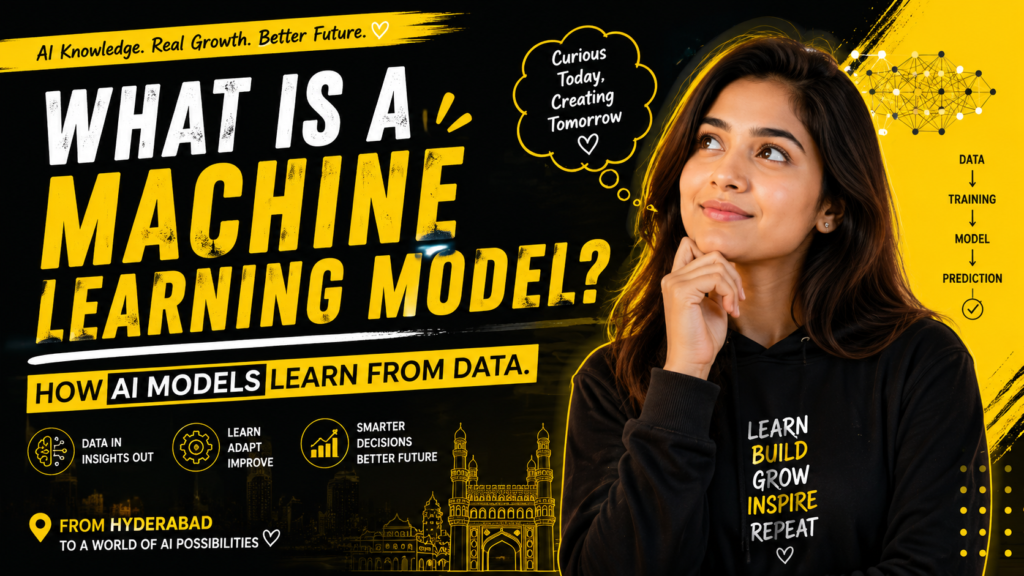
A machine learning model is a mathematical system that learns patterns from data and uses those patterns to make predictions or generate outputs.
The word model here means exactly what it sounds like. representation. A machine learning model is a representation of patterns found in data, encoded mathematically so a computer can use it to process new information and produce intelligent results.
Think of it like this. When a child learns to recognise cats, they look at hundreds of cats. Over time, their brain builds a mental model of what a cat looks like. Pointed ears. Whiskers. Fur. Four legs. The next time they see a new cat they have never seen before, their mental model recognises it immediately.
A machine learning model works the same way. Instead of a child’s brain, it uses mathematical algorithms. Instead of looking at cats, it processes millions or billions of data points. And instead of building a mental model, it builds a mathematical one that it uses to process new inputs and produce accurate outputs.
This is why the machine learning model is the foundation of everything modern AI can do. Every time Claude understands your question, every time ChatGPT generates a helpful response, every time a recommendation system suggests content you end up loving, a trained machine learning model is working behind the scenes.
How a Machine Learning Model Learns From Data
Understanding how a machine learning model actually learns from data removes the mystery from AI completely.
The learning process follows four clear stages regardless of the specific type of machine learning or application involved.
Stage 1: Data Collection
Every machine learning system starts with data. Text, images, numbers, user behaviour, sensor readings, and transaction records are the raw material needed for learning.
The relationship between data quality and performance is direct and non-negotiable. A system trained on high-quality, relevant, and diverse data produces accurate and useful outputs, while one trained on poor-quality or biased data produces unreliable or potentially harmful results.
This is why companies building large AI systems invest enormous resources in data collection and curation.
This is why companies building large AI systems invest enormous resources in data collection and curation.
Stage 2: Pattern Recognition
Once a machine learning model has access to data, it begins identifying patterns.
In language data, it recognises that certain words tend to follow other words in specific contexts. In image data, it recognises shapes, edges, textures, and colours that distinguish one object from another. In behavioural data, it recognises correlations between actions and outcomes.
The remarkable thing about a machine learning model is its ability to find patterns in data at a scale and speed completely beyond human capability. A machine learning model can process billions of data points and identify subtle patterns that no human analyst could detect manually.
Stage 3: Training
Training is the process through which a machine learning model improves its pattern recognition by being evaluated against known correct answers.
During training, the machine learning model makes a prediction. That prediction is compared against the correct answer. The difference between the prediction and the correct answer is called the error. then adjusts its internal parameters slightly to reduce that error.
This process repeats millions or billions of times. With each repetition, the machine learning model gets a little more accurate. By the end of training, the machine learning model has learned to make predictions that are correct the vast majority of the time across a wide range of inputs.
Training the most capable machine learning model systems today takes months, enormous computing power, and billions of data examples. This is why only a small number of organisations have built frontier AI models.
Stage 4: Inference
Inference is what happens when you actually use a machine learning model. You provide an input, and the machine learning model uses everything it learned during training to generate an output.
When you type a question into Claude and receive an intelligent answer, that is inference. The machine learning model powering Claude processes your input, runs it through billions of learned parameters, and generates the most appropriate response based on everything it learned during training.
Inference happens almost instantaneously from your perspective, despite the enormous mathematical complexity happening behind the scenes.
Types of Machine Learning Models
Not all machine learning model systems are the same. Different types of machine learning model are designed for different kinds of tasks and learning situations.
Supervised Learning Models
A supervised machine learning model learns from labelled data. Each training example includes both an input and the correct output.
For example, a model trained to detect spam emails is shown millions of emails, each labelled as spam or not spam. It learns the patterns that distinguish spam from legitimate emails and uses that knowledge to classify new emails it has never seen before.
Supervised learning systems are widely used for image recognition, fraud detection, medical diagnosis, and language translation. They are the most common type of AI model in real-world commercial applications today..
Unsupervised Learning Models
An unsupervised machine learning model learns from unlabelled data. Instead of being given the correct answers, it identifies patterns and structures in the data on its own.
For example, a model analysing customer purchasing behaviour can discover natural groupings of customers with similar preferences, without being told those groups exist in advance.
This type of learning is widely used in customer segmentation, anomaly detection, and recommendation systems, helping businesses uncover hidden insights from large datasets.
Reinforcement Learning Models
A reinforcement machine learning model learns through trial and error by receiving rewards for correct actions and penalties for incorrect ones.
This type of machine learning model is used in game-playing systems, robotics, and autonomous vehicles. It is also increasingly used in AI assistant training to help machine learning model systems learn to produce responses that humans find genuinely helpful and appropriate.
Large Language Models
A Large Language Model, commonly called an LLM, is a specific type of machine learning model trained on enormous amounts of text data.
LLMs are the machine-learning models powering Claude by Anthropic, ChatGPT by OpenAI, and Google Gemini. They learn the statistical patterns of human language at an extraordinary scale, enabling them to understand and generate human-like text across almost any topic or format.
Understanding the LLM as a type of machine learning model helps explain why these tools are so capable across such a wide range of tasks. They have learned patterns from a genuinely enormous slice of human-written knowledge.
Read our complete guide on Generative AI for Beginners to understand how Large Language Models connect to the generative AI tools you use every day.
Real World Examples of Machine Learning Models
The best way to understand a machine learning model is through real-world applications you already use every day.
Email spam filters are trained on millions of spam and legitimate emails. Every time you mark an email as spam, you help improve the system by adding new training signals.
YouTube recommendations are powered by models trained on billions of viewing sessions. They learn which videos people watch after others and use those patterns to suggest what you might enjoy next.
Medical diagnosis tools are trained on thousands of medical scans with known diagnoses. These systems learn to detect visual patterns linked to different conditions and can sometimes identify early signs of disease that humans may miss.
Fraud detection systems analyse historical transaction data to learn patterns associated with fraudulent activity and flag suspicious transactions in real time.
Voice assistants use multiple AI systems working together. One converts speech to text, another understands meaning, a third generates responses, and another converts text back into speech.
How Machine Learning Models Power the AI Tools You Use
Every AI tool you use in your daily work runs on a trained machine learning model under the hood.
When you use Claude to write content, the machine learning model powering Claude has learned patterns from billions of high-quality text examples. It uses those learned patterns to generate responses that are coherent, relevant, and genuinely helpful.
When you write a prompt and get an outstanding result, that is you communicating effectively with a machine learning model. When you write a vague prompt and get a mediocre result, that is the machine learning model doing its best with insufficient information.
This is exactly why prompt engineering matters so much. Read our complete Prompt Engineering Guide to understand how to communicate with machine learning model systems effectively and get dramatically better results from every AI tool you use.
The better you understand how a machine learning model works the better you become at using AI tools because you understand what they need from you to perform at their best.
Key Machine Learning Model Terms Every AI Learner Should Know
Understanding these terms helps you navigate machine learning concepts with confidence.
Parameters are the internal numerical values a model adjusts during training to improve accuracy. Large language models can have billions of parameters.
Training data is the dataset used to teach a model. The quality and size of this data directly influence performance.
Overfitting happens when a model learns training data too precisely and struggles to generalise to new, unseen data.
A neural network is the architectural structure behind most modern AI systems, loosely inspired by the human brain.
Fine-tuning is the process of taking a pre-trained machine learning model and training it further on a smaller specialised dataset to improve performance on specific tasks.
Find these and 100 more essential AI definitions in our complete guide, Top 100 AI Words You Need to Know.
Machine Learning Model and Your Career
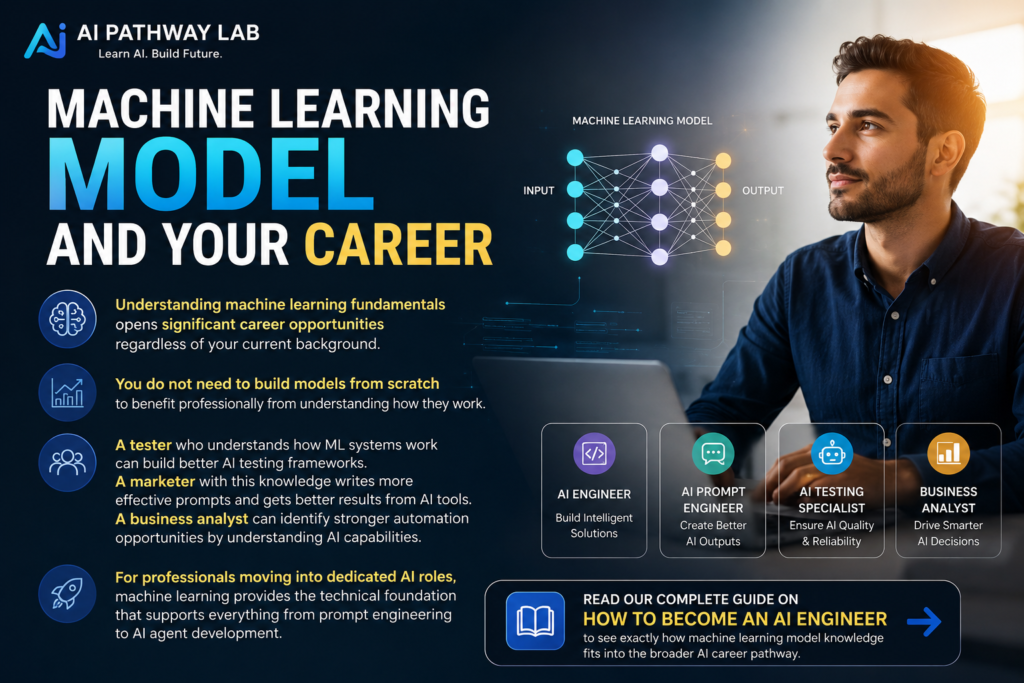
Understanding machine learning fundamentals opens significant career opportunities regardless of your current background.
You do not need to build models from scratch to benefit professionally from understanding how they work. The most in-demand AI professionals in 2026 are those who combine domain expertise with practical AI knowledge.
A tester who understands how machine learning systems work can build better AI testing frameworks. A marketer with this knowledge writes more effective prompts and gets better results from AI tools. A business analyst can identify stronger automation opportunities by understanding AI capabilities.
For professionals moving into dedicated AI roles, machine learning provides the technical foundation that supports everything from prompt engineering to AI agent development.
Read our complete guide on How to Become an AI Engineer to see exactly how machine learning model knowledge fits into the broader AI career pathway.
Frequently Asked Questions About Machine Learning Models
What is the difference between a machine learning model and artificial intelligence?
Artificial intelligence is the broad concept of machines performing tasks that require human intelligence. A machine learning model is one specific approach to building artificial intelligence systems where the machine learns from data rather than being explicitly programmed. All machine learning model systems are artificial intelligence, but not all artificial intelligence uses machine learning. Read our Artificial Intelligence for Beginners Guide for the full explanation.
How long does it take to train a machine learning model?
Training time varies enormously depending on the size and complexity of a machine learning system. A simple model for a narrow task might train in minutes on a standard computer. The large language models powering tools like Claude and ChatGPT took months to train using thousands of specialised computing chips. For most practical applications, beginners use pre-trained machine learning systems rather than training their own.
Training time varies enormously depending on the size and complexity of the system. A simple model for a narrow task might train in minutes on a standard computer. The large language models powering tools like Claude and ChatGPT took months to train using thousands of specialised computing chips. For most practical applications, beginners use pre-trained systems rather than building one from scratch.v
Do I need to understand machine learning models to use AI tools effectively?
You do not need deep technical knowledge of machine learning model mathematics to use AI tools effectively. However, understanding the basic principles of how a machine learning model learns from data helps you write better prompts, set realistic expectations for AI outputs, and identify when AI results need verification. Read our Prompt Engineering Guide to apply this understanding practically.
What is the best machine learning model for beginners to learn about?
For beginners, the most relevant machine learning model to understand is the Large Language Model powering tools like Claude and ChatGPT. These are the machine learning model systems you interact with daily through AI assistants. Understanding how they learn from text data explains why they are so capable at language tasks and where their limitations come from. Read our Generative AI for Beginners Guide for the complete picture.
Can I build my own machine learning model without coding?
Building a machine learning system from scratch typically requires programming skills and mathematical knowledge. However, many platforms now allow beginners to fine-tune existing AI models for specific tasks using no-code interfaces. For most professionals, the practical goal is not building a model from scratch but using and integrating existing systems effectively, read our guide on How to Build a No-Code AI Agent to see how this works in practice.
Conclusion
Every conversation with Claude, every YouTube recommendation, every fraud alert from your bank, and every autocomplete suggestion on your phone is powered by trained machine learning systems applying patterns learned from data to new situations at scale.
As a techie who has completed AI courses and spent years exploring these tools, the biggest insight I can share is this: you do not need to build models from scratch to benefit enormously from understanding how they work.
Understanding how machine learning systems learn from data makes you a better prompt writer, a more effective AI tool user, and a more informed professional. It helps you understand what AI does well, where it struggles, and how to guide it toward better outcomes. It also opens your eyes to automation opportunities across different industries and roles.
The machine learning model is not magic. It is mathematics, data, and computing power working together at scale, shaped by human design and training.
And once you understand that, AI stops feeling like a black box. You start using it with confidence, clarity, and purpose — not guessing, but guiding. That shift is what turns everyday users into skilled AI practitioners. Every conversation with Claude, every YouTube recommendation, every fraud alert from your bank, and every autocomplete suggestion on your phone is powered by trained machine learning systems applying patterns learned from data to new situations at scale.
As a techie who has completed AI courses and spent years exploring these tools, the biggest insight I can share is this: you do not need to build models from scratch to benefit enormously from understanding how they work.
Understanding how machine learning systems learn from data makes you a better prompt writer, a more effective AI tool user, and a more informed professional. It helps you understand what AI does well, where it struggles, and how to guide it toward better outcomes. It also opens your eyes to automation opportunities across different industries and roles.
The machine learning model is not magic. It is mathematics, data, and computing power working together at scale, shaped by human design and training.
And once you understand that, AI stops feeling like a black box. You start using it with confidence, clarity, and purpose — not guessing, but guiding. That shift is what turns everyday users into skilled AI practitioners.
Start applying this understanding today. Open Claude and notice the machine learning model working behind every response.
Explore more AI concepts in our complete Top 100 AI Words You Need to Know and continue your learning journey at AI Pathway Lab.
- AI Learning Hub
- AI Workflows for QA Automation: How to Integrate
- Prompt Engineering for QA Agents – Best Practices Complete Guide
- How to Earn Money While You Sleep Using AI Agents
- Blog
- 5 AI Tools to Save Time and Earn Money
Written by AI Pathway Lab – practical guides for building real AI knowledge and real careers.
Explore everything at aipathwaylab.com