Table of Contents
Challenges and Risks of AI- Artificial intelligence is changing how people work, shop, communicate, and make decisions, often without anyone noticing the shift happening in the background. Understanding the challenges and risks of AI matters just as much as understanding its benefits, since adopting a powerful tool without knowing its downsides tends to create problems that are harder to fix later. This guide walks through the most important challenges and risks of AI in plain language, along with practical ways individuals and organizations can reduce them.
What Are the Challenges and Risks of AI
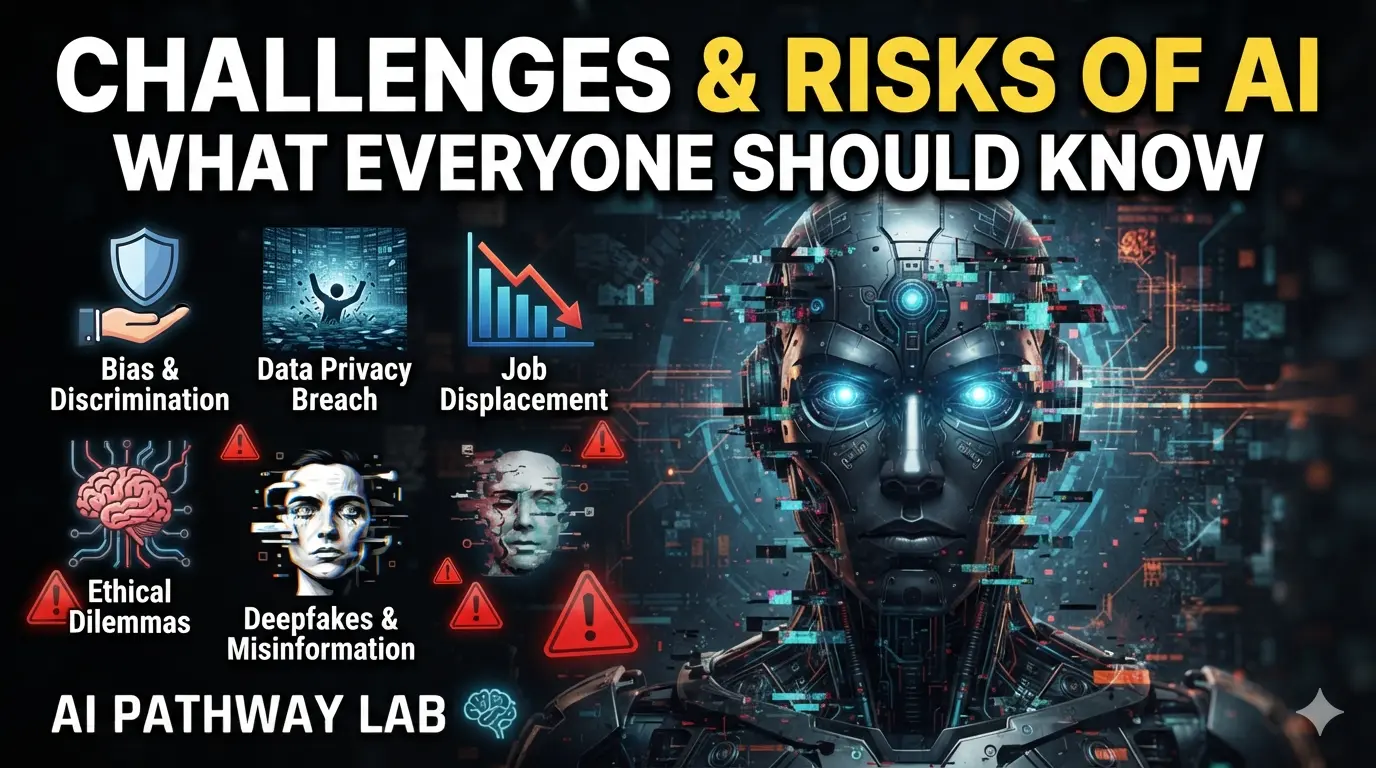
The challenges and risks of AI fall into several categories: economic effects on jobs, threats to privacy and security, unfair or biased outcomes, a lack of transparency in how decisions get made, new categories of cyber threats, the spread of convincing misinformation, growing dependence on automated systems, high implementation costs, and a set of ethical questions society has not fully answered yet. Each of these deserves its own explanation before looking at how to manage them responsibly.
1. Job Displacement and Workplace Changes
One of the most talked about challenges and risks of AI is its effect on jobs. Automation is well suited to repetitive, rule based tasks, which means roles built around that kind of work are the most exposed to change. This does not always mean a job disappears entirely; more often, the role shifts toward tasks that require judgment, creativity, or interpersonal skill instead of repetition.
Diane, an accounts payable clerk in Columbus, spent years manually matching invoices to purchase orders before her company introduced an AI powered matching tool. Rather than losing her position, her role shifted toward reviewing the exceptions the system flagged and handling vendor relationships, work that required more judgment than the repetitive matching she used to do by hand. Her experience is a useful reminder that the challenges and risks of AI in the workplace often look like a shift in responsibility rather than a straightforward loss.
New roles are also appearing directly because of this shift, including AI governance specialists, prompt engineers, automation analysts, and data quality managers. According to the World Economic Forum’s Future of Jobs Report, millions of roles are expected to be created alongside millions displaced over the next several years, which underscores why reskilling has become such a central part of managing this particular risk.
2. Data Privacy and Security Risks
AI systems generally require enormous amounts of data to function well, and that requirement introduces one of the more serious challenges and risks of AI for both individuals and organizations. Personal information collected by an AI assistant, a recommendation engine, or a facial recognition system can be exposed through a data breach, sold without clear consent, or used in ways the original person never anticipated.
Voice assistants that listen for a wake word, smart home devices that track daily routines, and retail apps that build detailed shopping profiles all illustrate how much personal data flows into AI systems every day. When that data is stored insecurely or shared with third parties without adequate safeguards, the consequences can range from targeted scams to identity theft, which is why data privacy remains one of the most frequently cited challenges and risks of AI among security researchers.
3. AI Bias and Unfair Decisions
AI models learn patterns from the data used to train them, and when that training data reflects historical inequities, the resulting system tends to repeat them. This is one of the more subtle challenges and risks of AI, since a biased outcome can look statistically confident even when it is unfair.
Hiring systems that favor certain resume formats or educational backgrounds, loan approval models that disadvantage applicants from specific neighborhoods, and healthcare recommendation tools that underperform for underrepresented groups have all been documented in real deployments. The fix requires deliberately testing for these gaps rather than assuming a system is neutral simply because a human is not directly making each decision, since these bias related challenges and risks of AI rarely announce themselves on their own.
4. Lack of Transparency (Black Box Problem)
Many advanced AI models, particularly deep learning systems, cannot fully explain why they reached a particular output. This is often called the black box problem, and it ranks among the more difficult challenges and risks of AI to solve because the complexity that makes a model powerful is often the same complexity that makes it hard to interpret.
This matters enormously in fields like healthcare, finance, and government, where a decision needs to be explainable to a patient, a loan applicant, or a court. Researchers are actively working on explainable AI techniques, but for now, many organizations choose to keep a human reviewer in the loop specifically for decisions that carry serious consequences, since transparency related challenges and risks of AI tend to erode public trust fastest.
5. Cybersecurity Threats
AI is a double edged tool in cybersecurity, since the same capabilities that help defenders also help attackers, making this one of the most rapidly evolving challenges and risks of AI today. AI powered phishing emails can now be written in fluent, personalized language at a scale no human team could match, and voice cloning tools have made phone based scams far more convincing than they were even a few years ago.
Automated attacks that probe for software vulnerabilities around the clock, combined with AI assisted malware that can adapt its behavior to avoid detection, represent some of the fastest growing challenges and risks of AI in the security space. The NIST AI Risk Management Framework offers a structured way for organizations to evaluate these risks before rather than after an incident occurs.
6. Misinformation and Deepfakes
Generative AI has made it dramatically easier to produce convincing fake images, videos, and audio recordings, sometimes called deepfakes. A fabricated video of a public figure saying something they never said can spread widely before anyone has a chance to verify it, which makes this one of the more visible challenges and risks of AI in public discourse.
Beyond deepfakes, AI generated text can flood social platforms with convincing but false claims, making it harder for the average person to tell reliable information apart from fabricated content. Media literacy, source verification habits, and platform level detection tools all play a role in managing these challenges and risks of AI, though no single solution has fully solved the problem yet.
7. Dependence on AI Systems
As AI tools become embedded in daily workflows, there is a real risk of over relying on them without maintaining the underlying human skill, a pattern that sits among the quieter challenges and risks of AI precisely because it develops so gradually. A navigation app that always finds the route removes the need to learn a city’s layout; an AI writing assistant that drafts every email can quietly erode a person’s own writing ability over time.
This kind of dependence becomes a serious problem when the AI system fails, produces an incorrect result, or is unavailable, and the humans who normally rely on it no longer have the practiced judgment to catch the error. Maintaining human oversight and periodically working without the tool are both practical ways to guard against this particular risk.
8. High Cost and Complexity of AI Implementation
Building or adopting AI systems is rarely as simple as flipping a switch, and cost is often an underestimated part of the challenges and risks of AI conversation. Infrastructure costs for computing power, the ongoing need for clean and well organized data, and the shortage of professionals who understand both the technology and the business problem it is meant to solve all add up quickly.
Smaller organizations in particular can find themselves priced out of building custom AI systems, though the growing availability of pretrained models and no code platforms has narrowed this gap considerably in recent years. Anyone exploring this space for the first time can get a practical overview of accessible starting points in this guide to AI tools for beginners.
9. Ethical Challenges of AI
Beyond the technical and financial questions sit a set of ethical ones that do not have universally agreed upon answers yet, and these are frequently the hardest challenges and risks of AI to resolve because they involve values rather than metrics. Who is responsible when an autonomous system makes a harmful mistake, the company that built it, the organization that deployed it, or the person who relied on its output? How much control should be handed to a system that makes decisions faster than any human could review them in real time? The Stanford HAI AI Index Report tracks many of these open questions annually, offering a useful benchmark for how the field as a whole is responding.
These questions connect directly to the broader idea of AI alignment, ensuring that a system’s behavior actually reflects the values and intentions of the people it serves. Working through the challenges and risks of AI at the ethical level requires input from far more than just engineers, including ethicists, regulators, and the communities most affected by a given deployment.
How Can We Reduce AI Risks?
Reducing the challenges and risks of AI is not about avoiding the technology altogether; it is about building enough structure around it that problems get caught early rather than after they cause real harm. A few practices consistently show up across organizations that manage this well.
Responsible AI development means testing AI systems for bias, safety, and reliability before release rather than treating these checks as an afterthought. Most AI challenges and risks are much cheaper and easier to fix during the development stage compared to fixing problems after launch.
Human review of consequential AI decisions ensures that a person remains accountable for outcomes that can significantly affect someone’s life. Examples include AI recommendations related to hiring, lending decisions, healthcare, or other critical areas.
Strong data protection practices help reduce privacy risks by limiting how much personal information is collected, how it is used, and how long it is retained.
Clear AI regulations and governance structures provide organizations with consistent standards to follow. Frameworks and guidelines published by organizations such as NIST and the European Union help businesses develop and deploy AI responsibly.
AI literacy and education help everyday users understand what AI systems can and cannot reliably do. Better awareness allows people to use AI tools more effectively while recognizing their limitations.
Regular testing and monitoring after deployment are essential because some problems only appear when AI systems operate at scale in real-world environments. Continuous evaluation helps organizations identify issues and improve system performance over time.
Benefits of Understanding AI Risks
Taking the time to understand the challenges and risks of AI pays off in several concrete ways. Organizations that map out these risks ahead of time tend to make better adoption decisions, choosing tools and use cases that fit their actual risk tolerance instead of chasing every new capability.
Individuals who understand the challenges and risks of AI use it more safely in their own lives, whether that means double checking an AI generated answer before acting on it or being more cautious about what personal data they share with a new app. Teams that build this awareness of the challenges and risks of AI into their workflows also tend to be more prepared for the changes AI brings to their industry, which supports more responsible innovation across the organization as a whole.
AI Risks vs AI Benefits
Seeing the challenges and risks of AI laid out next to its most common benefits side by side makes the overall trade off easier to evaluate at a glance.
| AI Benefits | AI Risks |
|---|---|
| Faster automation of repetitive tasks | Job disruption in exposed roles |
| Better decision support through pattern recognition | Bias in training data and outcomes |
| Improved productivity across many workflows | Privacy concerns from large scale data collection |
| New opportunities and entirely new job categories | Security threats from AI powered attacks |
Future of AI: Managing Risks While Unlocking Potential
None of this is an argument for slowing down AI adoption altogether. The goal is balancing innovation with responsibility, building systems that deliver real value while keeping the challenges and risks of AI manageable rather than ignored. Organizations that treat responsible AI practices as a foundation rather than an obstacle tend to move faster in the long run, since they spend less time recovering from avoidable mistakes.
Anyone building automated systems that rely on AI models, such as the workflows covered in this Step-by-Step AI Automation Setup for Beginners, will find that the same awareness of the challenges and risks of AI applies directly: test before scaling, monitor after launch, and keep a human in the loop for anything consequential. The same logic extends to writing effective instructions for AI systems, a skill covered in more depth in this prompt engineering guide, since clearer instructions tend to produce more predictable, less risky outputs.
Conclusion
AI will keep changing how people work and live, and that trend shows no sign of slowing down. Understanding the challenges and risks of AI, from job displacement and privacy concerns to bias, transparency, and ethical questions, gives individuals and organizations a much better foundation for using these tools safely and effectively. The organizations and individuals who take the challenges and risks of AI seriously today are the ones best positioned to benefit from its genuine advantages tomorrow. Readers who want to go deeper into how these systems actually work can also explore this overview of generative AI and this introduction to AI agents, both of which connect directly to several of the risks discussed here.
Explore More from AI Learning Hub Blogs Subdcribe to AI Pathway Lab for more AI guides and tutorials
Frequently Asked Questions
What are the biggest challenges and risks of AI right now?
The most significant challenges and risks of AI today include job displacement, data privacy concerns, algorithmic bias, and the rise of convincing deepfakes and misinformation. Cybersecurity threats powered by AI are also growing quickly.
Can the challenges and risks of AI be fully eliminated?
No, the challenges and risks of AI cannot be fully eliminated, but they can be significantly reduced through responsible development, human oversight, and ongoing monitoring. The goal is management, not elimination.
Is AI bias intentional?
AI bias is rarely intentional; it usually comes from historical patterns present in the training data itself. That said, unintentional bias remains one of the more persistent challenges and risks of AI, and it can still cause real, measurable harm if it is not tested for and corrected.v
How does the black box problem affect everyday people?
The black box problem makes it hard to know exactly why an AI system reached a particular decision, which matters most in areas like loan approvals, hiring, and healthcare. Among the challenges and risks of AI, this one is a major reason human review remains important for consequential decisions.
What can individuals do to protect themselves from the challenges and risks of AI?
Individuals can protect themselves by limiting the personal data they share with AI powered apps, verifying AI generated content before trusting it, and staying informed about how the tools they use actually work. Basic AI literacy goes a long way toward reducing personal risk.
Are small businesses affected by the same challenges and risks of AI as large companies?
Small businesses face many of the same challenges and risks of AI as large companies, including bias and security concerns, but often with fewer resources to address them. Choosing well established tools with clear data policies helps offset some of that gap