Table of Contents
Have you ever watched a well-run team in action and thought, how does everyone know exactly what to do without constant direction? One person handles logistics. Another manages client communication. A third reviews the quality. A fourth wraps everything up and delivers the result. Nobody steps on each other’s toes. The work just flows.
That is exactly what a multi-agent system does, except the team members are AI agents instead of people.
It is one of the most powerful ideas in modern AI, and it is already being used inside recruitment agencies, newsrooms, hospitals, and real estate companies right now. This guide explains what a multi-agent system is, how it works, where it is being used today, and why understanding it puts you ahead in 2026.
What Is a Multi-Agent System?
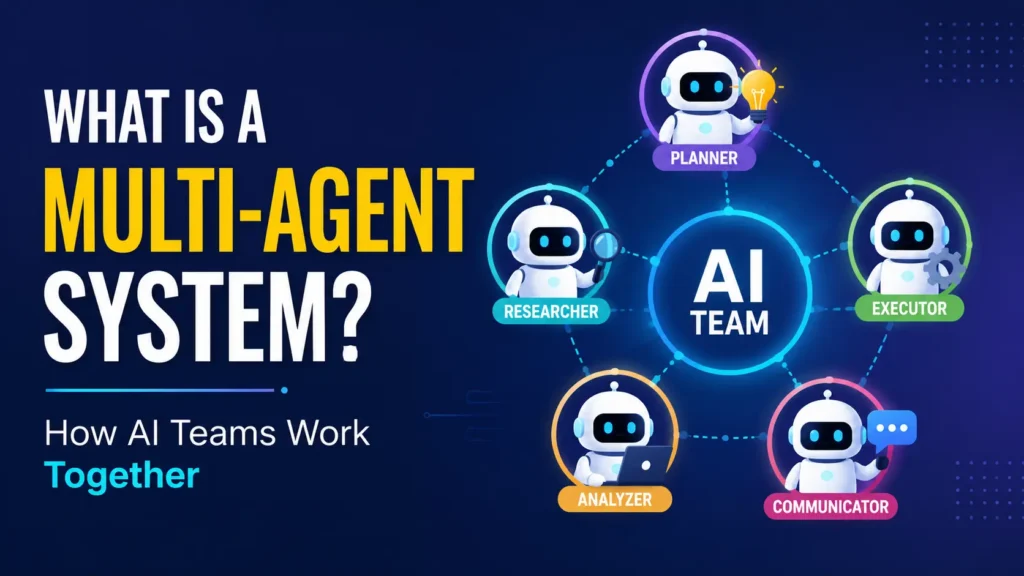
A multi-agent system is an AI architecture where multiple specialised AI agents work together, each handling a different part of a task, to complete a complex goal that a single agent could not achieve alone.
Think of it like a relay race. Each runner handles one leg of the race. They pass the baton at exactly the right moment. The team crosses the finish line together, faster and more efficiently than any individual runner could alone.
In this kind of system, the baton is information. One AI agent completes its piece of work and passes the output to the next agent, which builds on it, and so on, until the final result is delivered.
The key word here is specialised. Each agent is designed for a specific job. One agent might be built for research. Another for writing. Another for quality checking. Another for publishing or delivery. By giving each agent a clear role and letting them collaborate, the system achieves results that are faster, more accurate, and more comprehensive than anything a single AI agent working alone could produce.
To understand how iAgentic AI work before they are combined into one of these systems, our What Is Agentic AI? How AI Agents Are Changing Work, Business, and Careers (With Real-Life Examples) covers the fundamentals clearly.
How a Multi-Agent System Works
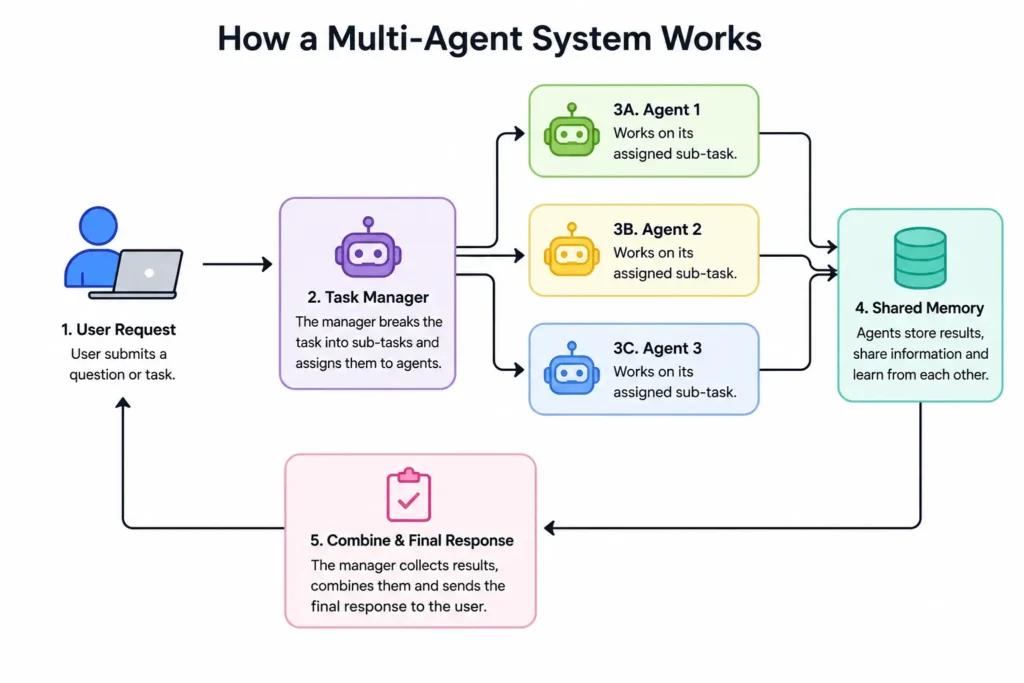
The workflow follows a clear and logical sequence. Here is what happens from start to finish:
Step 1: A goal is received A human gives the system a high-level objective. For example: “Find me the best three candidates for this marketing manager role.”
Step 2: The orchestrator assigns tasks In most systems, there is a coordinating agent called the orchestrator. Its job is to understand the overall goal, break it into subtasks, and assign each subtask to the right specialised agent.
Step 3: Agents work in parallel or sequence Depending on the task, agents can work simultaneously (in parallel) or one after another (in sequence). Research agents and data-gathering agents often run in parallel to save time. Writing or review agents often run in sequence because they depend on the output of a previous step.
Step 4: Agents pass outputs to each other When one agent finishes its job, it passes its output to the next agent in the workflow. This handoff is clean, structured, and automatic inside a well-built system.
Step 5: A final agent compiles the result Once all agents have completed their roles, a final agent assembles everything into a coherent output and delivers it to the human.
Step 6: The human reviews The human reviews the final output, provides feedback if needed, and either approves or sends it back through the system for refinement.
This is what makes the architecture so powerful. Complex work gets broken down, distributed, executed in parallel where possible, and assembled into a polished final result, all with minimal human involvement at every individual step.
To understand the large language models that power each agent in the system, our guide on what is a large language model explains the core technology underneath. Explore Top 100 AI Words You Need to Know
Single Agent vs Multi-Agent System
Before going further, it helps to understand exactly how this approach differs from using a single AI agent for everything.
| Single AI Agent | Multi-Agent System | |
|---|---|---|
| Task handling | One agent does everything | Multiple specialised agents share the work |
| Speed | Sequential, one step at a time | Parallel processing where possible |
| Accuracy | Can lose focus on complex tasks | Each agent stays sharp on its specific role |
| Scalability | Limited by one agent’s context window | Scales by adding more specialised agents |
| Error handling | One failure affects the whole task | Other agents continue while one is fixed |
| Best for | Simple, focused tasks | Complex, multi-step workflows |
The honest truth is that a single AI agent is perfectly good for many everyday tasks. But when a goal has multiple distinct components, requires different types of expertise, or needs to run at scale, this architecture is the right tool.
Real-Life Example 1: Job Recruitment Agency
Picture a busy recruitment agency in New York receiving 400 applications for a single marketing manager role. Two people in the team are supposed to screen them all by Friday.
Without this technology, two humans spend three days reading CVs, cross-referencing LinkedIn profiles, and trying to remember which candidates had the right mix of experience and culture fit. They miss things. They get tired. The shortlist is inconsistent.
With this approach, here is what happens instead:
Agent 1 (CV Scanner) reads all 400 applications and extracts key information including years of experience, skills, previous employers, and education level.
Agent 2 (LinkedIn Verifier) cross-checks each candidate’s CV against their LinkedIn profile and flags any inconsistencies or gaps.
Agent 3 (Job Fit Scorer) compares each candidate’s profile against the specific job description and scores them on a 100-point scale based on match percentage.
Agent 4 (Interview Scheduler) takes the top 20 candidates from Agent 3’s scoring, drafts personalised interview invitation emails, and prepares a calendar of available time slots.
The HR manager arrives Monday morning to a shortlist of 20 scored, verified candidates with interviews already drafted and ready to send. What took two people three days takes the system under two hours.
That is not science fiction. That is the power of this architecture in action.
Real-Life Example 2: Digital News Publishing House
Imagine a small but ambitious digital news outlet covering AI and technology. They want to publish breaking news faster than their competitors but have a lean team.
Here is how a multi-agent system transforms their workflow:
Agent 1 (News Monitor) continuously scans RSS feeds, Twitter, press releases, and industry blogs for breaking stories relevant to their coverage areas.
Agent 2 (Fact Checker) when a story is flagged, this agent verifies the core claims by cross-referencing multiple sources and flags anything unverified or potentially misleading.
Agent 3 (Writer) using the verified facts, this agent drafts a clear, engaging news article in the outlet’s house style, with a strong headline and structured body.
Agent 4 (SEO Optimiser) reviews the draft, inserts relevant keywords naturally, adds a meta description, suggests internal links to related articles, and checks readability score.
Agent 5 (Publisher) formats the final article correctly in WordPress, adds the featured image placeholder, sets the category and tags, and either publishes automatically or queues it for a human editor to approve with a single click.
A story that would take a journalist 90 minutes to research, write, optimise, and publish goes through the system in under 15 minutes. The journalist focuses on original investigative reporting and editorial judgment. The system handles the routine production work.
This is the architecture working as a creative production engine.
Real-Life Example 3: US Real Estate Company
A property buyer in Austin, Texas sends an enquiry to a real estate company:
“I am looking for a three-bedroom family home under $550,000 near a good school district. What do you recommend?”
A single agent could give a generic answer. This approach gives a personalised, research-backed property report.
Agent 1 (Listings Searcher) pulls current three-bedroom properties under $550,000 from Zillow and Realtor.com in the Austin metro area that have been listed in the past 14 days.
Agent 2 (Neighbourhood Analyst) for each property on the list, this agent checks school district ratings from GreatSchools.org, neighbourhood safety scores, proximity to parks and amenities, and average commute times to Austin’s major employment hubs.
Agent 3 (Financial Calculator) calculates estimated monthly mortgage payments for each property based on current US interest rates, a 20 percent down payment, and typical Texas property tax rates.
Agent 4 (Report Writer) compiles everything into a clean, personalised buyer report with the top five properties ranked by overall score, a summary of each neighbourhood, and a side-by-side financial comparison.
The buyer receives a professional, data-rich property report within minutes of sending their enquiry. The real estate agent reviews and sends it with a personal note. The system did the research. The human added the relationship.
That combination is exactly what modern business looks like with this technology in place.
Where Multi-Agent Systems Are Used Today
These systems are already deployed across a wide range of industries. Here is where you will find them right now:
Recruitment and HR: CV screening, candidate scoring, interview scheduling, and onboarding automation as shown in the recruitment example above.
Media and Publishing: News monitoring, fact-checking, content drafting, SEO optimisation, and automated publishing workflows.
Real Estate: Property search, neighbourhood analysis, financial modelling, and personalised buyer reports.
Legal: Case research across multiple databases, contract review, regulatory monitoring, and document summarisation across large case files.
Healthcare: Patient intake processing, appointment coordination, insurance verification, lab result review, and clinical summary preparation.
E-commerce: Inventory monitoring, dynamic pricing, customer query handling, fraud detection, and personalised product recommendation.
Software Development: Parallel code review by multiple specialised agents, security scanning, test generation, documentation writing, and deployment monitoring.
Financial Services: Multi-source market data aggregation, portfolio risk analysis, regulatory filing preparation, and automated client reporting.
Education: Personalised learning path creation, assignment grading, student progress tracking, and parent communication management.
Customer Experience: Multi-channel support coordination where one agent handles email, another handles chat, and a third handles escalations, all feeding into a unified customer record.
Popular Multi-Agent System Frameworks
If you want to build a multi-agent system, these are the leading frameworks used by developers and AI engineers today:
Microsoft AutoGen is the most widely adopted open-source framework for building multi-agent systems. It allows AI agents to converse with each other, debate solutions, check each other’s work, and collaborate toward a shared goal. AutoGen is particularly strong for research and complex reasoning tasks where agent-to-agent dialogue improves output quality.
Read What Is Microsoft AutoGen? Complete Guide to Building Multi-Agent AI Applications
CrewAI is built around the concept of AI crews, meaning teams of agents with defined roles, goals, and tools. You define who does what, and CrewAI coordinates the collaboration. It is one of the most beginner-accessible frameworks for building a multi-agent system without deep technical expertise.
Read What Is CrewAI? Complete Beginner’s Guide to AI Agent Teams
LangGraph uses a graph-based architecture to define the relationships and handoffs between agents in a multi-agent system. It is the best choice for workflows that require conditional logic, meaning where the next agent depends on the result of the previous one rather than following a fixed sequence.
You do not need to be a developer to benefit from this technology today. Platforms like Make.com read our full article Make.com Tutorial: Build AI Workflows With Claude AI – Step-by-Step Guide and Zapier let you build basic multi-agent workflows using visual interfaces with no code required.
Our prompt engineering guide will help you write clear, effective instructions for each agent in your system, which is the single most important skill for getting great results from any multi-agent setup.
Key Benefits of This Architecture
The advantages go beyond simple automation. Here is why organisations are investing in this architecture:
Specialisation produces better results. When each agent focuses on one job it is optimised for, the quality of each step is higher than a single generalist agent trying to do everything.
Parallel processing saves time. Multiple agents working simultaneously on different parts of a task dramatically reduces completion time compared to a single agent working sequentially.
Scalability without limits. Adding more agents to handle more volume is far simpler than scaling human teams. A multi-agent system can handle ten workflows or ten thousand without proportional cost increases.
Built-in error checking. When one agent reviews another’s output before passing it forward, the multi-agent system catches mistakes earlier and produces more reliable final results.
Human focus on what matters. By handling routine, repetitive, information-intensive work, the system frees human professionals to focus on judgment, creativity, relationships, and strategy.
Challenges and Risks Worth Knowing
Like any powerful technology, this technology comes with risks that are worth understanding before deploying one:
Coordination complexity. The more agents in a system, the more complex the coordination becomes. Poorly designed handoffs can cause errors to compound rather than get caught.
Hallucination propagation. If one agent generates incorrect information, the next agent may build on that error rather than catching it, potentially amplifying the mistake through the workflow.
Debugging difficulty. When something goes wrong, tracing exactly which agent made the error and why requires proper logging and monitoring tools.
Cost at scale. Each agent in a multi-agent system makes API calls to a large language model. At high volume, these costs add up quickly and need to be factored into business cases.
Security and data privacy. Agents sharing sensitive information and connecting to external APIs create multiple potential points of vulnerability that need careful security design.
Understanding these challenges does not mean avoiding a multi-agent system. It means building a multi-agent system thoughtfully with proper safeguards in place.
Our agentic AI guide covers the broader risks of autonomous AI systems in depth if you want to understand the wider landscape before building.
Read Challenges and Risks of AI: What Everyone Should Know
What the Future Holds
The trajectory of this technology is pointing toward a world that looks genuinely different from where we are today.
Self-organising agent teams where the system itself decides which agents to spin up, assign, and shut down based on the task requirements, without human configuration of the team structure.
Cross-company agent collaboration where AI agents from different organisations securely share information and collaborate on shared goals, the way human teams from different companies work together on joint projects.
Persistent agent memory where agents in a multi-agent system remember past interactions, learn from previous tasks, and improve their performance over time without retraining.
Physical world integration where multi-agent systems coordinate not just digital workflows but physical ones too, directing robots, drones, and smart devices toward shared goals in warehouses, hospitals, and construction sites.
AI-native organisations where entire business functions are run by multi-agent systems operating continuously, with humans providing strategic oversight rather than operational management.
The organisations and professionals who understand this architecture today will be the ones best positioned to lead, build, and govern these systems as they become the default way complex work gets done.
Our AI basics guide is the perfect starting point if you want to build the foundational AI knowledge that makes everything else, including the multi-agent system, easier to understand and apply.
Explore related articles
Future of AI: 15 Trends and Predictions That Will Shape the Next Decade
How to Build a No-Code AI Agent: From Zero to First Automation
What is a Rational Agent in AI – Powerful Beginner Guide with 4 types
10 AI Agent Tools Must Try in 2026 – Stop Wasting Time Without Them
Explore more in AI Agents AI Learning Hub subscribe to AI Pathway Lab for more AI guides and tutorials
Frequently Asked Questions
What is a multi-agent system in simple terms?
A multi-agent system is an AI architecture where multiple specialised AI agents work together as a team, each handling a different part of a complex task, to achieve a goal that a single agent could not complete alone. Think of it like a well-organised human team where each person has a specific role, except the team members are AI agents collaborating automatically.
How is a multi-agent system different from a single AI agent?
A single AI agent handles all parts of a task by itself, which works well for simple, focused goals. A multi-agent system distributes the work across multiple specialised agents, each optimised for their specific role. This produces faster results through parallel processing, higher quality through specialisation, and better error detection through agent-to-agent review.
What is the best framework for building a multi-agent system?
Microsoft AutoGen is the most widely adopted framework for building a multi-agent system and is excellent for complex reasoning tasks where agents need to debate and verify each other’s work. CrewAI is the most beginner-friendly option for defining agent roles and coordinating teamwork. LangGraph is best for workflows requiring conditional logic and dynamic handoffs between agents.
Do I need coding skills to use a multi-agent system?
Not necessarily. Platforms like Make.com and Zapier allow you to build basic multi-agent workflows using visual no-code interfaces. For more sophisticated multi-agent system builds with custom agent roles and complex logic, frameworks like AutoGen and CrewAI require Python knowledge. Starting with no-code tools is a perfectly valid entry point.
What industries use multi-agent systems today?
These systems are already deployed across recruitment, media and publishing, real estate, legal, healthcare, e-commerce, software development, financial services, education, and customer experience. In each of these industries, a multi-agent system handles complex multi-step information workflows that previously required significant human time and coordination.
Can multi-agent systems make mistakes?
Yes. A multi-agent system can make mistakes, particularly through hallucination propagation where one agent’s error is passed to and built upon by the next agent. Good system design includes review agents specifically tasked with checking the outputs of other agents before passing them forward. Human oversight at key checkpoints remains important, especially for high-stakes decisions.
How do agents communicate in a multi-agent system?
Agents in a multi-agent system communicate by passing structured messages, data outputs, and instructions between each other through a shared coordination layer managed by the orchestrator. Depending on the framework, this communication can take the form of direct agent-to-agent messaging, shared memory stores that all agents can read and write to, or structured handoff protocols that define exactly what information gets passed and in what format.
What is the future of multi-agent systems?
The future of multi-agent systems includes self-organising agent teams that configure themselves based on task requirements, persistent memory that allows agents to learn and improve over time, cross-company agent collaboration, and integration with physical systems like robotics and smart devices. As this technology matures, this architecture will become the default for how complex knowledge work gets done across every industry.
Explore other articles
What Is Retrieval Augmented Generation (RAG)? A Beginner’s Guide With Real Life Examples
Free AI Courses with Certificate in 2026
Explore articles AI Agents