Table of Contents
Introduction to AI Testing Pyramid
The AI testing pyramid is quietly changing everything about how software gets tested. I say quietly because most teams do not realise they are already using parts of it. They adopt a self-healing test tool here, an AI-based test generator there and suddenly their entire testing approach starts to look different.
That shift has a name. It is called the AI testing pyramid.
Traditional testing pyramids have served us well for years. Unit tests at the base. API tests in the middle. UI tests at the top. It was clean, logical, and it worked until the software started moving faster than any team could keep up with manually.
I have worked in QA for years. I have watched good automation suites become expensive maintenance nightmares almost overnight. Tests that passed on Monday would fail on Friday for no visible reason. Hours spent debugging flaky tests instead of finding real bugs.
The AI testing pyramid exists to solve exactly that problem. It takes the familiar three-layer structure and makes each layer smarter, more adaptive, and far less painful to maintain.
This guide covers everything you need to understand about the AI testing pyramid. What it is, how it works, what makes it different from traditional approaches, and how to start using it in your own projects.
If you are exploring how AI is reshaping QA as a profession, take a look at our AI for Testers page for a broader picture.
What is the AI Testing Pyramid?
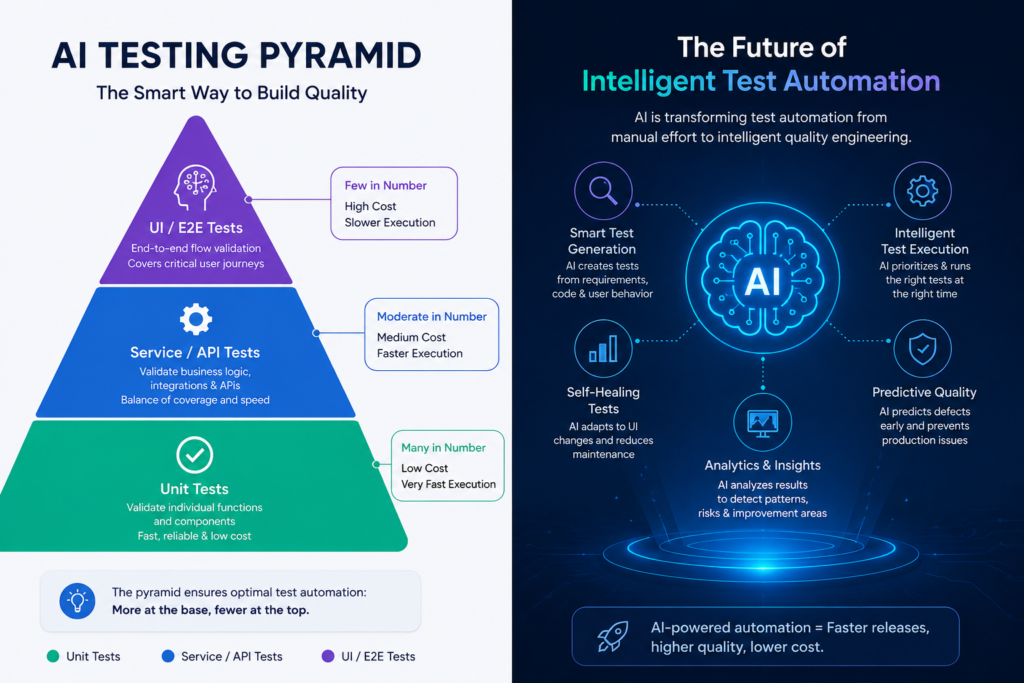
The ai testing pyramid is a structured approach to software testing that applies artificial intelligence across all three traditional testing layers. Unit, API and UI. The goal is to make automation smarter, faster and easier to maintain.
Think of it as the classic testing pyramid with a brain transplant.
In the traditional model, you write tests manually, run them on a schedule and fix whatever breaks. The process is rigid. When the application changes, your tests break. You spend time fixing tests instead of testing new features.
The AI testing pyramid flips this dynamic. Instead of static, manually written test scripts that need constant attention, you get:
- Tests that understand application behaviour and generate themselves
- Automation that detects when a UI element has changed and heals itself automatically
- Predictive systems that flag which areas of code are most likely to fail before you even run a test
- Continuous learning that improves test quality over time
The AI testing does not replace human testers. It removes the repetitive, low-value work so testers can focus on exploratory testing, edge cases, and the judgment calls that AI cannot make alone.
At its core, the AI testing pyramid is built on three principles. Intelligence at every layer, continuous learning from test results and adaptive response to application changes.
For a deeper look at how intelligent agents power this kind of automation, check out our AI Agents guide.
Why Traditional Testing Needs AI
Here is a truth about traditional test automation. It is expensive to build and even more expensive to maintain. Most QA teams spend more time keeping their test suites alive than actually using them to find bugs.
I have been in those conversations. The ones where someone asks why we have 800 automated tests but still ship bugs every release. The answer is almost always the same. The tests are too brittle. They break for the wrong reasons. The team loses confidence in them.
This is not a failure of skill or effort. It is a structural problem with how traditional automation was designed.
As Martin Fowler’s Test Pyramid originally outlined, the pyramid model was designed for stability. Write a test once, run it forever. But modern applications change constantly. New features, UI updates, backend refactors. Any of these can break a test that was perfectly valid the day before.
The AI testing addresses this with a fundamentally different assumption. It assumes the application will change. It builds adaptability into the system from the start.
Beyond maintenance, traditional automation also struggles with coverage. You can only test what someone thought to write a test for. The ai testing pyramid uses AI to analyse user behaviour, code changes and historical failure patterns to identify what needs testing, including things no one thought to check manually.
The result is a more complete, more reliable and far less painful testing process. That is why the testing pyramid is becoming the standard approach for teams serious about quality at speed.
Structure of the AI Testing Pyramid
The AI pyramid follows the same three-layer structure as the traditional pyramid. What changes is what happens inside each layer. Let us walk through each one.
Layer 1: AI-Enhanced Unit Testing
Unit tests form the base of the ai testing pyramid. They are fast, isolated and focused on individual functions or components. In the traditional model, developers write these by hand. In the testing pyramid, AI assists with generation, coverage analysis, and maintenance.
Diffblue Cover is one of the leading tools in this space. It uses AI to automatically write Java unit tests by analysing existing code. Tools like GitHub Copilot and Codium work in a similar way across multiple languages. They analyse function logic, identify edge cases and produce tests that a developer might miss under time pressure.
The AI testing pyramid also uses AI to monitor unit test coverage over time. When new code is added without adequate test coverage, the system flags it immediately. This keeps the base of the pyramid strong and comprehensive without requiring manual oversight.
Self-healing at the unit level means that when a refactor changes a function signature or return type, AI can detect the change and suggest updated tests rather than simply letting them fail.
Layer 2: AI-Enhanced API Testing
The middle layer of the AI testing focuses on API testing. This is where services communicate and where most application logic lives. It is also where some of the most valuable AI testing innovations are happening.
Traditional API testing means writing test cases for known endpoints, expected inputs and expected outputs. The AI testing pyramid goes further by using AI to:
- Generate API test cases from documentation or traffic analysis
- Detect API contract changes and flag breaking changes before deployment
- Identify anomalies in API responses that suggest bugs, even when tests pass
- Prioritise which API tests to run based on recent code changes
Tools like Postman with AI features and Schemathesis bring intelligent API testing closer to what the AI testing pyramid envisions at this layer.
The middle layer of the AI testing pyramid is particularly powerful because APIs are the connective tissue of modern software. Getting this layer right means catching most integration problems before they ever reach the UI.
For more on how automation workflows connect across these layers, explore our AI Automation Workflows guide.
Layer 3: AI-Enhanced UI Testing
The top layer of the AI testing pyramid covers UI testing. This is the layer that has historically been the most painful to maintain. UI tests break constantly because interfaces change. Buttons move, labels update, layouts shift.
The AI testing pyramid transforms UI testing through self-healing automation. Healenium is one of the best open source tools for this. It integrates with Selenium and detects when a UI element has changed, then automatically updates the test selector to match the new state. What used to take hours of manual debugging now resolves itself.
Testim by Tricentis takes this further with AI-powered test authoring and execution that learns from your application over time. It is particularly effective for teams that need fast, stable UI test coverage without a large maintenance overhead.
At this layer, the ai testing pyramid also uses visual AI to catch visual regressions. Rather than just checking whether an element exists, visual AI compares screenshots and flags unintended visual changes that functional tests would completely miss.
The AI testing pyramid keeps UI testing lean by design. Because unit and API layers catch most bugs earlier, fewer tests are needed at the UI level. This keeps the pyramid shape intact and the test suite fast.
How Intelligent Test Automation Works
Intelligent test automation inside the testing pyramid works through a continuous loop of observation, learning and action.
Here is how that loop works in practice.
Observation: The AI system monitors your application, your test results and your code changes continuously. It builds a model of normal behaviour across all three layers of the ai testing pyramid.
Learning: Every test run teaches the system something. Which tests are flaky? Which code areas fail most often? Which changes tend to cause regressions? Over time, the ai testing pyramid gets smarter about your specific application.
Action: Based on what it has learned, the system takes action. It generates new tests for uncovered areas. It heals broken selectors. It prioritises high-risk tests to run first. It skips low-risk tests to save time.
This loop runs continuously. The AI testing pyramid never stops learning and never stops improving.
In practical terms, this means your test suite gets better every sprint without requiring manual effort to maintain it. New features get test coverage automatically. Old tests adapt to application changes. The whole system stays healthy with far less human intervention.
For teams using CI/CD pipelines, the ai testing pyramid integrates directly into the deployment workflow. AI-powered test selection means only the most relevant tests run on each commit, cutting pipeline times significantly while maintaining confidence in the release.
AI Workflows for QA Automation, How to Integrate
Benefits of AI Testing Pyramid
The AI testing pyramid delivers benefits that go well beyond faster test execution. Here are the ones that matter most in real projects.
Reduced maintenance effort. Self-healing tests and AI-assisted updates mean your team spends less time fixing broken automation and more time finding real bugs. This alone is worth the investment in the ai testing pyramid for most teams.
Better test coverage. AI identifies gaps in coverage that manual test design misses. The ai testing pyramid ensures your most critical application paths are always covered, even as the codebase evolves.
Faster feedback loops. Intelligent test selection means the most important tests run first. Developers get feedback in minutes rather than waiting for a full regression suite to complete.
Higher confidence in releases. When your tests are stable, adaptive and comprehensive, you trust them. The ai testing pyramid restores that trust in automation that many teams have lost over the years of brittle scripts.
Scalability. As your application grows, the ai testing pyramid grows with it. AI handles the scaling work that would otherwise require more testers and more manual effort.
Cost efficiency. Fewer hours spent on test maintenance, faster pipelines and earlier bug detection all translate directly into cost savings. The ai testing pyramid pays for itself quickly in teams that have struggled with test suite maintenance.
Challenges and Limitations
The ai testing pyramid is powerful, but it is not without challenges. Being honest about this matters.
Tooling complexity. Implementing the ai testing pyramid requires selecting and integrating multiple AI-powered tools across different testing layers. This takes time, expertise and careful planning.
Data dependency. AI systems learn from historical test data. New projects or applications with limited test history will take longer to see the full benefits of the testing pyramid.
Over-reliance risk. Teams can develop false confidence if they trust AI-generated tests without reviewing them. The ai testing pyramid works best when human judgment guides the system, not the other way around.
Cost of tooling. Many advanced AI testing tools carry significant licensing costs. Smaller teams need to weigh the investment carefully against the scale of their testing challenges.
Skill gap. Using the AI testing pyramid effectively requires testers who understand both automation fundamentals and AI concepts. This is a new skill set that not every QA team has yet.
None of these challenges makes the ai testing pyramid not worth pursuing. They simply mean you need a thoughtful implementation plan rather than a rush to adopt every AI tool at once.
Best Practices for Implementing AI Testing Pyramid
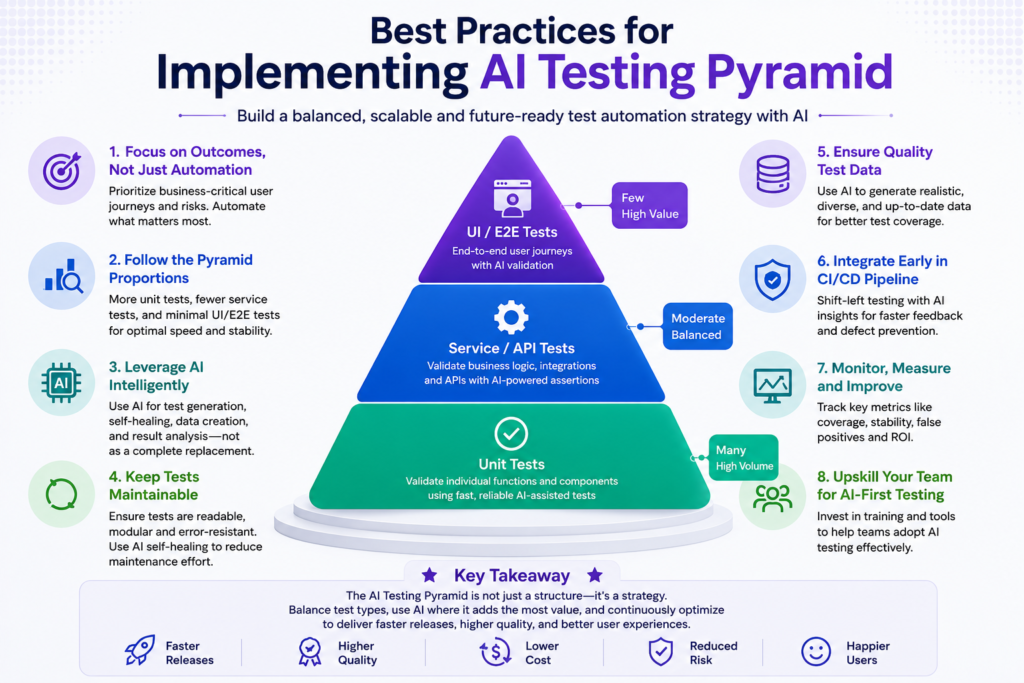
If you are ready to move toward the AI testing pyramid in your team, here are the practices that make implementation smoother.
Start with the base. Get AI-assisted unit testing working well before touching the UI layer. A strong foundation makes every layer above it more effective in the AI testing pyramid.
Choose tools with integration in mind. The AI testing pyramid works best when your tools talk to each other. Prioritise tools that integrate with your existing CI/CD pipeline and reporting systems.
Review AI-generated tests. Do not publish AI-generated test cases without human review. The AI testing pyramid is a collaboration between AI capability and human judgment, not a replacement for it.
Track metrics that matter. Measure test stability, coverage trends and mean time to detect bugs. These metrics show whether your AI testing pyramid implementation is actually improving quality.
Upskill your team. Invest in helping your QA team understand how the ai testing pyramid tools work. Testers who understand the AI layer make better decisions about what to automate and what to explore manually.
Iterate gradually. The AI testing pyramid does not have to be implemented all at once. Start with one layer, prove the value and expand from there.
For guidance on how to build the skills needed for intelligent automation, our Prompt Engineering Guide – The Skill That Makes You 10x FasterPrompt Engineering Guide is a great starting point.
Future of AI-Powered Test Automation
The AI testing pyramid, as we know it today, is still early. The tools are maturing rapidly, and the possibilities are expanding every year.
Here is where the ai testing pyramid is heading.
Fully autonomous test generation. AI systems will move from assisting with test creation to owning it entirely for large portions of the application. Human testers will focus on reviewing, guiding and exploring edge cases.
Predictive quality gates. Rather than waiting for tests to fail, future versions of the AI testing pyramid will predict failure probability before a build even runs, blocking high-risk deployments automatically.
Natural language test authoring. Testers will describe what they want to test in plain language and the AI testing pyramid will generate, execute and report on those tests automatically. No code required.
Deeper integration with development. The boundary between writing code and writing tests will blur. AI will generate tests in real time as developers write features, making the ai testing pyramid a native part of the development experience rather than a separate QA activity.
Cross-platform intelligence. The ai testing pyramid will manage test coverage across web, mobile and API simultaneously, using shared intelligence to avoid redundant testing and maximise coverage efficiency.
The direction is clear. The ai testing pyramid is evolving from a smarter version of what we already do into something genuinely new. A self-managing quality system that learns, adapts and improves continuously.
Conclusion
The AI testing pyramid is not a trend. It is a response to a real problem that every QA team faces. How to maintain quality when applications change faster than any manual process can keep up with.
By bringing intelligence into unit testing, API testing and UI testing, the AI testing pyramid gives teams the coverage they need without the maintenance burden that has made traditional automation so costly. It makes tests smarter, more stable and more useful.
I am not suggesting the AI testing pyramid replaces human testers. It does not. What it does is remove the repetitive, frustrating work that stops good testers from doing what they are actually good at. Finding the bugs that matter.
Whether you are just starting with test automation or looking to modernise a suite that has become hard to manage, the AI testing pyramid gives you a clear structure to work toward.
Start with the base. Add intelligence gradually. Let the tools learn your application. And keep your own judgment at the centre of every decision the system makes.
That combination of human insight and AI capability together is what makes the ai testing pyramid genuinely powerful.
For more on how AI is reshaping the testing profession, visit our AI for Testers hub and explore the full range of tools and strategies available to modern QA teams.
Frequently Asked Questions
What is the ai testing pyramid?
The ai testing pyramid is a structured approach to software testing that applies artificial intelligence across unit, API and UI testing layers to make automation smarter, more stable and easier to maintain than traditional testing methods.
How is the ai testing pyramid different from the traditional testing pyramid?
The traditional testing pyramid relies on manually written, static test scripts. The ai testing pyramid adds intelligence to each layer through AI-powered test generation, self-healing automation, predictive failure detection and continuous learning from test results.
What tools are used in the AI testing pyramid?
Common tools include Testim and Healenium for UI testing, Postman with AI features for API testing, and Diffblue Cover or GitHub Copilot for unit test generation. The right combination depends on your stack and testing goals.
Is the AI testing pyramid suitable for small teams?
Yes, though smaller teams should start with one layer and expand gradually. The biggest immediate benefit for small teams is reduced test maintenance effort, which frees up capacity even when resources are limited.
Do I need AI expertise to implement the ai testing pyramid?
You do not need deep AI expertise. Most tools in the AI testing pyramid ecosystem are designed for QA professionals rather than data scientists. A solid understanding of test automation fundamentals, combined with a willingness to learn new tools, is enough to get started.
Will the AI testing pyramid replace QA engineers?
No. The ai testing pyramid handles repetitive, rule-based testing tasks. Human QA engineers remain essential for exploratory testing, edge case analysis, risk assessment and the strategic decisions that keep quality standards high. AI makes testers more effective, not redundant
Explore more on AI Pathway Lab:
- AI for Testers
- AI Agents
- Prompt Engineering for QA Agents – Best Practices Complete Guide-10x faster Work
- AI Workflows for QA Automation: How to Integrate
- Blog
- AI Test Case Generation Guide for QA Engineers Using ChatGPT and Claude
- 10 Best AI Based Testing Tools That Will Transform Your QA Career – Don’t Get Left Behind
- AI Tester Workflow That Makes You 10x Faster – Stop Manual