Table of Contents
The idea that AI is only for people who can code keeps a lot of capable people on the sidelines. It is also not true. Non-technical AI jobs are not just possible, they are one of the fastest-growing categories in the field right now, precisely because companies adopting AI need far more than engineers. They need people who can write good prompts, evaluate AI output, train teams, manage AI projects, and explain what these tools actually do to a room full of non-experts.
This guide walks through what “non-technical” really means in an AI context, the most common non-technical AI jobs available today, the skills worth learning first, free tools to start practicing with, a realistic 90 day roadmap, and the myths that stop good candidates from even applying.
What Do Non-Technical AI Jobs Actually Mean?
In most job postings, “non-technical” does not mean “no skills required.” It means the role does not require writing or maintaining code. Non-technical AI jobs can still involve serious skill, including structured thinking, clear writing, data literacy, and a working understanding of how AI models behave.
The confusion usually comes from lumping every AI-related job into one category. Building a machine learning model is technical work. Writing the prompts and workflows that make an AI tool useful inside a company is not. Both are valuable. Only one requires programming, and that distinction is exactly what separates non-technical AI jobs from engineering roles.
A useful way to think about it: technical AI roles build the underlying systems. Non-technical AI jobs apply those systems to real problems, communicate the results, and keep the human side of the process working correctly. Neither is lesser than the other. They are different jobs that happen to sit in the same industry.
Can You Really Work in AI Without Coding?
Yes, and the demand for non-technical AI jobs is growing quickly. Recent labor market data backs this up. LinkedIn data reported through the World Economic Forum shows the global economy has added 1.3 million new AI-related jobs in just two years, and many of these sit outside traditional engineering. Roles like AI consultants and strategists are among the fastest-growing on LinkedIn, and these positions typically lean on communication, domain expertise, and strategic thinking rather than programming ability.
The World Economic Forum’s Future of Jobs Report 2025 draws on data from over 1,000 employers and consistently points to a mix of technical and human skills as the winning combination for the next several years. That combination is exactly what non-technical AI jobs are built on: understanding what AI can do, paired with the judgment to apply it well.
None of this means coding is worthless. It means coding is one entry point among several, not the only one, and this represents a genuinely separate path rather than a smaller version of an engineering career.
Non-Technical AI Jobs That Don’t Require Programming
These are some of the most common non-technical AI jobs, and they show up regularly in job postings without listing programming as a requirement.
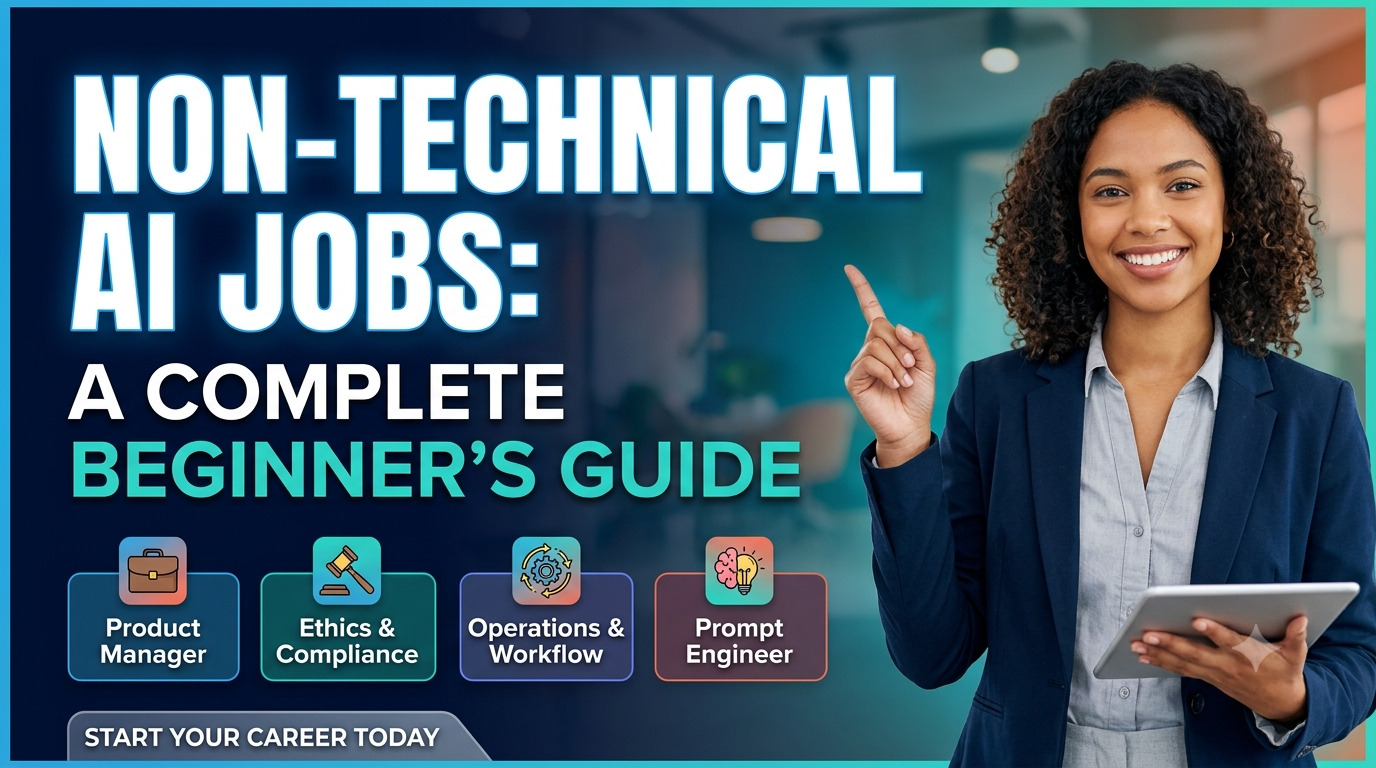
AI prompt specialist or prompt engineer (applied, not technical)
Writes and refines prompts for internal tools, customer-facing chatbots, or content workflows. Requires strong writing skills and an understanding of how models respond to different instructions, not code. This is one of the most visible roles in this category precisely because prompt quality has such a direct effect on output quality.
Explore Prompt Engineering Guide
AI content strategist.
Plans how a company uses AI-generated content, sets quality standards, and manages the editorial review process. Draws heavily on existing content and marketing skills.
AI product coordinator or AI project manager
Manages timelines, requirements, and communication between technical teams and business stakeholders on AI-related projects. Project management experience transfers directly into this category of work.
AI trainer or AI quality reviewer
Evaluates AI output for accuracy, bias, and tone, often for companies fine-tuning models or reviewing chatbot conversations. Strong judgment and attention to detail matter more than technical background.
AI-focused customer support or AI implementation specialist.
Helps customers or internal teams adopt AI tools correctly, troubleshoots usage issues, and gathers feedback. Customer-facing experience is a direct advantage in this type of role.
AI consultant or AI strategist.
Advises businesses on where and how to apply AI tools. Often draws on existing industry expertise combined with AI literacy rather than a technical degree.
AI-enabled marketing or sales roles.
Uses AI tools for research, campaign generation, and personalization at scale. Builds on existing marketing or sales skills with an AI layer added on top.
A real example of this shift: consider someone like Rachel, a customer support lead in Ohio with no programming background. Rather than switching industries, she moved into an AI implementation specialist role at her own company, training staff to use a new AI ticketing tool and refining the prompts behind it. Her value came from already understanding the support workflow, not from learning to code.
Explore Future of AI trends
If you want to learn AI basics Explore this Article AI Basics
More Non-Technical AI Jobs to Consider
Beyond the roles above, a growing number of non-technical AI jobs sit inside departments that already exist, just with an AI layer added on top.
AI research assistant (applied). Gathers, organizes, and summarizes information using AI research tools, then packages findings for teams that need to make fast decisions. This role rewards curiosity and organization far more than technical skill.
AI policy or ethics coordinator. Helps a company think through responsible AI use, data privacy, and disclosure practices. Often draws on backgrounds in compliance, legal support, or HR rather than engineering.
AI-enabled operations analyst. Uses AI tools to identify inefficiencies, summarize reports, and support process improvement work. A natural fit for anyone already comfortable with spreadsheets and reporting.
AI curriculum designer or AI trainer for teams. Builds internal training materials that help non-technical staff use AI tools confidently. Teaching or instructional design experience transfers well here.
AI community manager. Manages user feedback, forums, or support channels for AI products, translating user pain points back to product teams. Community management experience is directly relevant.
Each of these non-technical AI jobs proves the same point from a different angle: the fastest-growing opportunities in AI are not limited to people who can build the technology. They belong just as much to people who know how to apply it well.
Skills You Should Learn First
Before touching a specific tool, a few foundational skills make everything else easier and apply across nearly every category of non-technical AI jobs.
- AI literacy. Understand what large language models are, what they are good at, and where they reliably fail. This alone prevents costly mistakes later.
- Prompt writing. Learning to write clear, specific instructions is the single highest-leverage skill for non-technical AI jobs. It applies across nearly every AI tool on the market.
- Critical evaluation of AI output. AI tools produce confident-sounding answers that are sometimes wrong. Knowing how to fact-check and spot errors is essential, especially in client-facing or regulated work.
- Basic data literacy. Reading a chart, spotting a flawed conclusion, and understanding what a dataset can and cannot tell you go a long way, even without any statistics background.
- Communication and documentation. Translating AI capabilities into plain language for non-expert colleagues is a skill in itself, and one that technical teams often lack.
- Domain expertise. Existing industry knowledge, whether in healthcare, retail, education, or finance, becomes more valuable once paired with AI literacy, not less. This is often what separates a strong candidate for non-technical AI jobs from a generic one.
Notice that none of these require a programming language. They require curiosity, practice, and a habit of testing tools rather than reading about them.
Explore AI Basics Page AI Lerning Hub, AI Career Pathways
Free Tools to Start Practicing
Hands-on practice matters more than reading theory. These are accessible starting points with no coding involved, and they cover most of what these roles actually expect a candidate to know.
- Claude, ChatGPT, or Gemini for direct, everyday prompting practice across writing, research, and problem-solving tasks.
- Google’s AI Essentials course on Coursera, a free, beginner-friendly course built specifically for people with no technical background.
- NotebookLM for practicing document summarization and structured research using AI without any setup.
- Canva’s AI features for a low-stakes way to see how AI assists with creative and design tasks.
- Free tutorials on prompt engineering, which build the single most transferable skill on this list.
The goal at this stage is not mastery. It is building comfort and pattern recognition, learning what kinds of prompts get better results and how different tools handle the same request differently.
Explore more AI Tools
A 90-Day Roadmap to Land Non-Technical AI Jobs
Days 1 to 30: Build the foundation. Focus entirely on AI literacy and prompt writing. Use Claude, ChatGPT, or Gemini daily for real tasks, not test questions. Complete one beginner-level free course. Start keeping a simple log of prompts that worked well and ones that did not, along with why.
Days 31 to 60: Specialize and practice publicly. Pick one role category from the non-technical AI jobs list above that matches existing background, whether that is marketing, support, project management, or another field. Start applying AI tools directly to that kind of work. Share a few short posts or examples of AI-assisted work on LinkedIn to start building visibility. This is also a good window to explore in more depth and get familiar with how AI agents and automated workflows actually function.
Days 61 to 90: Apply and network. Update a resume and LinkedIn profile to highlight AI tool experience alongside existing domain skills. Start applying specifically to non-technical AI jobs that combine the two, rather than roles asking for AI expertise alone. Reach out to people already working in AI-adjacent roles for short conversations. Keep practicing daily, since consistency matters more than intensity at this stage.
This roadmap is intentionally realistic. Ninety days will not produce deep technical expertise, and it does not need to for most non-technical AI jobs. It produces enough fluency, evidence, and direction to start applying for real roles with confidence.
Common Myths About Non-Technical AI Jobs
Myth: Every AI job requires a computer science degree. Most companies hiring for non-technical AI jobs care far more about practical fluency with AI tools and domain expertise than formal credentials.
Myth: Non-technical AI jobs are lower-paying or less serious. Roles like AI consultant, AI strategist, and AI product coordinator often pay competitively because they combine AI literacy with skills that are already in short supply, such as judgment, communication, and industry knowledge.
Myth: It takes years to become employable in AI. Genuine AI fluency for non-technical AI jobs can be built in a few focused months, not years, because the barrier is practice and comfort with the tools, not a long academic track.
Myth: If AI can do the task, there is no role for a human. Every AI tool in production still needs people to guide it, check its output, and decide how it should be used. That oversight is the job itself, not a temporary gap before automation finishes the work.
Myth: Switching into AI means starting a career over. Most successful transitions into non-technical AI jobs build directly on existing experience. A marketer moving into AI-enabled marketing, or a support lead moving into AI implementation, is not starting over. They are adding a new layer to skills they already have.
Non-technical entry points also show up naturally across adjacent fields worth exploring,
Explore more articles from AI blogs AI Learning Hub subscribe to AI Pathway Lab
- What Are AI Agents? Complete Beginner Guide 2026
- 12 Proven Ways to Make Money With AI That Actually Work
- How to Become an AI Engineer in 2026: Complete Roadmap
- Free AI Courses with Certificate in 2026
- Claude AI to Earn Money Guide: 4 Proven Ways That Actually Work
- Claude Tutorial for Beginners: Master AI in 20 Minutes (Step-by-Step Guide)
- How to Sell Claude AI Prompts Online: A Complete Passive Income Guide
Frequently Asked Questions
Do I need to learn to code to work in AI?
No. Many non-technical AI jobs focus on strategy, communication, quality review, and implementation rather than building the underlying technology. Coding helps for engineering-focused roles specifically, not for AI work in general.
What is the fastest way to break into non-technical AI jobs with no technical background?
Start using AI tools daily for real work, build visible examples of that work, and target roles that combine AI literacy with an existing skill set like marketing, support, or project management.
Are non-technical AI jobs well paid?
Many are, particularly roles like AI consultant, AI strategist, or AI product coordinator, since they combine in-demand AI fluency with skills that are already valuable on their own.
How long does it take to become job-ready for non-technical AI jobs?
A focused 60 to 90 day period of daily practice, combined with one or two free courses, is often enough to reach a credible starting point for entry-level or transitional roles.
What is the difference between an AI job and an AI engineering job?
An AI engineering role builds and maintains the technology itself, which requires programming. Non-technical AI jobs apply, manage, or communicate about that technology instead, which does not require it.
Can someone switch to non-technical AI jobs from a completely unrelated career?
Yes. Most successful transitions into non-technical AI jobs succeed by pairing existing domain expertise, whether in healthcare, education, retail, or another field, with newly built AI literacy, rather than discarding that experience entirely.
Which non-technical AI jobs are the easiest to start with?
Roles that build on an existing skill set tend to be the easiest entry point, such as AI-enabled marketing for someone already in marketing, or AI implementation support for someone already in customer service.
Conclusion
The idea that AI careers belong only to engineers has already fallen behind the reality of the job market. Companies rolling out AI tools need people who can write clear prompts, judge whether an output is actually good, train colleagues, manage rollouts, and translate what these systems do into plain language. None of that requires a line of code.
The path forward is not complicated. Pick one role from the list above that fits an existing background, spend focused time building comfort with the free tools already covered, and follow the 90 day roadmap step by step. Most people who make this transition are not starting a new career from zero. They are adding an AI layer to a skill set they already have, and that combination is exactly what makes them a strong candidate in this space today.