Table of Contents
If you have used ChatGPT, Claude, or Google Gemini, you have already interacted with a large language model. But what exactly is one, how does it work, and why does it matter for your career and daily life? This guide breaks it all down in plain English with real examples, zero technical jargon, and practical steps you can take today.
By the end of this article, you will understand what a large language model is, how it learns, which tools are built on them, and how to start using them immediately.
What Is a Large Language Model?
A large language model is a type of artificial intelligence trained on massive amounts of text data to understand and generate human language. The word “large” refers to both the size of the training dataset and the number of parameters, which are the internal settings the model uses to make decisions.
Think of it as an extremely well-read assistant that has processed billions of web pages, books, research papers, and articles. It has not memorised all of that content word for word. Instead, it has learned patterns, relationships between words, and how ideas connect across topics.
When you type a question into ChatGPT or Claude, a large language model reads your input, predicts the most useful and accurate response based on everything it has learned, and generates text that answers your query. This all happens in seconds.
The technology is different from a traditional search engine. A search engine finds existing pages that match your keywords. A large language model generates a brand new response tailored specifically to your question.
How Does a Large Language Model Work?
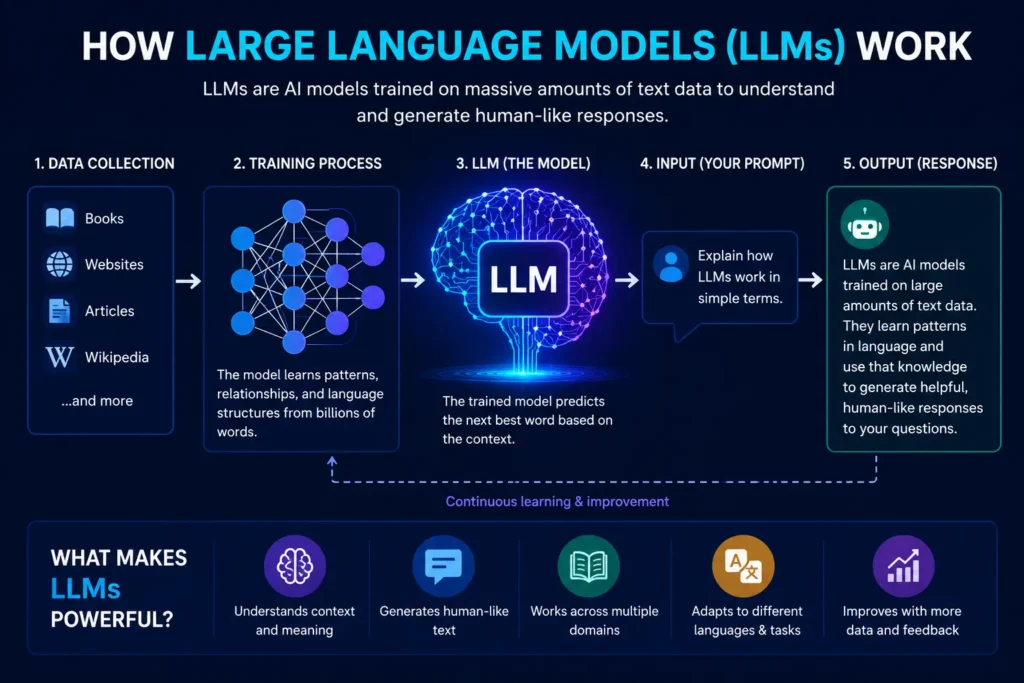
Understanding how a large language model works does not require a computer science degree. Here is the process broken into three stages.
Stage 1: Pre-Training on Massive Data
Before the model can answer any question, it goes through a training phase. During pre-training, it reads through an enormous dataset that typically includes:
- Websites and web pages (Common Crawl dataset)
- Books and academic papers
- Wikipedia articles
- Code repositories like GitHub
- News articles and forums
During this phase, the model learns to predict the next word in a sentence over and over billions of times. This simple task is what teaches it grammar, facts, reasoning patterns, and even tone.
GPT-4, for example, was trained on an estimated 1 trillion tokens of text. A token is roughly three-quarters of a word, so one trillion tokens represents hundreds of billions of words. That is more text than any human could read in thousands of lifetimes.
Stage 2: Fine-Tuning for Helpfulness
Raw pre-training produces a model that can generate text, but not necessarily helpful or safe text. The second stage is fine-tuning, where human trainers rate model responses and teach it to be more accurate, honest, and useful.
This is where a LLM learns to follow instructions, avoid harmful outputs, and give structured answers. Anthropic uses Constitutional AI for Claude, while OpenAI uses Reinforcement Learning from Human Feedback (RLHF) for ChatGPT. Both approaches make the model far more practical for everyday use.
Stage 3: Inference (Answering Your Questions)
Once trained, the large language model is deployed and ready to use. Every time you send a message, it processes your input and generates a response token by token. This is why you sometimes see AI responses appear word by word rather than all at once.
The model does not look up answers in a database. It generates each word based on probability, context, and everything it learned during training. This is what makes it feel like a conversation rather than a keyword search.
Why Are Large Language Models Important?
A large language model is not just a chatbot. It is a general-purpose reasoning engine that can be applied to hundreds of tasks across almost every industry.
Here is why the large language model matters right now:
Productivity at scale. These AI systems can draft emails, summarise long documents, write code, and create reports in seconds. Tasks that took hours now take minutes.
Accessible AI for everyone. You do not need to know how to code to use these tools. If you can type a sentence, you can use one. This democratises access to powerful AI capabilities.
Foundation for other AI products. Almost every major AI product built today sits on top of an LLM. Customer service bots, AI writing assistants, coding tools, and search engines all use one at their core.
Career relevance. Knowing how to work with a large language model is becoming as fundamental as knowing how to use a spreadsheet. If you are building toward an AI career, understanding LLMs is your starting point.
Large Language Model Examples: The Top Tools in 2026
Here are the most widely used large language model tools available today, with a brief description of what makes each one useful.
ChatGPT (OpenAI)
ChatGPT is the AI product that introduced mainstream audiences to conversational AI. Built on the GPT-4o model, it handles text, images, and voice. It is widely used for writing, brainstorming, coding assistance, and customer support automation.
Best for: General productivity, content creation, and coding help. Access: chat.openai.com (free and paid tiers)
Claude (Anthropic)
Claude is a large language model developed by Anthropic with a strong focus on safety, accuracy, and long-context reasoning. Claude can process up to 200,000 tokens in a single conversation, making it exceptional for analysing long documents, research reports, and complex writing projects.
Claude is the large language model this site is built around. If you want to learn how to use it effectively, our Claude tutorial for beginners is the best place to start.
Best for: Long document analysis, research, and safety-critical applications. Access: claude.ai (free and paid tiers)
Google Gemini
Gemini is Google’s AI model family, with versions ranging from Gemini Nano (on-device) to Gemini Ultra (enterprise). It is deeply integrated with Google Search, Google Docs, and Google Workspace, making it practical for users already in the Google ecosystem.
Best for: Google Workspace integration and multimodal tasks (text plus image plus video). Access: gemini.google.com (free and paid tiers)
Meta Llama 3
Llama 3 is Meta’s open-source AI model. Unlike ChatGPT or Claude, it can be downloaded and run locally on your own hardware, giving developers and researchers full control without sending data to a third party.
Best for: Developers, researchers, and privacy-focused deployments. Access: meta.ai or via Hugging Face
Microsoft Copilot
Microsoft Copilot is an AI assistant powered by GPT-4 and integrated directly into Microsoft 365 products including Word, Excel, Outlook, and Teams. For enterprise users already in the Microsoft ecosystem, Copilot brings AI capabilities directly into existing workflows.
Best for: Enterprise Microsoft 365 users. Access: microsoft.com/copilot
Explore more about these tools AI Tool Comparison: ChatGPT vs Claude vs Gemini vs Copilot – Pros, Cons & Best Uses
Large Language Model vs Traditional AI: What Is the Difference?
Many people confuse a large language model with older AI systems. Here is a simple comparison.
Traditional AI (rule-based): Follows a fixed set of if-then rules written by programmers. It can only handle situations it was explicitly programmed for. A traditional chatbot, for example, can only answer questions from a predefined list.
Large language model (learning-based): Learns patterns from data rather than following fixed rules. It can handle questions it has never seen before by reasoning from what it has learned. This is why LLMs feel so much more flexible and natural to interact with.
The key difference is generalisation. A traditional AI system is narrow and brittle. An LLM is general-purpose and adaptive.
What Can You Do with a Large Language Model Today?
Here are ten practical things anyone can do with a large language model right now, no technical skills required.
- Summarise a long PDF or research report in seconds
- Draft professional emails from a one-line brief
- Generate social media captions for an entire week
- Explain complex topics in simple language
- Translate content into multiple languages
- Write and debug code with plain English instructions
- Create interview preparation questions for any job role
- Build a content calendar for a blog or social channel
- Analyse data and identify patterns from a spreadsheet paste
- Answer customer questions through an AI-powered chatbot
These tasks all run through the same interface: a text input box. You describe what you need, and the AI generates a response.
To get better results, the quality of your instructions matters enormously. Our prompt engineering guide shows you exactly how to write prompts that get consistently great outputs.
Limitations of a Large Language Model
No guide on the large language model is complete without an honest look at its limitations. Understanding these will help you use AI tools more effectively.
Hallucinations. These systems can generate confident-sounding text that is factually wrong. This happens because the model predicts likely language rather than verifying facts in real time. Always double-check important facts from any AI output.
Knowledge cutoff. Most LLMs are trained on data up to a specific date. They do not know about events after their training cutoff unless they have a web search tool attached.
Context window limits. While models like Claude support very long contexts, there are still limits to how much text the system can process in one conversation.
Bias from training data. These systems learn from human-generated text, which contains human biases. This can surface in outputs, especially on sensitive or contested topics.
No persistent memory by default. Most LLMs do not remember previous conversations unless the product you are using has a memory feature built in.
Knowing these limitations makes you a smarter, more effective AI user.
How to Get Started with a Large Language Model
If you are new to AI, here is the simplest path to getting started with a large language model today.
Step 1: Pick one tool. Start with Claude at claude.ai or ChatGPT at chat.openai.com. Both have free tiers that give you full access to a powerful AI assistant with no credit card required.
Step 2: Start with a real task. Do not just experiment randomly. Bring a real work task, such as an email you need to write, a document you need to summarise, or a question you have been researching. Using a real task makes the learning stick.
Step 3: Learn basic prompting. The quality of your instructions determines the quality of your output. A vague prompt gives a vague answer. A specific, detailed prompt gives a far better result. Our AI basics guide covers the fundamentals of communicating effectively with AI.
Step 4: Explore tools built on LLMs. Once you are comfortable with direct chat interfaces, explore tools like Notion AI, Jasper, Perplexity, and GitHub Copilot, all of which are purpose-built on top of these models for specific workflows.
Step 5: Keep learning. The LLM space moves fast. Anthropic, OpenAI, and Google release new model updates regularly. Following AI news and communities will keep you ahead of the curve.
To understand where the large language model fits in the broader AI landscape, read our generative AI guide, which covers the full picture of AI tools and how they connect.
Frequently Asked Questions About Large Language Models
What is a large language model in simple terms?
A large language model is an AI system trained on billions of words of text that learns to understand and generate human language. It works by predicting the most useful next word based on patterns learned during training. Tools like ChatGPT, Claude, and Google Gemini are all built on a large language model at their core.
Is ChatGPT a large language model?
Yes, ChatGPT is built on GPT-4o, which is LLM developed by OpenAI. The large language model is the underlying AI technology, and ChatGPT is the consumer product built on top of it. Other products built on LLMs include Claude by Anthropic and Gemini by Google.
How is a large language model different from a search engine?
A search engine retrieves existing web pages that match your keywords. An LLM generates a completely new response based on patterns it learned during training. The key difference is that search engines find content while a large language model creates it. This makes LLMs far more useful for writing, analysis, and reasoning tasks.
Can a large language model replace human writers?
A large language model cannot fully replace human writers because it lacks lived experience, original opinions, and genuine creativity. It is best used as a writing assistant that drafts, edits, and structures content faster. The most effective approach is a human directing the LLM rather than removing the human from the process entirely.
Is a large language model safe to use?
For everyday productivity tasks, a large language model is safe to use. Leading providers, including Anthropic, OpenAI, and Google, invest heavily in safety research and content moderation. However, you should never share sensitive personal data such as passwords, financial details, or private medical information in any AI chat interface.
What does LLM stand for?
LLM stands for large language model. It is the technical term for AI systems trained on massive text datasets to understand and generate human language. When you see LLM mentioned in AI articles, news, or job descriptions, it refers to the same technology powering tools like ChatGPT, Claude, Gemini, and Copilot.
How big is a large language model?
A large language model is measured in parameters, which are the internal settings the model uses to make decisions. GPT-4 is estimated to have over one trillion parameters. More parameters generally means better reasoning and language understanding, though model architecture and training data quality matter just as much as raw size.
Which large language model is best for beginners?
Claude and ChatGPT are the best large language model options for beginners. Both have free tiers, simple chat interfaces, and strong safety guardrails that make them easy and safe to start with. Claude is particularly strong for reading and analysing long documents, while ChatGPT is widely used for general writing and coding tasks.
Can I use a large language model for free?
Yes. Several large language model tools offer free access, including Claude at claude.ai, ChatGPT at chat.openai.com, and Google Gemini at gemini.google.com. Free tiers have some usage limits but are more than enough to explore the technology, complete everyday tasks, and decide which tool suits your workflow best.
How do I learn more about large language models?
The Anthropic Academy offers free courses on Claude and AI fundamentals. The Google AI Essentials course is another excellent free starting point. For hands-on learning, the fastest approach is to pick one large language model tool, bring a real task, and experiment daily. Reading AI news from sources like The Verge AI section and MIT Technology Review will keep your knowledge current.
anthropic. AcademyLearn Digital. Grow with google
Final Thoughts
A large language model is the most transformative technology of this decade. It is already reshaping how we write, code, research, and communicate. Understanding what one is, how it works, and how to use it puts you ahead of the majority of professionals in almost every field.
You do not need to be a developer or data scientist to benefit from a large language model. You just need to start. Pick a tool, bring a real task, and experiment. The AI will do the heavy lifting.
Explore other articles
- What Are AI Agents? Complete Beginner Guide 2026
- How to Become an AI Engineer
- Free AI Courses with Certificate in 2026
- Earn Money with AI
- Claude AI tutorials
- Blogs – Pathway Lab