- Why AI based Testing Tools Matter Right Now
- What Makes a Genuine AI Based Testing Tools
- 1. Katalon – The All-in-One AI Testing Platform
- 2. Playwright – The Modern Standard for AI-Powered Test Generation
- 3. Applitools – The Pioneer of Visual AI Testing
- 4. mabl – Autonomous Testing for Modern Teams
- 5. testRigor – Testing in Plain English
- 6. Testim – Solving the Flaky Test Problem with AI
- 7. Functionize – Natural Language Processing for Test Creation
- 8. GitHub Copilot – AI Code Generation for QA Engineers
- 9. Claude AI – The Thinking Partner Every QA Engineer Needs
- 10. TestRail – AI Enhanced Test Management
- How to Get Started with AI Based Testing Tools
- The Honest Truth About AI in QA
- What Comes Next in This Series
- Frequently Asked Questions
- Final Thoughts
These 10 best AI based testing tools can transform your career into an AI automation tester. The way we test software is changing faster than most people realise.
Not long ago, being a great QA engineer meant writing detailed test cases, executing them manually and documenting every bug with precision. That skill set built careers. It paid well. It was respected.
But something fundamental has shifted.
Today, the most in-demand QA engineers are not just the ones who can write test scripts. They are the ones who know how to work alongside AI – using intelligent AI-based Testing Tools that write scripts automatically, heal broken tests without human intervention and detect visual bugs that human eyes would miss entirely.
This is not a distant future prediction. This is happening right now across software teams globally.
If you are in QA today – whether you are a manual tester, an automation engineer or a QA lead – understanding AI based Testing Tools is no longer optional. It is the single most important career investment you can make in the AI era. Check out our Prompt Engineering Guide – The Skill That Makes You 10x Faster
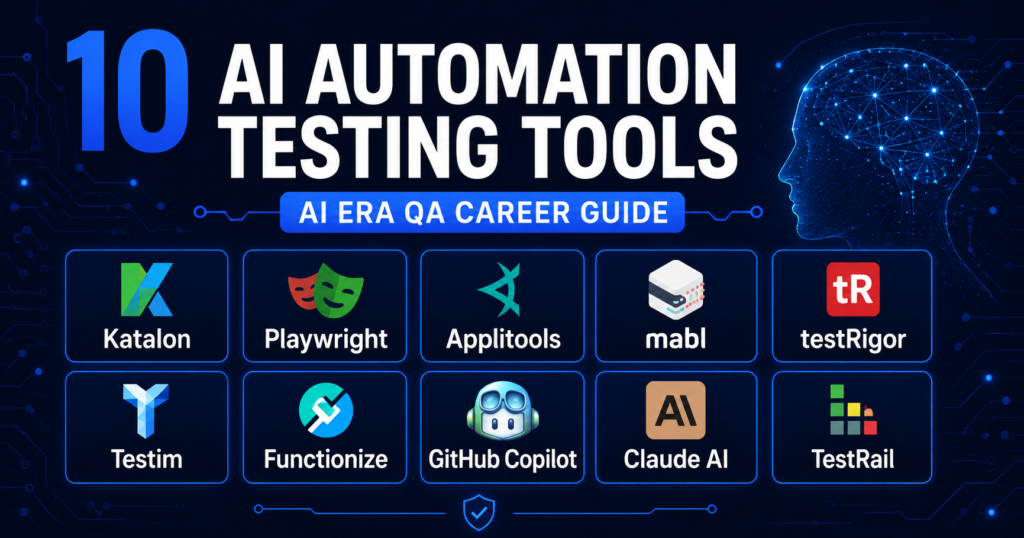
In this guide, we are covering 10 AI based testing tools that are genuinely transforming how QA teams work. Not hype. Not theory. Real tools that real teams are using right now to deliver better software faster.
Let us get into it.
Why AI based Testing Tools Matter Right Now
Before we look at the tools, it is worth understanding why this shift is happening so rapidly.
Traditional test automation has always had a fundamental problem. Tests break. Constantly.
Every time a developer changes a button, moves an element or updates a form, dozens of automated tests fail. Not because the application is broken. Just because something moved on the screen.
QA engineers end up spending more time fixing broken tests than actually testing. It is frustrating, time-consuming and completely unsustainable as applications grow more complex.
AI based testing tools solve this problem in a way that was simply not possible before. They use machine learning to understand your application – not just its current state but its intent. When something changes, these tools adapt automatically. Tests heal themselves. Scripts update without manual intervention.
The result is a QA team that spends less time on maintenance and more time on what actually matters – finding the bugs that impact real users.
According to recent industry research, 81% of development teams are now using AI in their testing workflows. The question for QA engineers is no longer whether to adopt AI based testing tools. The question is which ones are worth your time.
These 10 AI based testing tools are worth your time.
What Makes a Genuine AI Based Testing Tools
Not every tool that claims to use AI actually delivers meaningful AI capabilities. A lot of what gets marketed as AI based testing tools is simply a thin layer of automation with a fancy label on top.
Genuine AI based testing tools share specific characteristics that set them apart:
Self-healing capabilities mean the tool automatically updates test scripts when application elements change – without any manual intervention from the QA team.
Intelligent test generation means the tool can create meaningful test cases from plain English descriptions, user stories or application behaviour – not just record and playback scripts.
Visual intelligence means the tool understands what your application should look like to a real user – detecting visual regressions that traditional assertion-based testing completely misses.
Predictive analytics means the tool learns from test history to predict which areas of your application are highest risk – helping teams focus testing effort where it matters most.
The AI based testing tools in this guide deliver on at least one of these capabilities in a meaningful and proven way.
If you want to understand how AI is transforming QA workflows more broadly, read our complete guide on AI Tester Workflow That Makes You 10x Faster – Stop Manual where we break down the full picture for testers at every level.
1. Katalon – The All-in-One AI Testing Platform
Katalon covers web, mobile, API and desktop testing with genuine AI built in. StudioAssist generates test scripts from plain English descriptions. TrueTest creates autonomous regression tests based on real user behaviour. For teams wanting one comprehensive platform without managing multiple tools – Katalon is the strongest all-in-one choice available. It sits on the Gartner Magic Quadrant, confirming enterprise validation in real production environments.
Full step-by-step Katalon guide coming soon.
Honest take: Katalon has a generous free tier for individuals and small teams. Enterprise features come with a cost – but for what it delivers across web, mobile and API testing simultaneously, it represents strong value.
Learn more: Katalon
If you are looking for one tool that covers everything – web, mobile, API and desktop testing with built in AI capabilities – Katalon is where most teams start.
2. Playwright – The Modern Standard for AI-Powered Test Generation
Backed by Microsoft, Playwright integrates directly with GitHub Copilot allowing QA engineers to describe test scenarios in plain English and get complete scripts generated automatically. Its architecture handles dynamic content and single page applications reliably – reducing flaky tests that traditional frameworks produce constantly. Playwright skills are among the most in demand in QA job markets globally right now.
Full step-by-step Playwright guide coming soon.
Best for: Development teams working with modern web applications who want a framework that integrates naturally with AI code generation tools.
Honest take: Playwright has a learning curve for testers without a development background. But the investment is absolutely worth it – Playwright skills are among the most in demand in QA job markets globally right now.
Learn more: Playwright
3. Applitools – The Pioneer of Visual AI Testing
Traditional automation misses visual bugs entirely. A wrong colour. Overlapping text on mobile. A broken layout on one browser. Applitools Visual AI mimics how the human eye perceives interfaces – detecting visual regressions across hundreds of browser and device combinations simultaneously. For teams where visual quality matters as much as functional correctness – Applitools catches what everything else misses.
Best for: Teams where visual quality matters as much as functional correctness – ecommerce, consumer apps, financial platforms and any application where brand and visual consistency is critical.
Honest take: Applitools is a specialist tool – it does visual testing exceptionally well. It works best alongside a functional testing framework rather than as a standalone solution.
Learn more: Applitools
4. mabl – Autonomous Testing for Modern Teams
mabl automatically updates affected tests when your application changes – without any manual intervention. Its agentic workflow capabilities execute complex testing scenarios autonomously and report results with context that actually helps developers fix issues quickly. For agile teams practising continuous delivery who need automation that keeps pace with rapid development cycles, mabl directly solves that problem.
AI Automation testing tools Full step-by-step Mabl guide coming soon
Honest take: mabl is a low-code platform that makes AI testing accessible to testers without deep programming skills. If your team struggles with test maintenance overhead, mabl directly addresses that pain point.
Learn more: mabl
5. testRigor – Testing in Plain English
testRigor removes the biggest barrier to automation – programming skills. Write tests in plain English and testRigor handles everything else. It creates the automation, maintains it when the application changes and executes across web, mobile and desktop. Manual testers who understand application behaviour deeply can now contribute directly to automation without learning a single line of code.
Full step by step testRigor guide coming soon.
Honest take: testRigor is genuinely accessible for non-technical testers. The plain English approach does have limitations for highly complex scenarios – but for the majority of application testing needs it delivers real automation value without the technical overhead.
Learn more: testRigor
6. Testim – Solving the Flaky Test Problem with AI
Testim’s machine learning-powered Smart Locators analyse multiple element attributes simultaneously – understanding what each element is rather than just where it is located. When elements move or change – Testim adapts automatically. The longer you use it the more reliable your test suite becomes as it learns your application’s patterns and adjusts its approach accordingly.
Full step by step Testim guide coming soon.
Best for: Teams struggling with test maintenance overhead and flaky test suites that have eroded confidence in automation results.
Learn more: Testim
7. Functionize – Natural Language Processing for Test Creation
Functionize translates plain language test instructions into robust automated tests across web and mobile applications. Its self-healing capability updates scripts automatically when application changes are detected – saving QA teams hundreds of maintenance hours annually. For enterprise teams managing large, complex test suites who need high reliability automation with minimal overhead – Functionize delivers consistent value.
Full step by step Functionize guide coming soon.
Learn more: Functionize
8. GitHub Copilot – AI Code Generation for QA Engineers
Describe what you want to test in a comment – Copilot generates the complete test function. It has learned from millions of test files and understands testing patterns deeply – generating contextually relevant code for your specific framework. Teams consistently report 30 to 50 percent faster test script development after adopting Copilot – making it one of the highest ROI tools for automation engineers.
Full step-by-step GitHub Copilot guide coming soon.
Honest take: GitHub Copilot requires a subscription but the productivity gains for engineers writing automation code are substantial. Many teams report 30-50% faster test script development after adopting Copilot.
Learn more: GitHub Copilot
9. Claude AI – The Thinking Partner Every QA Engineer Needs
Claude AI brings deep reasoning to QA work – generating comprehensive test cases from feature descriptions, reviewing automation code for quality issues and helping analyse complex bugs. Unlike execution focused tools – Claude amplifies your thinking across the entire testing process. Available 24/7 and genuinely understands software testing concepts in a way that makes every QA engineer more effective immediately.
Full step-by-step Claude AI for QA guide coming soon.
Honest take: Claude AI is not a test execution tool – it will not run your tests for you. But as a thinking partner, that makes you more effective across every aspect of QA work – it is genuinely invaluable.
Get started: Claude AI
10. TestRail – AI Enhanced Test Management
TestRail is the industry standard for organising, tracking and reporting testing activities – now enhanced with AI-assisted test case creation and smart reporting. As AI automation generates more tests faster, managing that growing suite becomes critical. TestRail provides the structure and visibility QA leads need to understand coverage and make informed quality decisions across teams and releases.
Full step-by-step TestRail guide coming soon.
Learn more: TestRail
How to Get Started with AI Based Testing Tools
Looking at AI based testing tools can feel overwhelming – especially when you are already managing a full testing workload.
Here is a practical approach that works for most QA engineers:
Start with the tool that solves your biggest pain point right now.
If flaky tests are destroying your team’s confidence in automation, start with Testim or mabl.
If your team includes manual testers who want to contribute to automation, start with testRigor.
If visual quality is critical to your application, start with Applitools.
If you write automation code daily and want to move faster, start with GitHub Copilot.
If you want AI assistance across all aspects of your QA work, start with Claude AI.
You do not need to adopt all AI based testing tools simultaneously. One tool adopted well delivers more value than ten tools used superficially.
Read our AI Testing Pyramid guide on AI Testing Pyramid Explained, The Future of Intelligent Test Automation, where we map out the full career transition pathway.
The Honest Truth About AI in QA
Here is something worth saying clearly.
AI based testing tools will not replace skilled QA engineers. The teams winning with AI right now are not teams that replaced their testers with tools. They are teams that equipped their testers with AI capabilities – amplifying human expertise rather than substituting for it.
What AI does eliminate is the tedious, repetitive work that burns out good engineers. The maintenance cycles. The flaky test debugging. The repetitive script writing. The visual checking across dozens of browser combinations.
When AI handles that work, QA engineers get to focus on what humans do best. Understanding business risk. Exploring edge cases that automation would never find. Building the kind of testing culture that actually prevents serious bugs from reaching users.
That is the real opportunity in AI era testing. Not replacement – amplification.
If you want to explore the broader world of AI-based testing tools beyond testing, check out our guide on 10 Best AI Based Testing Tools That Will Transform Your QA Career for a practical overview of what is genuinely worth your attention.
What Comes Next in This Series
This post is just the beginning.
Over the coming days, we are publishing a complete deep dive guide for each tool in this list: 10 AI-based testing tools- step-by-step setup instructions, practical usage examples, real-world test scenarios and honest assessments of where each tool delivers genuine value and where it falls short.
Bookmark this page and come back daily – or subscribe to our newsletter to get each guide delivered directly to your inbox.
Your AI era QA career starts here.
Frequently Asked Questions
Q1: What are AI based testing tools? AI based testing tools are software platforms that use artificial intelligence and machine learning to create, execute, maintain and improve automated tests. Unlike traditional automation tools that require manual script writing and maintenance, AI-based testing tools adapt automatically to application changes, generate tests from natural language descriptions and detect issues that rule-based automation would miss entirely.
Q2: Will AI-based testing tools replace QA engineers? No. AI-based testing tools amplify what QA engineers can do – they do not replace the human expertise, business knowledge and creative thinking that great testing requires. What they do replace is the repetitive, time-consuming maintenance work that prevents QA engineers from doing their most valuable work. The QA engineers most at risk are those who refuse to learn AI-based testing tools – not those who embrace them.
Q3: Which AI based testing tools are best for beginners? testRigor is the most accessible AI based testing tools for beginners because it requires no programming knowledge – you write tests in plain English. Claude AI is also excellent for beginners as a thinking partner that helps you understand testing concepts, write test cases and learn new frameworks through natural conversation.
Q4: How much do AI-based testing tools cost? Pricing varies significantly across tools. GitHub Copilot starts at around $10 per month. Claude AI has a generous free tier. Katalon, testRigor and mabl offer free plans for individuals and small teams. Enterprise pricing for tools like Applitools and Functionize is typically usage-based and negotiated directly with vendors.
Q5: Can AI based testing tools work with existing test frameworks? Most modern AI based testing tools integrate with existing frameworks like Playwright, Selenium and Cypress. GitHub Copilot works within whatever framework you are already using. Applitools integrates with virtually every major automation framework. The level of integration quality varies – always run a proof of concept with your specific stack before committing to any tool.
Q6: What is self-healing in AI based testing tools? Self-healing means the tool automatically detects when application changes have broken test scripts and updates those scripts without manual intervention. When a button moves, an element is renamed, or a form is restructured – self-healing AI based testing tools adapt automatically. This capability alone can save QA teams dozens of hours every sprint cycle.
Q7: How do AI based testing tools handle visual testing? Visual AI based testing tools like Applitools use computer vision technology to compare how your application looks against a baseline – across different browsers, devices and screen sizes simultaneously. Instead of checking whether specific elements exist, visual AI checks whether the application looks correct to a real user. This catches an entire category of bugs that functional testing completely misses.
Q8: Are AI based testing tools suitable for mobile testing? Yes. Tools like Katalon, testRigor and mabl support mobile testing alongside web and API testing. Applitools Visual AI works across mobile interfaces as effectively as web applications. The mobile AI testing landscape is evolving rapidly – capabilities that were limited a year ago are significantly more mature today.
Q9: How long does it take to learn AI based testing tools? Most modern AI based testing tools are designed for rapid adoption. testRigor users report writing their first automated test within an hour of signing up. GitHub Copilot delivers value from the first day of use. More comprehensive platforms like Katalon typically require a few days of learning before teams reach full productivity. The investment in learning time is consistently worth it.
Q10: Where should I start if I want to transition from manual to AI automated testing? Start with testRigor to experience automation without coding barriers – it builds confidence quickly. Simultaneously use Claude AI as a learning partner to understand automation concepts, frameworks and testing strategies. Once comfortable with automation fundamentals, explore Playwright with GitHub Copilot for a modern framework skill set that is highly valued in the job market right now.

Final Thoughts
The AI era in software testing is not coming. It is already here.
The QA engineers building the most successful careers right now are not waiting for AI testing to mature further. They are learning these AI based testing tools today – understanding their capabilities, experimenting with their limits and building the kind of practical AI testing expertise that engineering teams urgently need.
Every tool in this list solves a real problem that QA engineers face every day. Pick the one that addresses your biggest challenge. Learn it properly. Then add the next one.
Your QA career in the AI era starts with a single tool and a decision to move forward.
That decision starts today.
For more practical AI learning resources, explore our complete AI Learning Hub, where we have structured guides for every stage of your AI journey.