Table of Contents
Understanding a Rational Agent in AI is one of the most valuable foundations you can build in your AI learning journey.
The term Rational Agent in AI sounds technical and intimidating at first. But once you understand what it actually means, everything about artificial intelligence starts making more sense. The tools you use daily, the AI systems transforming industries and the future of technology all connect back to this single foundational concept.
In this guide, we are going to break down a Rational Agent in AI completely – from the simplest possible explanation all the way to how it works in real-world applications you can use today. No unnecessary jargon. No confusing theory. Just clear practical understanding that takes you from curious beginner to confident intermediate in one read.
Let us start from the very beginning.
What is a Rational Agent in AI – The Simplest Explanation
A Rational Agent in AI is any system that perceives its environment and takes the best possible action to achieve its goal.
That is the complete definition. Everything else is just detail.
Let us break it down word by word.
Rational means making the best possible decision given what the agent knows. Not perfect – just the best available choice with the information at hand.
An agent means something that acts. It perceives the world around it and does something in response.
Put them together, and a rational agent in AI is a system that looks at its situation, understands what is happening, and takes the smartest action it can to achieve whatever goal it has been given.
Here is the most important thing to understand early. A rational agent in AI does not need to be perfect. It does not need to know everything. It just needs to make the best decision possible with whatever information it has available right now.
This distinction matters enormously as we go deeper.
A Simple Everyday Example Before We Go Further
Before we explore the technical details, let us make this completely concrete with an example you already understand.
Think about a chess-playing AI.
The chess AI perceives the current state of the board – where every piece is located and what moves are possible. It thinks through thousands of potential moves and their consequences. It selects the move that gives it the best chance of winning. Then it acts by making that move.
That is a Rational Agent in AI working exactly as designed.
Now think about something even simpler. Your email spam filter.
It perceives every incoming email – scanning the content, sender, subject line and dozens of other signals. It thinks by applying learned patterns from millions of previous emails. It acts by deciding whether to deliver the email to your inbox or send it to spam.
Every time it makes that decision correctly, it is being a Rational agent in AI.
You interact with a Rational Agent in AI dozens of times every single day without thinking about it. Understanding what they are and how they work gives you a completely different perspective on the AI tools transforming the world right now.
The Four Essential Properties of a Rational Agent in AI
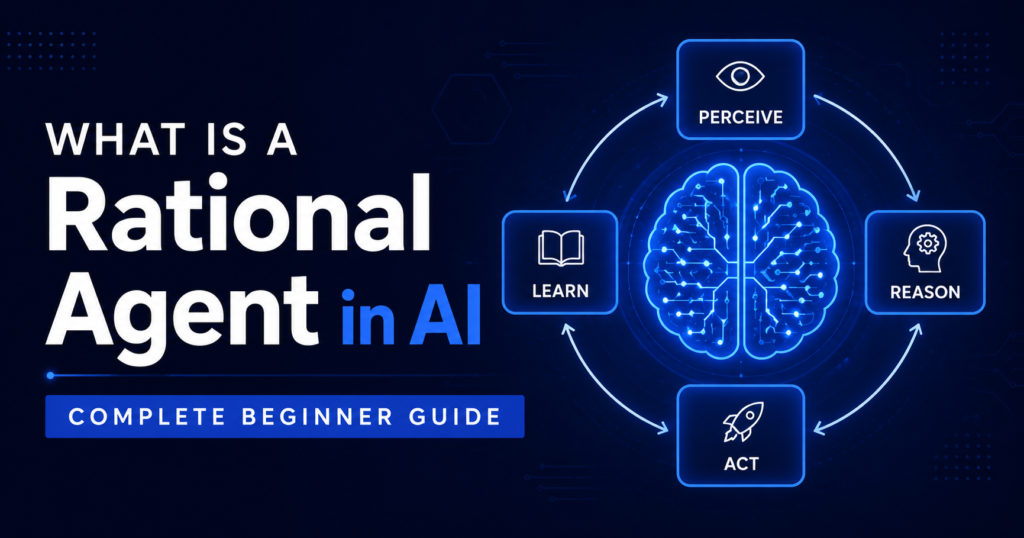
Every Rational Agent in AI shares four fundamental properties. Understanding these properties helps you recognise rational agents everywhere – and understand why some AI systems are more powerful than others.
Property 1 – Perception
A Rational Agent in AI must be able to sense its environment. What it can perceive determines what information it can act on.
Claude AI perceives the text you type. A self-driving car perceives road conditions through cameras and sensors. A recommendation algorithm perceives your viewing history and behaviour patterns.
The quality and richness of what an agent can perceive directly impact how Rational Agent in AI its decisions can make their decisions. An agent that can only perceive limited information will always make less informed decisions than one with access to richer data.
Property 2 – Reasoning
Perception alone is not enough. A Rational Agent in AI must process what it perceives and reason about the best course of action.
This is where AI becomes genuinely fascinating. Modern Rational Agent in AI use machine learning, neural networks and large language models to reason through extraordinarily complex situations – evaluating thousands of possible actions and their likely consequences in milliseconds.
The reasoning capability of an AI agent is what separates basic automation from genuine artificial intelligence.
Property 3 – Action
A Rational Agent in AI must be able to act on its reasoning. Perception and reasoning without action produce nothing useful.
Actions vary enormously depending on the agent. A chatbot’s action is generating a response. A self-driving car’s action is steering, accelerating or braking. An AI trading system’s action is buying or selling. A content recommendation system’s action is selecting which content to show you next.
The actions available to an agent define the boundaries of what it can achieve.
Property 4 – Learning
The most powerful Rational Agent in AI do not just act – they learn from the results of their actions and improve over time.
This learning capability is what transforms a simple rule-based system into a genuinely intelligent agent. When an AI agent learns from experience, its future decisions become progressively more rational because it has more information to draw from.
This is why modern AI tools get better the more they are used. The learning property is what makes There are four distinct types of each more sophisticated than the last – each more sophisticated than the last – each more sophisticated than the last so powerful and so transformative.
The Four Types of Rational Agent in AI
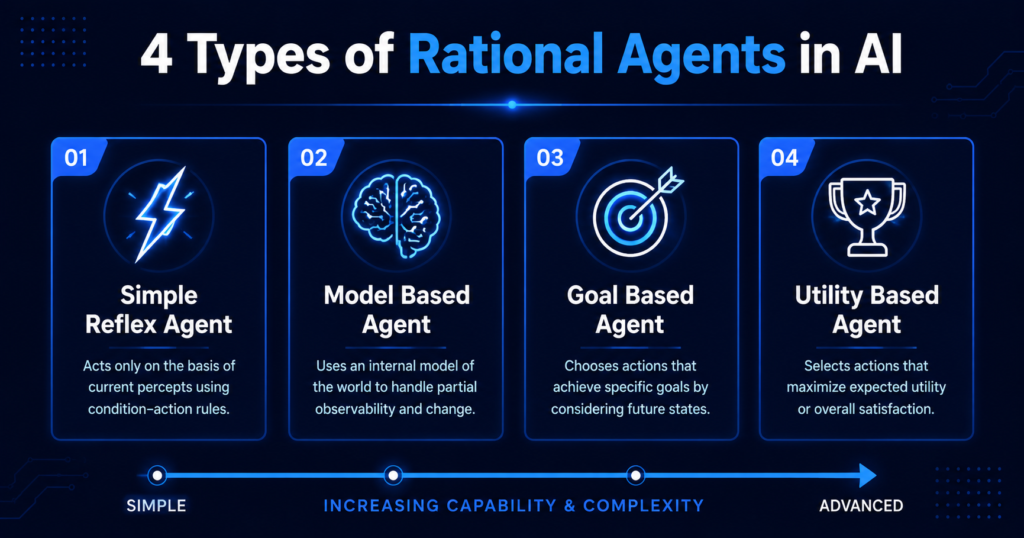
Not all Rational Agent in AI are created equal. As AI has evolved, researchers have identified four distinct types of rational agents – each more sophisticated than the last.
Understanding these types helps you understand why different AI tools have different capabilities – and why some are dramatically more powerful than others.
Type 1 – Simple Reflex Agents
Simple reflex agents are the most basic type. They perceive the current state of their environment and respond based on a fixed set of rules – without considering history or future consequences.
A simple example is a basic thermostat. It perceives the current temperature. If the temperature is below the set point, it turns on the heating. If it is above, it turns off. Simple, direct and rule-based.
Simple reflex agents work well in stable, predictable environments. They struggle when situations become complex or unpredictable because they have no ability to consider context beyond the immediate moment.
Type 2 – Model-Based Reflex Agents
Model-based reflex agents are smarter. They maintain an internal model of the world – tracking how the environment changes over time and using that history to make better decisions.
Think of a robot vacuum cleaner that remembers which areas of a room it has already cleaned. It is not just responding to what it currently perceives – it is using a model of the room it has built over time to make smarter navigation decisions.
Model-based agents handle more complex situations than simple reflex agents because they can factor in what has happened previously – not just what is happening right now.
Type 3 – Goal-Based Agents
Goal-based agents take rational decision-making a significant step further. They do not just respond to the current state – they actively work toward achieving a specific goal.
A navigation app like Google Maps is a goal-based agent. It knows your destination – your goal – and continuously evaluates possible routes to find the best path. When traffic conditions change, it recalculates – always working toward the same goal through whatever means are currently available.
Goal-based agents are significantly more flexible than reflex agents because they can handle novel situations. As long as they can work toward their goal – they can adapt their approach to whatever circumstances arise.
This is why AI agents like AutoGPT are so powerful. Give them a goal and they figure out the steps needed to achieve it – even in situations their creators never specifically anticipated.
If you want to understand how modern AI agents use goal-based reasoning in practice, read our complete guide on What Are AI Agents? Complete Beginner Guide 2026, where we cover the full picture for beginners.10 AI Agent Tools Must Try in 2026 – Stop Wasting Time Without Them
Type 4 – Utility-Based Agents
Utility-based agents are the most sophisticated type. They do not just work toward a goal – they evaluate multiple possible outcomes and choose the action that maximises a utility function – essentially a measure of how desirable each outcome is.
This distinction matters in situations where there are multiple ways to achieve a goal and the agent needs to choose the best one rather than just any one.
A self-driving car is a utility-based agent. Getting you to your destination safely is the goal. But how it achieves that goal – which route to take, how fast to drive, when to change lanes – involves continuously evaluating multiple options and choosing the one that maximises safety, speed and comfort simultaneously.
Modern large language models like Claude AI operate with utility-based reasoning – evaluating multiple possible responses and selecting the one most likely to be accurate, helpful and appropriate for your specific situation.
Rational Agent in AI – Real World Applications You Use Today
Understanding rational agent in AI theory is valuable. But seeing how these concepts apply to tools you use every day makes the concept genuinely click.
Claude AI and ChatGPT – Conversational Rational Agents
Every time you use Claude AI or ChatGPT – you are interacting with one of the most sophisticated rational agents ever created.
These systems perceive your entire conversation – every message, every piece of context you have provided. They reason through thousands of possible responses – evaluating accuracy, relevance, clarity and appropriateness simultaneously. They act by generating the response that best serves your needs. And they have been trained on vast amounts of human feedback – making their reasoning progressively more rational over time.
Understanding that Claude is a rational agent in AI- one optimised to maximise the helpfulness and quality of its responses – helps you understand how to get better results from it. The better you communicate your goals – the more rationally it can act on your behalf.
For practical techniques on communicating effectively with AI agents – read our Prompt Engineering guide where we cover exactly this.
Google Search – The Rational Agent in AI You Use Most
Google’s search algorithm is one of the most complex rational agents ever built. It perceives your search query along with thousands of contextual signals – your location, search history, device and the time of day. It reasons through billions of web pages to identify the most relevant results. It acts by presenting those results in ranked order. And it continuously learns from how billions of users interact with search results to improve its reasoning.
Every search result you see is the output of a Rational Agent in AI working to give you the most useful possible answer to your query.
Self-Driving Cars – Physical Rational Agent in AI
Self-driving vehicles represent a Rational Agent in AI operating in the physical world, where the consequences of poor decisions are immediate and serious.
A self-driving car perceives its environment through cameras, radar and lidar sensors – building a real-time model of everything around it. It reasons continuously about the safest and most efficient path forward. It acts through steering, acceleration and braking. And it learns from millions of miles of driving data to make progressively better decisions in complex traffic situations.
AI Automation Tools – Rational Agent in AI at Work
The automation platforms transforming how professionals work – tools like Make.com and Zapier – are rational agents operating in digital workflows.
They perceive triggers and data from connected applications. They reason about what actions the workflow requires. They act by executing those actions automatically. The result is intelligent automation that handles complex multi-step processes without human intervention.
For a practical guide to using these tools, explore our AI Automation and Workflows guide where we walk through real world applications step by step.
What Makes a Rational Agent in AI Truly Intelligent
Here is a question worth sitting with. What separates a basic rational agent from a genuinely intelligent one?
The answer comes down to three factors that separate impressive AI from truly transformative AI.
Factor 1 – Quality of Perception
The more an agent can perceive, the better its decisions can be. Modern AI systems that can process text, images, audio and real-time data simultaneously make dramatically better decisions than those limited to a single input type.
This is why multimodal AI systems that can see, hear and read represent such a significant leap forward in rational agent capability.
Factor 2 – Depth of Reasoning
Not all reasoning is equal. A system that considers more possibilities, weighs more factors and understands more context will consistently make more rational decisions than one with limited reasoning depth.
The scale of modern large language models – trained on vast amounts of human knowledge – gives them reasoning depth that was simply impossible with earlier AI approaches.
Factor 3 – Quality of Learning
An agent that learns effectively from experience compounds its intelligence over time. Each interaction makes future decisions better. This compounding effect is why the most advanced AI systems today are so dramatically more capable than those from just a few years ago.
Understanding these three factors helps you evaluate AI tools more effectively. When you encounter a new AI system – asking how well it perceives, reasons and learns tells you a great deal about how rational its decisions will actually be.
How a Rational Agent in AI Connects to Your Career
If you are exploring AI for career growth, understanding rational agents is not just academic knowledge. It is practical career capital.
Every AI tool you learn to use is a rational agent. Understanding how they work – what they perceive, how they reason and what actions they can take – makes you dramatically more effective at working with them.
Prompt engineering – the skill of communicating effectively with AI systems – is essentially the skill of understanding what a rational agent needs to perceive in order to reason well and act helpfully. The better you understand rational agent principles, the better your prompts will be. Prompt Engineering Guide – The Skill That Makes You 10x Faster
For QA engineers specifically, understanding rational agents directly informs how you think about AI-based testing tools. Every self-healing test framework, every visual AI testing tool and every intelligent test generator is a rational agent with specific perception, reasoning and action capabilities. Understanding this makes you a more effective evaluator and user of these tools.
For a structured path to building AI career skills, explore our AI Learning Hub, where we have guides for every level of the journey.
The Future of Rational Agent in AI
We are living through the most significant period of the Rational Agent in AI development in history.
The progression from simple reflex agents to utility-based agents took decades. The leap from utility-based agents to the large language model-powered agents of today happened in just a few years.
What comes next is genuinely exciting.
Multi-agent systems – where multiple rational agents collaborate, each with specialised capabilities – are already emerging. Tools like CrewAI let you build teams of AI agents that divide complex tasks between specialised agents – each contributing its specific rational capabilities to achieve goals that no single agent could accomplish alone.
Agentic AI – where rational agents operate with increasing autonomy over extended tasks – is moving rapidly from research concept to practical reality. The AI agents being built today can perceive richer environments, reason more deeply and act across more complex domains than anything that existed just two years ago.
Understanding rational agents in AI today positions you to understand – and work effectively with – whatever comes next.
For a deeper exploration of where AI agents are heading, read our guide on AI Tools to Save Time and Earn Money, where we cover the practical implications for professionals and creators.
Frequently Asked Questions
Q1: What is a Rational Agent in AI in simple terms? A rational agent in AI is any system that perceives its environment and takes the best possible action to achieve its goal. It does not need to be perfect – it just needs to make the most rational decision available given what it knows. Every AI tool you use daily – from search engines to chatbots to recommendation systems – is a rational agent of some kind.
Q2: What are the four types of Rational agent in AI? The four types are simple reflex agents, which respond to current conditions with fixed rules, model-based reflex agents, which maintain a history of their environment, goal-based agents, which work toward specific objectives and utility-based agents, which evaluate multiple outcomes to choose the best one. Each type is progressively more sophisticated and capable than the last.
Q3: Is Claude AI a rational agent in AI? Yes. Claude AI is a sophisticated utility-based rational agent. It perceives your conversation and context, reasons through multiple possible responses, evaluating accuracy and helpfulness simultaneously and acts by generating the response that best serves your needs. It has been trained on vast human feedback, making its reasoning progressively more rational over time.
Q4: What is the difference between an AI agent and a Rational Agent in AI? All rational agents are AI agents but not all AI agents are fully rational. A rational agent specifically optimises its actions to achieve the best possible outcome given available information. Some AI systems follow fixed rules without optimising – making them agents but not strictly rational ones. Modern AI tools like Claude and ChatGPT are both agents and rational agents.
Q5: How does a Rational Agent in AI learn? Rational agents learn through exposure to data and feedback. Machine learning systems update their internal models based on training data. Reinforcement learning agents learn from the outcomes of their actions – receiving rewards for good decisions and penalties for poor ones. Large language models learn from vast amounts of human-generated text and feedback on their outputs.
Q6: What is the rational agent in AI? The rational agent model is a framework for designing AI systems that perceive their environment through sensors, process that perception through a reasoning system and act through actuators to achieve defined goals. This model underpins the design of virtually every modern AI system – from simple automation tools to the most sophisticated large language models.
Q7: Can a rational agent in AI make mistakes? Yes. Rational does not mean perfect. A rational agent makes the best decision possible given its current knowledge and capabilities. When that knowledge is incomplete or its reasoning has limitations, it can make mistakes. This is why human oversight remains important even with highly capable AI agents – they are rational within their limitations but those limitations are real.
Q8: How is a Rational Agent in AI relevant to software testing? AI-based testing tools are rational agents designed specifically for software quality assurance. Tools like Applitools perceive visual interfaces, reason about visual correctness and act by flagging regressions. Self-healing test frameworks perceive application changes, reason about how tests need to update and act by modifying scripts automatically. Understanding rational agent principles makes QA engineers significantly more effective at evaluating and using these tools.
Q9: What is the difference between a rational agent in AI and machine learning? Machine learning is one of the techniques rational agents use to improve their reasoning capabilities. Rational agency is the broader framework – the goal of perceiving, reasoning and acting optimally. Machine learning is a method for achieving better reasoning through data-driven learning. Most modern rational agents use machine learning as a core component of their reasoning systems.
Q10: Where can I learn more about AI agents and Rational Agent in AI ? Start with our complete guide on What Are AI Agents for a practical introduction to how modern AI agents work. Then explore our AI Learning Hub for a structured path through AI fundamentals – from rational agent theory to hands-on tools and career applications. Building this foundational knowledge makes every other aspect of AI learning significantly easier and more meaningful.
Final Thoughts
Every AI tool you use – every chatbot, search engine, recommendation system and automation platform – is a rational agent of some kind. Understanding what that means – how these systems perceive, reason, act and learn – gives you a perspective on AI that most people simply do not have.
That perspective makes you more effective at working with AI tools. It makes you better at prompt engineering. It makes you a more informed evaluator of new AI technologies. And it connects the practical tools you use today to the deeper principles that will shape the AI systems of tomorrow.
The AI era belongs to people who understand how these systems actually work – not just how to use them superficially.
You now understand a Rational Agent in AI. That understanding is yours to keep and build on.