What Is Generative AI?
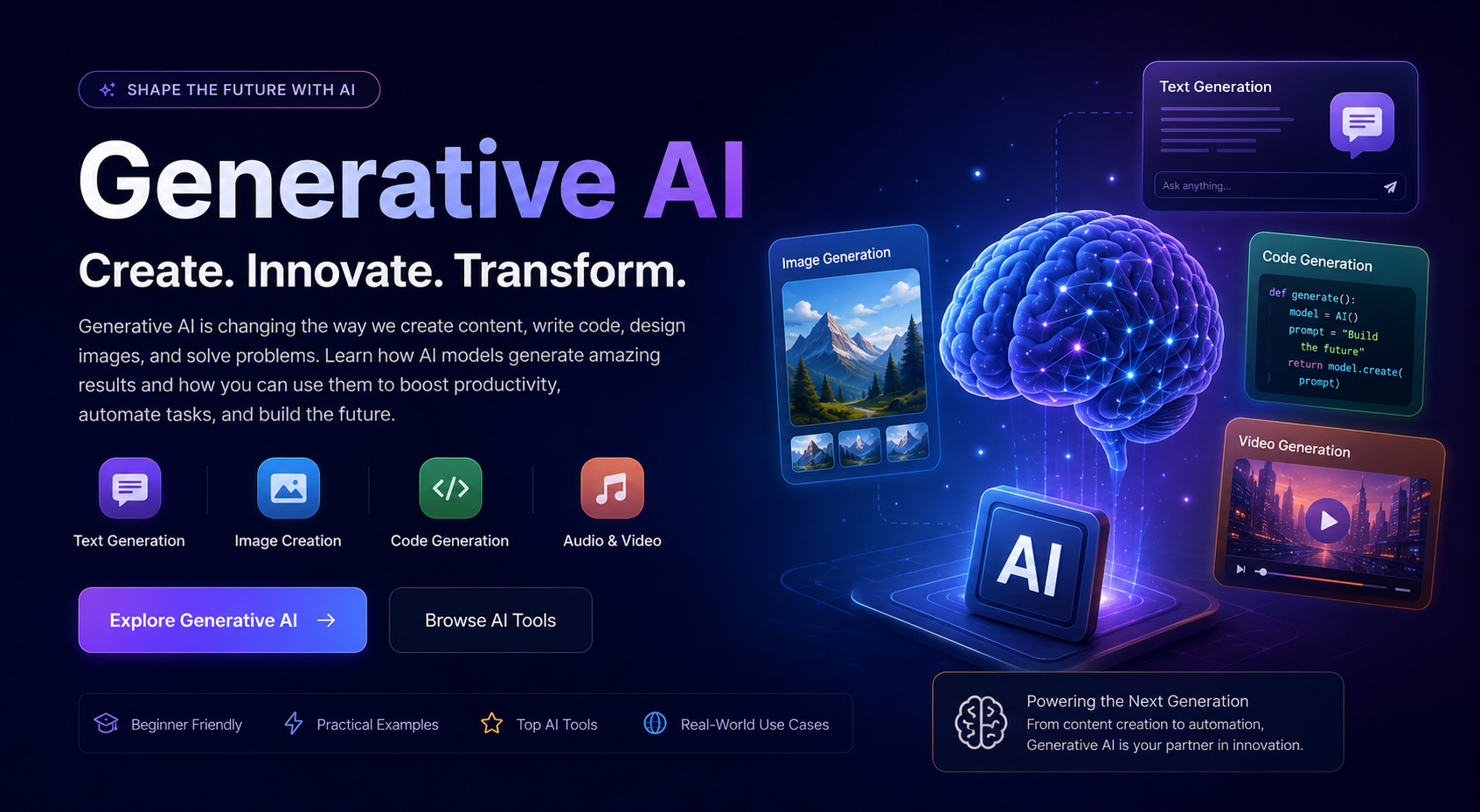
Generative AI is a type of artificial intelligence that creates entirely new content based on patterns it has learned from large amounts of data.
Unlike traditional software that follows fixed rules and produces predictable outputs, Generative AI thinks dynamically. It understands context, interprets your instructions, and generates original responses every single time.
When you type a question into Claude or ChatGPT and receive a detailed, natural sounding answer — that is Generative AI working in real time. When someone describes an image in words and Midjourney creates stunning artwork from that description — that is Generative AI. When a business automates its customer responses and they feel genuinely human — that is Generative AI.
The content Generative AI can produce includes:
- Text — articles, emails, social media captions, code, reports
- Images — artwork, logos, product photos, illustrations
- Video — short clips, animations, social media reels
- Audio — voiceovers, music, podcasts
- Code — websites, applications, automation scripts
- Designs — presentations, infographics, brand visuals
This is why Generative AI has become one of the most transformative technologies of our time — and why learning to use it effectively is one of the most valuable skills you can develop right now.
How Generative AI Works
Generative AI works by training large models on massive datasets. These models learn patterns, language structure, and relationships between data points over billions of examples.
The process happens in two main stages. First the model learns from enormous amounts of existing content during training. Then during use it applies everything it learned to generate new, original responses based on your specific instructions.
Think of it like this. A Generative AI model has read more books, articles, websites, and documents than any human could read in a thousand lifetimes. When you ask it a question it draws on everything it has learned to give you the most relevant, helpful, and accurate response it can.
Machine Learning Models
Machine learning is the foundation that makes Generative AI possible. Instead of being programmed with fixed rules, machine learning models learn from data. They identify patterns, make connections, and improve their understanding over time through exposure to more and more examples.
In practical terms this means the more a AI model is used and refined, the better it becomes at understanding what you need and delivering outputs that genuinely match your expectations.
Large Language Models (LLMs)
Large Language Models are the specific type of machine learning model that powers most of today’s popular Generative AI tools including Claude by Anthropic, ChatGPT by OpenAI, and Google Gemini.
These models are trained on billions of words of text from across the internet, books, academic papers, and other sources. This training gives them a deep understanding of language, context, tone, and meaning that allows them to generate text that reads naturally and responds intelligently to almost any question or instruction.
LLMs are why you can have a genuine back and forth conversation with an AI tool, ask follow up questions, request changes to outputs, and receive responses that feel thoughtful rather than mechanical.
Neural Networks
Neural networks are the underlying architecture that makes Large Language Models work. Inspired loosely by how the human brain processes information, neural networks consist of layers of interconnected nodes that pass information between each other.
When you send a message to a AI tool, that message travels through hundreds of layers of a neural network. Each layer processes the information, adds context, and passes refined understanding to the next layer. The final output is a response that reflects all of that deep, layered processing.
You do not need to understand the technical details of neural networks to use AI effectively. But knowing they exist helps you appreciate why these tools feel so remarkably capable — there is genuine computational intelligence happening behind every response.
Prompt Engineering
Prompt engineering is the skill of communicating with AI in a way that consistently produces excellent results.
Every Generative AI tool responds to instructions called prompts. A prompt can be as simple as a question or as detailed as a multi paragraph brief. The quality of your prompt directly determines the quality of the output you receive.
A weak prompt produces a generic, unhelpful response. A strong prompt produces a specific, useful, high quality output that saves you significant time and effort.
For example:
Weak prompt:
“Write about AI tools.”
Strong prompt:
“Write a 300 word beginner friendly introduction to AI tools for small business owners who have never used AI before. Use a warm, encouraging tone and include two practical examples of how AI saves time.”
The difference in output quality between these two prompts is enormous.
Prompt engineering is a skill that anyone can learn regardless of technical background. The better you become at it, the more value you extract from every Generative AI tool you use. Read our complete Prompt Engineering Guide: The Skill That Makes You 10x Faster to master this skill from scratch.
Why These Components Work Together
Understanding how these four components connect helps you see why Generative AI is so powerful.
Machine learning gives the system the ability to learn. Large Language Models give it deep understanding of language and context. Neural networks give it the computational power to process complex information at remarkable speed. And prompt engineering gives YOU the ability to direct all of that power toward exactly what you need.
Together these components create tools that feel less like software and more like genuinely intelligent collaborators — capable of helping you work faster, think more clearly, and produce better results across almost every professional and creative task you face.
Want to see all of this in action? Read our Generative AI Beginner Guide: Master AI Tools the Easy Way for a complete practical introduction.
Generative AI refers to AI systems that can generate new content based on patterns learned from large datasets.
These models use deep learning and neural networks to understand context and produce meaningful outputs.
Examples include:
1. AI writing tools (blog posts, emails, scripts)
2. AI image generators (digital art, designs)
3. AI code generators (software development)
4. AI voice and music creation