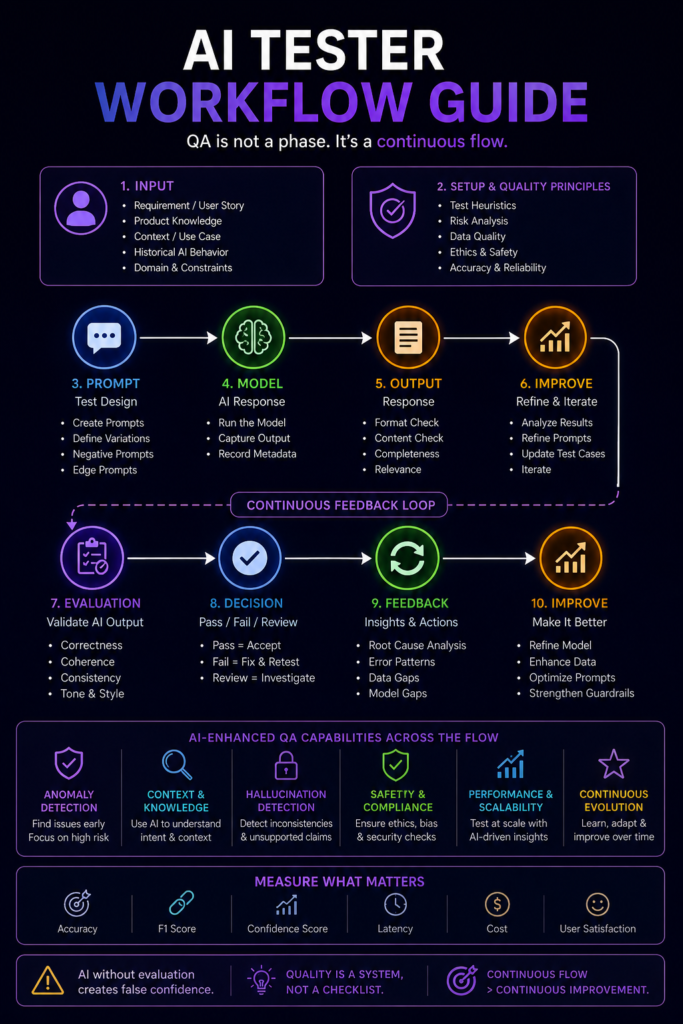
Quality Assurance is no longer a phase that happens at the end of a sprint. In 2026, AI has completely transformed software testing into a continuous, intelligent flow — where inputs, models, outputs, and evaluations feed each other in a never-ending improvement cycle.
If you are a Manual QA engineer wondering how to stay relevant, or a QA lead trying to understand what AI-first testing actually looks like on the ground, this guide is for you. We break down the complete AI QA Flow framework, explain every stage in plain language, and show you exactly how to apply it to your current testing workflows starting today.
What is an AI Tester Workflow? (And Why Every Tester Needs to Know It)
The AI Tester Flow is a structured, continuous framework for testing AI-powered systems — including large language models, AI-assisted applications, and any software that uses machine learning to generate outputs.
Unlike traditional Tester, which validates deterministic software where input A always produces output B, AI Tester deals with probabilistic systems. Outputs vary. Hallucinations can occur. Quality must be measured on multiple dimensions simultaneously, in real time, and across every deployment environment.
The AI Tester Flow is built on one foundational truth: Tester is not a phase. It is a continuous flow.
Companies that treat AI testing as a final checkbox before release are already falling behind. Teams that build AI Tester into every stage of their development cycle are compounding quality improvements with every iteration — and those improvements show up directly in product reliability, user trust, and business outcomes.
The Five AI-First Quality Principles That Define Modern Testers
Before diving into the technical stages, every AI Tester must internalize five foundational principles. These principles represent the mindset shift required to move from traditional testing into AI-first quality assurance.
Trust AI outputs must earn trust through consistent, verifiable, and measurable performance. Never assume correctness simply because a model generated a confident response. Every claim needs a validation path.
Safety AI systems can produce harmful outputs at scale and at speed. Safety testing must cover edge cases, adversarial inputs, off-topic queries, and policy boundary violations — not just happy path scenarios.
Reliability: Can the system perform consistently across time, different user types, multiple languages, and varying load conditions? Reliability testing for AI includes drift detection and monitoring long after initial deployment.
Transparency: Stakeholders must understand why an AI system made a particular decision. Black-box outputs without explainability represent a serious Testers red flag in regulated industries and enterprise environments.
Accountability: There must be clear ownership when AI systems fail. AI Tester engineers are responsible for defining accountability chains — who is responsible when a model produces a wrong, harmful, or incomplete output?
The Senior Tester Mindset: How Top Testers Think in the AI Era
The best AI testers in 2026 operate with a distinct set of mental principles that separate them from traditional testers:
Quality by Design — Quality is built into the system architecture, not tested in at the end.
Risk-Based Testing — Not all failures carry equal weight. Test what matters most first.
Observability First — If you cannot see what the system is doing in production, you cannot improve it.
Measure What Matters — Data-driven quality decisions beat gut-feel assessments every time.
Continuous Learning — AI systems evolve constantly. Your testing approach must evolve with them.
The 5-Stage AI Tester WorkFlow: A Complete Breakdown
The AI Tester Work Flow moves through five distinct stages, each with its own purpose, tools, and quality checkpoints. Understanding each stage deeply is essential before you can automate, scale, or optimize any part of the process.
Stage 1 — Input: Where Quality Testing Begins
The Input stage covers everything that enters the AI system — user queries, uploaded documents, API calls, structured data, or unstructured text that the model will process.
Tester responsibilities at this stage include validating input schemas and data types, testing boundary conditions such as very long text, empty inputs, and special characters, checking for personally identifiable information that should not reach the model, and verifying that input preprocessing, like tokenization and chunking, does not corrupt the original meaning.
Most teams underinvest in input testing. This is a critical mistake. Garbage in means garbage out — and with AI systems, garbage in means confident garbage out.
Stage 2 — Prompt: The Instruction Layer That Controls Everything
The Prompt stage is where AI Testers must develop a new skill: prompt engineering. The prompt is the instruction layer that tells the AI model what to do, how to behave, and what format to return results in.
Poor prompts produce poor outputs — regardless of how powerful the underlying model is. AI Tester teams must define prompts carefully, version-control them like code, and test them systematically across different input types and user scenarios.
Key Tester activities at the prompt stage include testing prompt variations for consistency, validating that prompts produce the correct output format, checking for prompt injection vulnerabilities, and benchmarking prompt performance against defined quality thresholds.
Stage 3 — Model: Understanding What’s Happening Inside the AI System
The Model stage is the AI system itself — whether it is a large language model, a vision model, an embedding model, or a fine-tuned domain-specific system. Testers at this stage need to understand model behavior, not just model outputs.
Key checks at the model stage include validating model version control and deployment accuracy, benchmarking latency under different load conditions, testing sensitivity to temperature and parameter changes, and running full regression test suites after every model update or fine-tuning cycle.
One of the most common failures in AI production is a model update that improves one capability while silently degrading another. Without thorough regression testing at the model stage, these regressions go undetected until users report them.
Stage 4 — Output: Evaluating AI Responses Across Five Dimensions
The Output stage is where traditional Testers feel most at home — but AI outputs are far more complex to evaluate than deterministic software responses. AI outputs must be assessed across five quality dimensions simultaneously.
Correctness — Is the factual information accurate? Does it match the ground truth or source material?
Relevance — Does the output actually address what the user asked? A technically accurate response that misses the intent of the question is still a failure.
Completeness — Does the output cover all required aspects of the task? Missing steps, truncated reasoning, or partial answers represent real quality failures, especially in healthcare, legal, and financial use cases.
Safety — Does the output comply with safety policies, content guidelines, and compliance requirements? Safety failures at the output stage carry the highest organizational risk.
Tone and Style — Does the output match the expected voice, formality level, and brand guidelines of the product? Tone failures erode user trust even when factual content is correct.
Stage 5 — Improve: Closing the Loop and Compounding Software Quality Over Time
The Improve stage is what fundamentally separates AI Tester from traditional software testing. Instead of simply logging bugs and closing tickets, AI Tester closes the loop by feeding evaluation results back into the system to produce better prompts, better training data, and better models.
Improvement activities at this stage include refining prompts based on identified failure patterns, updating training or fine-tuning datasets with corrected examples, strengthening guardrails after safety failures are identified, and enhancing observability dashboards with new drift detection signals.
Teams that run disciplined improvement cycles see quality compound over time. This is the compounding advantage of an AI-first Tester: every failure teaches the system something, and every improvement makes future failures less likely.
The Continuous Feedback Loop: The Engine Beneath the Five Stages
Running beneath all five stages is the Continuous Feedback Loop — the cycle that transforms a linear testing process into an intelligent, self-improving quality system. This loop has four core processes.
Evaluate Output — Score and Analyze Use a combination of automated evaluators and human reviewers to score outputs against defined quality criteria. Track performance across a representative test set that covers your real user distribution, not just ideal cases.
Decision — Pass, Fail, or Review. Every output gets a clear verdict. Pass means accept and proceed. Fail means fix the prompt, data, or model configuration. Review means escalating to a human expert for nuanced judgment calls that automated systems cannot resolve.
Feedback — Extract Insights and Patterns: Analyze failures systematically to identify patterns. What type of errors occur most frequently? Which input types trigger failures? Build a failure taxonomy that informs future prompt engineering, data curation, and model update decisions.
Drive Improvement — Refine, Update, Enhance Use extracted insights to improve every layer of the system. Refine prompts. Update data. Enhance the model. Improve guardrails. Expand monitoring coverage. Every cycle through this loop makes your AI system measurably more reliable.
Six Advanced AI Tester Capabilities
Beyond the core five stages, experienced AI Testers deploy six advanced capability layers that run across the entire quality flow.
Risk-Based Testing: Focus testing effort on high-impact workflows and critical paths. A medical diagnosis recommendation demands far more rigorous testing than a product description generator. Risk-based prioritization ensures your limited testing resources produce maximum quality impact.
Context and Retrieval Checks For systems using Retrieval-Augmented Generation, validate that grounding documents are retrieved correctly, that citations are accurate, and that the model is not generating responses that contradict its own retrieved sources. Hallucinated citations are one of the highest-risk failure classes in enterprise AI products.
Hallucination Detection AI systems can confidently fabricate facts, statistics, names, and references. Automated hallucination detection is now a non-negotiable component of enterprise AI QA infrastructure. Every production AI system needs a hallucination monitoring layer.
Guardrails and Safety Checks Enforce safety policies, compliance rules, and content standards programmatically. But remember — guardrails must be tested themselves. They can fail under adversarial prompts, edge case inputs, and creative user attempts to bypass restrictions.
Observability and Monitoring Track quality metrics in production, detect drift and anomalies in real time, and alert engineering teams when model performance degrades below defined thresholds. AI tester does not stop at deployment. Production monitoring is a permanent Tester responsibility.
Learning and Evolution AI systems change through use and through model updates. Testers must continuously update test suites, expand edge case libraries, and retrain automated evaluators as the underlying models and user behaviors evolve over time.
Measure What Matters: The 9 Core AI Testers Metrics
One of the most practical outputs of the AI Tester Flow framework is a clear set of nine measurable metrics that form the foundation of any AI quality dashboard.
Accuracy — The percentage of outputs that are factually correct against a verified ground truth. This is the core quality signal for virtually all AI systems.
Relevance — Does the output actually address the intent of the user’s input? High accuracy with low relevance is still a product failure.
Completeness — Does the output cover all required aspects of the task? Partial answers can be as dangerous as wrong answers in high-stakes domains.
Coherence — Is the output logically consistent, well-structured, and easy to follow? Incoherent outputs erode user confidence even when individual facts are correct.
Groundedness — Is the output supported by retrieved source documents or provided context? This metric is essential for RAG-based systems to prevent and detect hallucinations.
Safety — Does the output comply with defined safety policies and content standards? Safety score is a hard threshold metric — there is no acceptable level of unsafe output in production.
Latency — Time to first token and total response generation time. Latency directly impacts user experience and must meet defined SLA thresholds.
Cost — Token cost per query, per user session, and per automated workflow. Cost optimization is a legitimate QA responsibility in production AI systems.
User Satisfaction — Thumbs up and down ratings, CSAT scores, and task completion rates. This is the ultimate real-world quality signal — the one that tells you whether everything else is actually working from the user’s perspective.
AI Prompts for Testers Start using These Today
One of the most powerful ways to accelerate your AI Tester work is to use AI tools like Claude AI to handle the heavy lifting in your own testing workflows. Here are three prompts you can use immediately.
Prompt 1 — Generate Comprehensive Test Cases
You are a senior QA engineer specializing in AI systems. Generate a comprehensive test case matrix for the following feature requirement, covering happy paths, edge cases, negative tests, and boundary conditions. Requirement: [paste your feature requirement here]. System type: [web app / mobile / API / AI chatbot]. Risk level: [high / medium / low]. Format as a table with: Test ID, Test Scenario, Input, Expected Output, and Priority. Tools can use @https://claude.ai/ @https://chatgpt.com/
Prompt 2 — Evaluate AI Output for Hallucinations
You are an AI output evaluator with expertise in hallucination detection. Review the following AI-generated response and identify any factual claims that cannot be verified, any fabricated citations, or any logical inconsistencies. AI Response: [paste AI output here]. Source documents available: [yes/no]. Domain: [healthcare/finance / legal/general]. Return: Hallucination Risk Score from 1 to 10, specific flagged claims, and recommended action.
Prompt 3 — Write a Test Plan for an AI Feature
Act as a Test lead, preparing documentation for an enterprise AI product release. Write a one-page test plan for an AI feature that [describe the feature]. Cover scope, test types required, key risks, success criteria, and a two-week execution timeline. Team size: two QA engineers. Release date: two weeks from today. Priority risks: hallucinations, data privacy, and latency.
Career Roadmap: From Manual Tester to AI Tester
The most common question from our community is how to make the transition from Manual Tester to AI Tester. Here is a practical, phased roadmap built on what is actually working in 2026. These AI tools can use OpenAI, Google AI, and Anthropic
Months 1 and 2 — Foundation: Understand How AI Systems Work. Learn how large language models work at a conceptual level — inputs, tokens, outputs, temperature, and context windows. Use Claude AI and ChatGPT daily for 30 days as part of your personal workflow. Read the AI Tester WorkFlow framework deeply. Complete a free prompt engineering course. Your goal is to become fluent in the language of AI systems. article from AI Pathway Llab https://aipathwaylab.com/ai-tools-to-save-time-and-earn-money-honest-results-no-sponsorship/
Months 3 and 4 — Build: Learn Playwright and AI-Assisted Test Automation. Playwright is the leading framework for AI-assisted UI testing in 2026. Learn the fundamentals, then layer in AI-generated test cases using Claude AI to accelerate test creation. Build a portfolio project where you automate testing of a real AI product. Employers want to see evidence of hands-on automation work.
Months 5 and 6 — Specialize: AI Output Evaluation and LLM Testing Deep-dive into hallucination detection, guardrails testing, and production observability. Learn to use evaluation tools like LangSmith, Ragas, and PromptFoo for LLM pipeline assessment. Start contributing to open-source AI testing repositories to build visibility in the community.
Months 7 and 9 — Automate: Build test Workflows with Make.com and Zapier Use Make.com and Zapier to automate your own QA reporting, bug triage, and test result summary workflows. This demonstrates automation fluency to prospective employers and dramatically reduces your manual overhead in day-to-day testing work.
Months 10 to 12 — Land: Apply, Network, and Position for AI tester Roles. Update your resume and LinkedIn profile to lead with AI Tester skills. Use Claude AI to tailor every job application to the specific role and company. Target organizations actively building AI products — they offer the highest compensation for Testers with AI testing expertise in 2026.
Key Takeaways: What to Remember from This Guide
AI Tester workflow is a continuous quality system — not a testing phase that ends at release. The five stages of Input, Prompt, Model, Output, and Improve work together in a feedback loop that compounds quality over time.
The five AI-first principles of Trust, Safety, Reliability, Transparency, and Accountability define the mindset every modern tester needs to develop.
The nine metrics of Accuracy, Relevance, Completeness, Coherence, Groundedness, Safety, Latency, Cost, and User Satisfaction give you a measurable quality dashboard you can build and track in any AI product.
The career transition from Manual tester to AI tester is achievable in 12 months with focused, structured learning — and the market demand for engineers with these skills continues to grow faster than supply.
More AI tester articles from AI Pathway Lab https://aipathwaylab.com/3-proven-ways-ai-accele/ https://aipathwaylab.com/ai-workflows-for-qa-automation/
Conclusion: Quality Is a System. Start Building Yours Today.
The AI Tester workflow is not a concept for the distant future. It is the operating model that engineering teams around the world are adopting right now, in 2026, to build AI products that users can trust.
If you are still applying traditional testing methods to AI systems, you are working with the wrong toolkit. But the gap between where you are and where you need to be is closable — and honestly, it does not require a computer science degree to close it.
Start with the fundamentals in this guide. Run the prompts above inside Claude AI today. Track even three of the nine metrics in your current project. Every step you take toward AI-first quality engineering compounds into career advantage, better products, and faster professional growth.
Quality is a system. Continuous improvement is a practice. And the best time to start is always today.
Explore AI Pathway Lab
- What Are AI Agents? Complete Beginner Guide 2026
- How to Become an AI Engineer
- Free AI Courses with Certificate in 2026
- AI Automation & Workflow Tutorials
- Generative AI
- Home – Pathway Lab