What Is Agentic AI? How AI Agents Are Changing Work, Business & Careers in 2026
Agentic AI isn’t just a buzzword — it’s the biggest shift in how we work since the internet. In this guide, we break down exactly what AI agents are, how they work autonomously, and step-by-step how you can use them today to automate tasks, grow your business, and future-proof your career.
Table of Contents
What Is Agentic AI? (Simple Definition)
Most AI tools you’ve used so far — like Claude AI, ChatGPT, or Gemini — work in one direction. You ask. It answers. You’re still the one doing the thinking, planning, and connecting the dots.
Agentic AI is completely different.
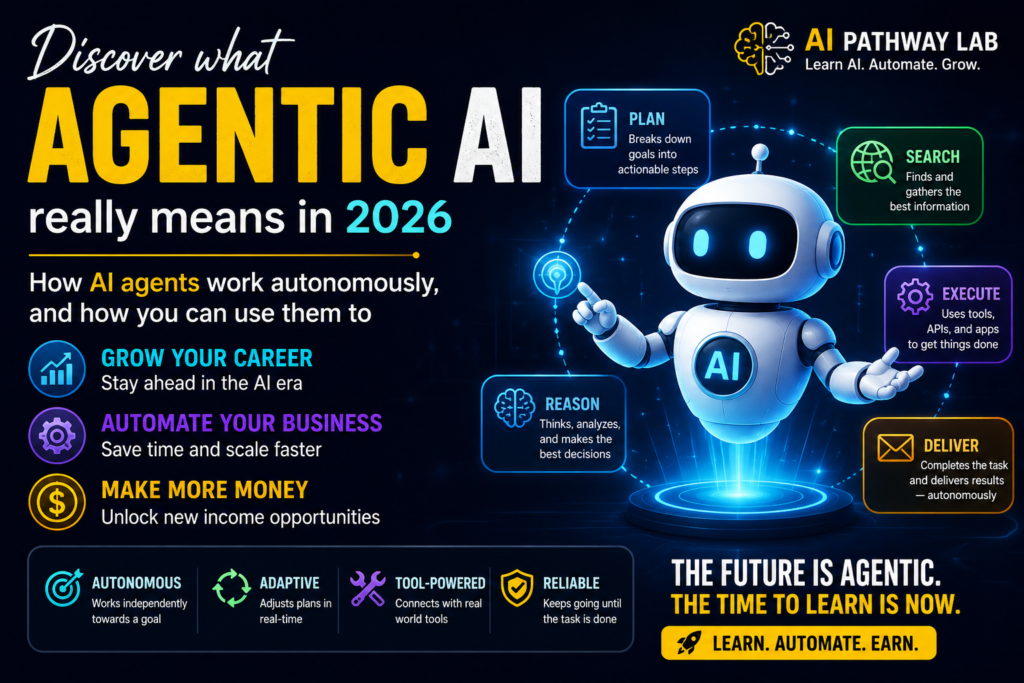
An AI agent is a system that can plan a goal, break it into tasks, take actions across multiple tools or platforms, and adapt when something goes wrong — all without you holding its hand at every step.
💡 Simple Definition
Agentic AI = an AI system that can think + plan + act + self-correct to complete a goal on its own. It’s the difference between a chatbot that answers questions and an AI assistant that actually does things for you.
Think about it like this. If regular AI is a calculator, agentic AI is an employee. You give it a goal, not a command. It figures out the steps. And it keeps going until the job is done.
Regular AI vs Agentic AI — What’s the Real Difference?
| Capability | Regular AI | Agentic AI |
|---|---|---|
| Works on a single prompt | Yes | Yes |
| Takes multi-step actions | No | Yes |
| Uses external tools & apps | No | Yes |
| Adapts if something fails | No | Yes |
| Runs in the background | No | Yes |
| Needs human input every step | Yes | Optional |
How Agentic AI Works — The 4-Step Loop
AI agents follow a consistent decision loop — called the Observe → Plan → Act → Reflect cycle. Understanding this is key to deploying them in your business or career.
Observe — Understand the Goal & Context
The agent reads your instructions, scans available data (emails, files, web searches), and understands what “success” looks like. This is where clear prompting becomes critical.
Plan — Break the Goal Into Tasks
Instead of jumping to an answer, the agent creates a roadmap. “To achieve X, I need to first do A, then B, then C, then verify D.” This reasoning step is what separates agents from basic chatbots.
Act — Execute Using Tools
Now it takes action — searching the web, writing and running code, sending emails, filling forms, calling APIs, or updating spreadsheets. Real work. Real results.
Reflect — Check & Correct
The agent reviews its own output. Did it work? Is it accurate? If not, it retries, adjusts the approach, or flags for human review. This self-correction is what makes agents reliable.
🔥 Real Example
You tell your AI agent: “Research the top 5 competitors in my niche, compare their pricing, and write a summary report.”
A regular chatbot says “Sure, here’s a general answer.” An AI agent actually opens browser tabs, reads competitor websites, compares pricing tables, writes the report, and saves it — all while you’re on a call.
Why 2026 Is the Tipping Point for AI Agents
The term “agentic AI” has existed in research papers for years. But 2026 is different. Three things converged to make AI agents finally practical for everyday people and small businesses:
The most important shift? Models got smarter at reasoning. Modern models like Claude Sonnet 4, GPT-4o, and Gemini 2 can hold complex goals in mind over dozens of steps — which is the foundation of all agentic behavior.
Real-World Use Cases: Career, Business & Money
Here’s where it gets practical. Agentic AI isn’t a concept for researchers — it’s a tool for you, right now. Below are the highest-value use cases broken down by goal:
💼 For Career Growth
| Task | What the Agent Does | Time Saved |
|---|---|---|
| Job Application | Reads job description → rewrites resume → drafts cover letter → submits application | 4–6 hrs |
| Interview Prep | Researches company, generates likely questions, writes STAR-format answers | 2–3 hrs |
| LinkedIn Optimization | Analyzes your profile vs top profiles in your field, rewrites each section | 1–2 hrs |
| Skill Gap Analysis | Compares your skills to job listings, creates a 30-day learning plan | 3 hrs |
💸 For Making Money with AI
AI Automation Freelancing
Building AI agent workflows for small businesses using Make.com and Zapier. Rates range from ₹15,000–₹80,000 per project. High demand, low competition right now.
AI-Powered Content Agency
Using agents to produce 10x more content for clients. One operator can manage 8–10 client accounts with minimal effort using the right agent stack.
Selling AI Agent Templates & Workflows
Pre-built Make.com scenarios and prompt packs sell for $19–$99 on Gumroad. Low effort to create, high passive income potential. See our AI Prompt Pack →
Best Agentic AI Tools in 2026 (Free + Paid)
You don’t need a developer background to start. Here are the best options across different skill levels and budgets:
Claude AI (Anthropic)
Best for long-form reasoning, document analysis, and multi-step agent prompts. The most nuanced AI model in 2026.
→ Try Claude FreeMake.com
Visual automation workflows connecting AI to your apps (Gmail, Sheets, Slack, CRM). No-code. Beginner-friendly.
→ Start Free on Make.comZapier AI
Quick AI-powered automations between 5,000+ apps. Great for beginners. Less flexible than Make but faster to set up.
→ Try Zapier Freen8n
Open-source workflow automation with native AI agent support. Full control. Self-hostable for advanced users.
→ Explore n8nClaude Code
For developers and QA engineers. Claude Code autonomously writes, tests, and debugs code. A full AI development agent.
→ Get Claude CodePerplexity AI
Real-time research agents. Searches the web, synthesizes sources, delivers cited answers. Great for competitive research.
→ Try Perplexity Free⚠️ Pro Tip
Don’t try to use all of these at once. Start with Claude AI + Make.com. Master that combination first. You can automate 80% of your routine business tasks with just those two tools.
How to Get Started With Agentic AI Today
Here’s the fastest path from zero to running your first AI agent — even with no technical background:
Pick One Repetitive Task You Do Every Week
Email writing, research, reporting, content drafting, data formatting — pick the one that takes the most time. Start specific, not broad.
Write a Clear Multi-Step Prompt in Claude
Use the RCTF formula: Role + Context + Task + Format. Give Claude everything it needs to complete the task without asking follow-up questions.
Test, Refine, and Document Your Best Prompts
The first output won’t be perfect. Iterate 3–5 times. Once reliable, save it. This becomes your “agent template.”
Connect to Make.com or Zapier to Automate the Trigger
Instead of manually running your Claude prompt, connect it to a trigger — a new email, a form submission, a scheduled time — and let it run automatically.
Scale: Repeat for 3–5 Core Tasks
Once you’ve mastered one agent workflow, apply the same process to your other biggest time drains. Within 30 days, you can have a full AI automation system running your routine work.
Starter Prompt Template — Copy & Use Now
// Claude AI Starter Prompt — RCTF Formula
You are a [ROLE — e.g., “senior content strategist”].Context: [BACKGROUND — e.g., “I run a personal finance blog targeting Indian millennials.”]
Goal: [TASK — e.g., “Research the top 5 trending personal finance topics this week and create a content plan with post titles, hooks, and formats for Instagram.”]
Output format: [FORMAT — e.g., “A numbered list. Each item: Title | Hook | Format | Posting Day”]
Constraints: [LIMITS — e.g., “Keep language simple. Avoid jargon. Assume audience earns ₹50K–₹1L/month.”]
Agentic AI for QA Engineers & Testers
If you work in software testing or QA, agentic AI isn’t just a productivity tool — it’s a career-defining upgrade. The transition from Manual QA to AI-powered QA Engineering is one of the most in-demand pivots in tech right now.
| Manual QA Task | Agentic AI Alternative | Tool Stack |
|---|---|---|
| Writing test cases | Agent reads requirements → auto-generates test cases | Claude + Playwright |
| Regression testing | Agent runs full regression suite, reports failures | Playwright + CI/CD |
| Bug report writing | Agent captures screen + error → writes structured bug report | Claude + Jira API |
| Test data generation | Agent creates diverse, edge-case-rich test data sets | Claude + Python |
| API testing | Agent generates, runs, and validates API test scripts | Playwright + Postman |
At AI Pathway Lab, the career transition from Manual QA to AI QA Engineer is our core niche. If you’re a QA professional reading this, you’re in exactly the right place. Explore our QA to AI QA Learning Path →
Frequently Asked Questions
Free Resource from AI Pathway Lab
Want the Exact AI Prompts We Use to Automate Everything?
Our “Make Money With AI Prompts” pack has 50+ ready-to-use prompts for business, career, and content creation. Instant download. Just $19.
Get the Prompt Pack → Join Free NewsletterThe AI Pathway Lab Team
We help professionals and entrepreneurs use AI tools to grow their careers, automate their businesses, and build income streams with artificial intelligence. Follow us on Instagram @aipathwaylab for daily AI tips, prompts, and tool reviews.
Read Next